Algorithmic Expectations And Public Opinion
On Argentina, Kimi K3, and the difference between controlling the scoreline and winning the argument underneath it.

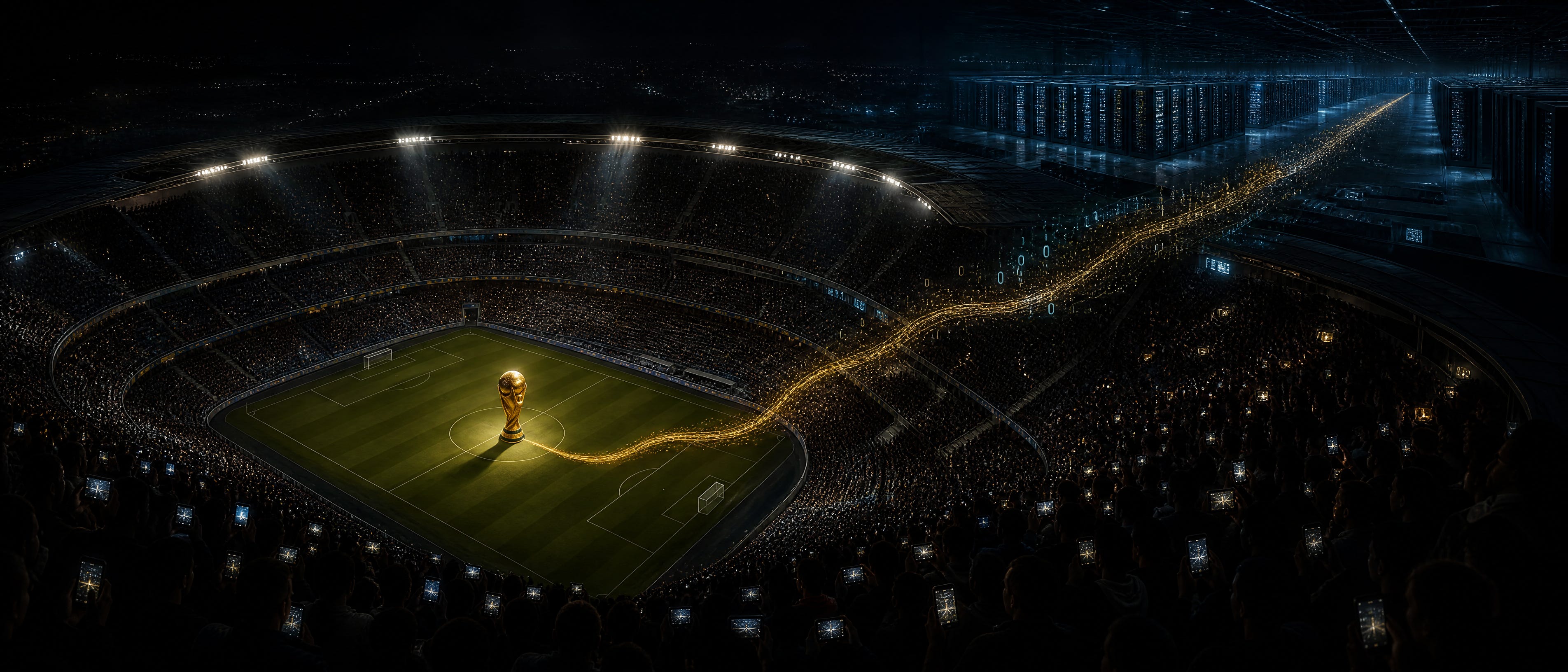
Three days after Spain beat Argentina 1–0 in extra time on July 19, 2026, a petition titled “Argentina Out” closed with 23,316,108 signatures from 170 countries, a number that came within roughly a million of the Guinness World Record for the largest petition ever collected. The demand was a lifetime ban from the World Cup, on the grounds that Argentina’s players had turned the final whistle into a brawl and that the tournament’s referees had favored Lionel Messi’s team throughout. FIFA did not respond to the petition. It opened three separate investigations instead — into the brawl, into a Falklands banner, into individual player conduct — and everyone involved understood immediately that a permanent ban was never going to happen, because FIFA has never expelled a nation from the World Cup for player conduct in the tournament’s history.
None of that is the interesting part.
The interesting part is that Argentina had, by any reasonable account, already won the argument that mattered inside the sport. They had the trophy, the favorable whistle, the benefit of a month of officiating that plenty of neutral observers described as generous. Controlling the field, the referees, and the tournament’s institutional machinery is exactly what a team is supposed to do, and Argentina did it about as completely as a team can. And 23 million people who had no formal standing in the sport, no vote on the officiating, and no mechanism to overturn a single call, looked at the outcome anyway and decided the result was fraudulent regardless of who had signed off on it. The petition carries no official authority. It changes no scoreline. What it demonstrates is that controlling the apparatus that judges a contest and actually winning the underlying contest are two different achievements, and a large enough number of people who were never in the room can tell the difference even when every institution with formal jurisdiction insists there is nothing to see.
This is the frame for what Scott Galloway has been saying on every podcast circuit for the better part of a month, and it is the frame for why he is right.
AI and Steel: A Geopolitical Pattern

Galloway’s thesis, delivered on Diary of a CEO, on his own Prof G Markets show, and most recently in a July 18, 2026 newsletter titled “1999.AI”, is that China is engaged in what he calls AI dumping — comparing the strategy explicitly to steel dumping in the 1980s: releasing a cascade of cheap, open-weight models specifically to collapse the pricing power that American labs need to justify their valuations. The mechanism is not speculative. In one week in February 2026, Chinese AI models delivered 4.12 trillion tokens against 2.94 trillion from American models, a gap attributable to cheaper Chinese electricity and to a mixture-of-experts architecture that requires meaningfully less compute per token than the dense models most American labs still favor. Moonshot AI released Kimi K2 in July 2025 as a trillion-parameter model that runs on only 32 billion active parameters, open-sourced under a permissive license. Its November 2025 reasoning-focused successor, Kimi K2 Thinking, reportedly cost as little as $4.6 million to train, a figure Moonshot’s own researchers have since called too simple to quantify, and it still beat GPT-5 on tool-augmented benchmarks like Humanity’s Last Exam and BrowseComp even as it trailed on SWE-Bench Verified (CNBC, Recode China AI).
On Prof G Markets in early June 2026, he attached a number to the consequence: a 50 to 70 percent correction in AI valuations within 24 months, alongside a citation to an MIT-affiliated study finding that 95 percent of enterprise AI projects connect to no return a CFO can name. Anthropic confidentially filed a draft S-1 on June 1, 2026, following a round that valued it near $965 billion. OpenAI, valued at $852 billion after a $122 billion round that closed in March 2026, filed its own confidential S-1 a week later and by late June was reportedly weighing a delay into 2027 rather than debuting this year, even as it books annual recurring revenue near $13 billion against spending running more than double that figure. Neither company has actually gone public. Both are underwriting private valuations that assume the current architecture keeps improving at the rate the last four years suggested, against competitors who have just demonstrated that the same architecture can be reproduced for a fraction of the capital and released for free.
Galloway is making a pricing argument. Underneath the pricing argument is a structural one, and it is the structural one that actually matters.
A Work-in-progress Algorithm And Inflated Expectations
Strip away the branding, the safety researchers, the billion-dollar compute clusters, and every product built on top of a chat interface since November 2022, and the entire post-ChatGPT industry rests on one 2017 paper describing a transformer architecture and one training objective: predict the next token in a sequence, conditioned on everything that came before it. That is the trick. It is a genuinely clever trick, capable of producing text, code, and reasoning traces fluent enough to be mistaken for understanding by people who should know better. It is still, mechanically, a system trained to be plausible rather than a system trained to be true, and those two properties are correlated often enough to be commercially useful and different often enough to hallucinate with the confidence of a system that has no internal representation of the difference.
Noam Chomsky made this argument in a 2023 New York Times op-ed with Ian Roberts and Jeffrey Watumull, and called the underlying systems a form of “high-tech plagiarism” that describes what is statistically probable rather than explaining what is causally true — a system that can tell you a stone will fall if released but cannot tell you why in any sense that constitutes actual understanding of physical law. Kurt Gödel supplies the deeper version of the same wall from a different direction: a system trained entirely to predict the next most probable token has no mechanism, from inside that training objective, to verify whether the sequence it just produced corresponds to anything real. Truth was never a variable the loss function was optimizing for. Fluency was. A formal system this constrained will confabulate exactly as often as its training distribution allows and will not, by construction, know it has done so.
Scale did not resolve this. It made it more articulate.
GPT-5’s reception in 2025 was the industry’s first widely public admission of this, arriving on a wave of pre-launch expectation that a bigger model would finally close the reasoning gap that scaling had been promised to close for three straight generations. It did not. Not yet, and the people making that promise have started quietly retiring the word “yet.” Yann LeCun left Meta in November 2025, after Meta declined to invest in the world-model venture he wanted to build. His own startup, AMI Labs, went on to close a $1.03 billion seed round in Paris in March 2026, reportedly the largest seed round in European startup history, precisely because he had concluded that pure-language scaling was a dead end for anything resembling actual reasoning about the physical world. He may be right that a model built around prediction of physical states rather than prediction of tokens is a better foundation. He has not proven it yet, and a correct diagnosis of the current architecture’s ceiling is not the same achievement as building the replacement. Both bets are still bets. What has stopped being a bet is the observation that the current one has a ceiling, and that the ceiling is structural rather than a temporary shortage of parameters.
Kimi K3 and The Emperor’s Moat
Moonshot AI released Kimi K3 on July 16, 2026, a 2.8 trillion parameter model that debuted third on the Artificial Analysis leaderboard, behind only Claude’s Fable 5 and OpenAI’s GPT-5.6 Sol, while outperforming both on Arena.ai’s front-end web development benchmark; full open weights are scheduled to follow on July 27. The announcement matters less for where it landed than for how quickly it landed there, on an architecture no more fundamentally different from the transformer paper than anything American labs are shipping, built by a lab operating on a cost structure Western labs cannot match and are not trying to. The premise underwriting nearly a trillion dollars of combined American AI valuation was that scale and capital access constituted a moat wide enough to survive years of competitive catch-up. Kimi K3 is not an isolated leap. It is the sixth release in Moonshot’s cadence since Kimi K2’s July 2025 debut, with K2 Thinking, K2.5, K2.6, and K2.7 Code all shipping in the eleven months between them, and the gap it is closing is not a gap in cleverness. It is a gap in who is willing to keep dumping compute into an architecture that both sides now understand has a ceiling neither has figured out how to raise.
The moat was never made of a better algorithm. Nobody has a better algorithm. What both sides have is the same stochastic parlor trick, running at different scales, priced at wildly different multiples of its actual cost of production, and defended by referees and sponsors who have every financial incentive to keep insisting the scoreline is legitimate. China’s dumping strategy works precisely because it does not need to solve the Chomsky-Gödel problem to undercut the price of not solving it. It only needs to reproduce the trick more cheaply, which it has now done on a release cadence measured in months rather than years, and let the American side’s own balance sheet do the rest of the damage.
Twenty-three million people could not overturn a World Cup result, and they were never going to. What they proved is that a large enough number of people with no formal jurisdiction over the outcome can still see the loose thread the officials have every incentive not to pull. The AI industry has spent four years controlling its field, its referees, and its sponsors more completely than almost any industry in modern memory. It has not yet found an answer to the algorithm’s actual ceiling, and it is running out of quarters in which the people counting the tokens have no reason to notice.
Alan Eyzaguirre, a Silicon Valley corporate and product strategist, writes about AI, market structure, and the arguments that survive contact with an invoice.