
Picture a business owner buying an AI system.
She wants the backlog cleared. Customers need answers. Proposals take too long. Administrative work consumes evenings that belong to her family. A capable assistant offers something immediately understandable: more work completed, fewer mistakes, a shorter wait between having an idea and earning money from it.
That is genuine customer value.
Now follow the same purchase through the business. Some of those saved hours belonged to employees. Some belonged to contractors. Some represented the next person she planned to hire.
Then follow those people home.
They are customers, too.
The economic question surrounding Anthropic’s prospective IPO lives inside that movement—from the business buying intelligence to the household earning a living by supplying it. The same capability can improve the first balance sheet while weakening the second.
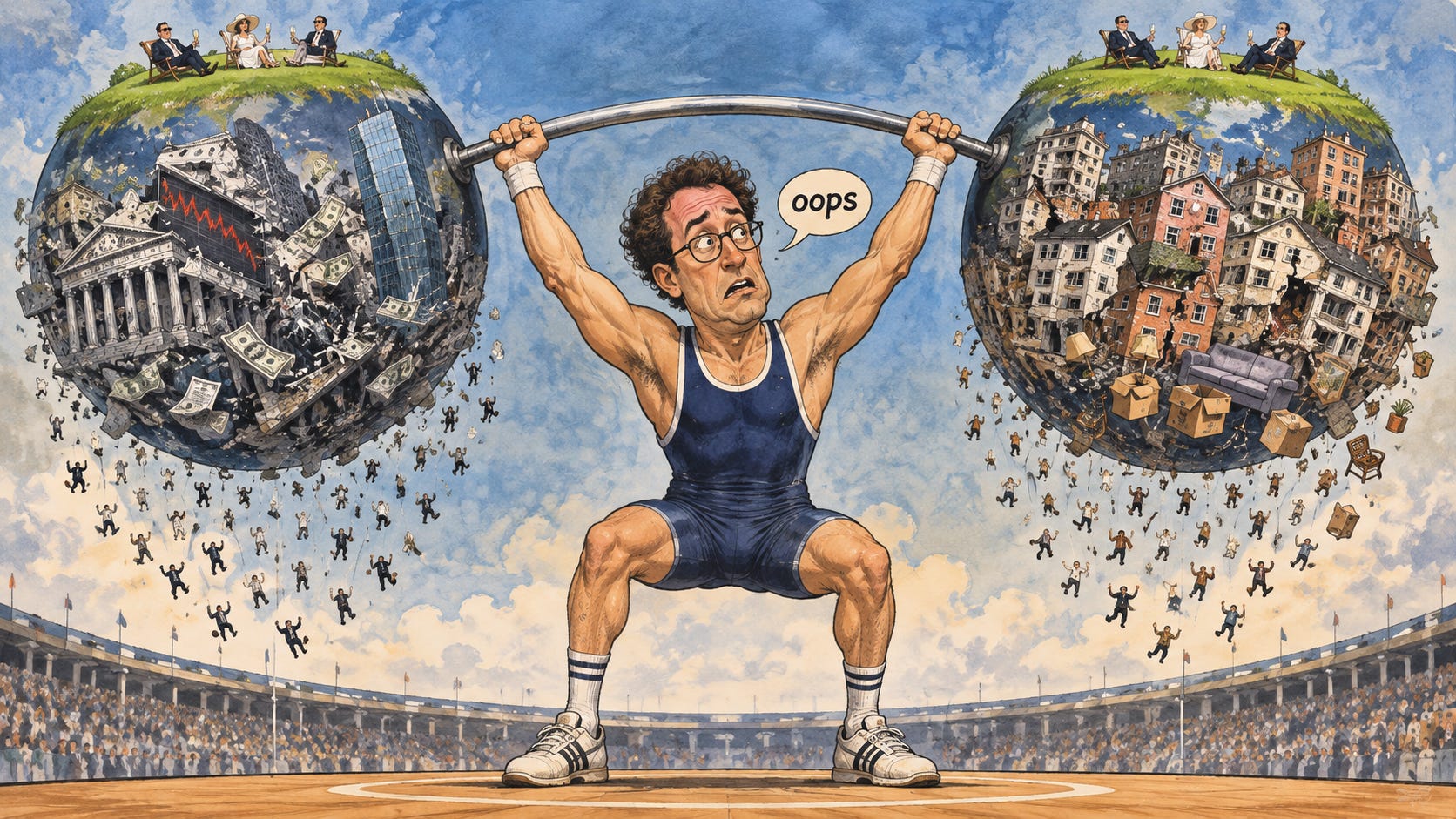
At one end of the barbell sits successful automation, arriving faster than people can replace their incomes. At the other sits an investment boom whose financial commitments outrun the value customers can afford to buy.
The customer stands underneath both weights.
Buying Back the Evening
Start with the strongest case for the product.
Imagine a small company that has enough demand to grow and too little organizational capacity to handle it. Its owner spends the day serving customers and the evening reconciling information: estimates, invoices, schedules, follow-ups, unanswered questions.
An effective AI system could turn that evening back into personal time. It could also make the company more responsive, help it pursue work it previously declined, and give a small operation capabilities it could rarely justify hiring separately.
For the customer, this is a substantial improvement in agency. A person with limited money and limited hours gains room to act.
The same logic applies inside a larger organization. A manager wants a project finished while the opportunity still exists. An employee wants help with unfamiliar work. A customer wants a problem resolved without explaining it repeatedly.
A useful system earns its place by delivering those outcomes reliably.
Every investment thesis should begin there. Someone has a problem worth solving and a budget that can support a solution. Revenue becomes durable when the product keeps fulfilling that bargain.
The harder question emerges when the product becomes capable enough to change the budget itself.
The Payroll Becomes Available
Consider a hypothetical support operation.
At first, an assistant helps employees find information and prepare responses. Customers receive faster service. Employees spend less time searching through documentation. Management has a plausible opportunity to improve service and expand capacity.
As the system improves, it handles more of the interaction independently.
Management now has choices. It can serve more customers with the existing team. It can shorten working hours. It can move employees into other responsibilities. It can reduce hiring or reduce headcount.
The product creates the capacity for each decision. Ownership, competition, demand, and management determine which decision follows.
From the buyer’s perspective, labor substitution can make the product more valuable. A tool budget becomes access to a much larger pool of expenditure. The purchasing conversation moves from employee convenience toward the economics of operating the department.
That is where the commercial promise becomes socially consequential.
A company can make a sensible purchasing decision while participating in a damaging collective outcome. Its executives are responsible for keeping that company competitive. They have limited power to preserve employment across every customer, supplier, and rival.
The household experiences the collective outcome anyway.
Customers Need an Income
A worker whose job disappears may still receive real benefits from AI. Some services could become cheaper. Previously expensive expertise could become accessible. Starting a business could require less capital.
Those gains deserve to be counted.
So does the lost paycheck.
The transition works for that household when lower expenses, replacement earnings, ownership income, or public support restore a workable standard of living. The timing matters. Rent and groceries come due while retraining, business formation, and institutional adjustment are still underway.
The severe success scenario is therefore a race between substitution and replacement purchasing power.
If firms can remove paid work much faster than the economy creates new ways for people to earn, individual productivity gains can coincide with widespread financial insecurity. The people receiving cheaper output may have less money with which to purchase it.
The customer-value proposition then acquires a second obligation: the economy needs a mechanism through which the benefits of greater output reach the people expected to consume it.
That mechanism could involve new employment, broader ownership, lower prices, shorter working hours with maintained income, transfers, or some combination. Each has different implications for who pays, who gains, and how quickly households recover.
“AI creates abundance” leaves those arrangements unspecified.
A household needs the arrangements.
What Means and What Ends?
A household can be seriously harmed through reduced hours, weaker bargaining power, a lower-paid replacement job, or a career ladder that stops admitting beginners. A society can face substantial disruption well before unemployment approaches an overwhelming majority.
Success also needs a definition.
Anthropic could succeed at building a useful business without achieving broad labor replacement. A strong stock-market debut would establish investor demand at a particular price. Widespread autonomous performance across economically important work would represent a much larger technological and institutional change.
The dangerous success scenario concerns that larger change: capability that substitutes for paid human effort across many activities, deployed faster than income and ownership arrangements adapt.
That is the scenario to examine directly. Inflating the certainty weakens an argument whose consequences are already serious.
The Other Weight
Now consider disappointing economics.
Suppose customers genuinely like the technology. They use it regularly. It saves time and improves some work.
The revenue generated could still fall short of what suppliers and investors need to justify their commitments.
A customer purchases the value available today. An infrastructure project may depend on years of demand growth. A financing arrangement may require payments on a schedule. An equity valuation may assume that capability, adoption, and profitability advance together.
Those expectations can separate.
In the adverse scenario, customers continue buying useful AI while paying less, adopting more slowly, or discovering that deployment requires more supervision than expected. Suppliers then confront a gap between the economics they financed and the economics buyers deliver.
For the ordinary customer, the consequence could extend beyond a disappointed shareholder.
If an overextended investment cycle involved enough borrowing, concentrated counterparties, construction, and household wealth exposure, a reversal could transmit through spending and credit. Projects could be canceled. Suppliers could lose orders. Employers could cut back. Households could become more cautious.
The scale of that transmission requires current evidence. The failure of one company, a disappointing IPO, or a falling share price would each be insufficient by itself to establish an economic depression.
The systemic scenario requires widespread exposure and weak capacity to absorb losses.
That is the research question behind the second weight: **how much of the wider economy has already committed to the expected return?**
The Two Risks Can Meet
The unsettling possibility is that labor disruption and disappointing investment returns arrive together.
Imagine systems that become effective at a substantial set of paid tasks. Employers reduce hiring and spending on outside services. Competition among AI suppliers pushes prices downward. Customers capture savings while providers struggle to earn the returns embedded in their financing.
Workers experience substitution. Investors experience repricing.
Technical usefulness and attractive investment returns have come apart.
This possibility matters because the comforting version of the debate offers a clean trade: either the technology delivers extraordinary benefits, or the boom fades and ordinary life continues.
A more demanding scenario gives society meaningful automation, unevenly distributed gains, and financial losses from having paid too much for the businesses supplying it.
The technology can work while the financing disappoints. Firms can save money while their customers lose income.
Those relationships deserve to appear in the same analysis.
What an IPO Actually Shares
A public listing could widen access to ownership. It could also provide capital and make more information available for investors to examine.
For a household worried about employment, ownership offers a conceivable route to participate in productivity gains. Its usefulness depends on how much that household can afford to own, the price paid, and the income the investment eventually produces.
Buying a small equity position offers limited protection against losing the salary that supports a mortgage and a family. An expensive share can also perform poorly while the underlying technology becomes more capable.
The household therefore faces a difficult asymmetry. Its labor income may be exposed to automation, while meaningful ownership of the resulting capital requires savings it may struggle to accumulate.
An IPO distributes securities to buyers able and willing to pay for them. A durable social settlement has to reach further.
It has to address the person whose contribution becomes less marketable before accumulated savings become sufficient to live on.
A Customer’s Measure of Success
A business customer has every reason to want a capable, reliable product. She should receive better service, more productive time, and a fair share of the savings.
As a member of the economy, she also needs customers of her own.
That connects her purchasing decision to a larger standard of success. Growing output should translate into lives people can sustain: useful services, dependable incomes, affordable essentials, and a credible path into ownership or paid work.
For an enterprise deploying AI, that suggests measuring what happens to saved time and money. Does the business expand? Do service quality and customer retention improve? Do employees move into valuable work? Does the gain mainly appear as a temporary reduction in expenditure?
For policymakers and financiers, the corresponding questions concern distribution and exposure. Who receives the income created by automation? Who carries infrastructure losses when forecasts disappoint? How quickly can either shock reach households?
These questions bring the barbell back to the person paying for the product.
She wants the evening back. She wants a business that can compete. She wants her children to find a place in the economy the technology helps create.
An honest account of customer value has to follow her through all three.