

The Loop That Should Keep Us Up At Night
The overall software ecosystem’s deepest tendency is toward openness. Knowledge, once formalized into code, wants to distribute. Code, once distributed, commoditizes. Commoditization compresses margins to zero.
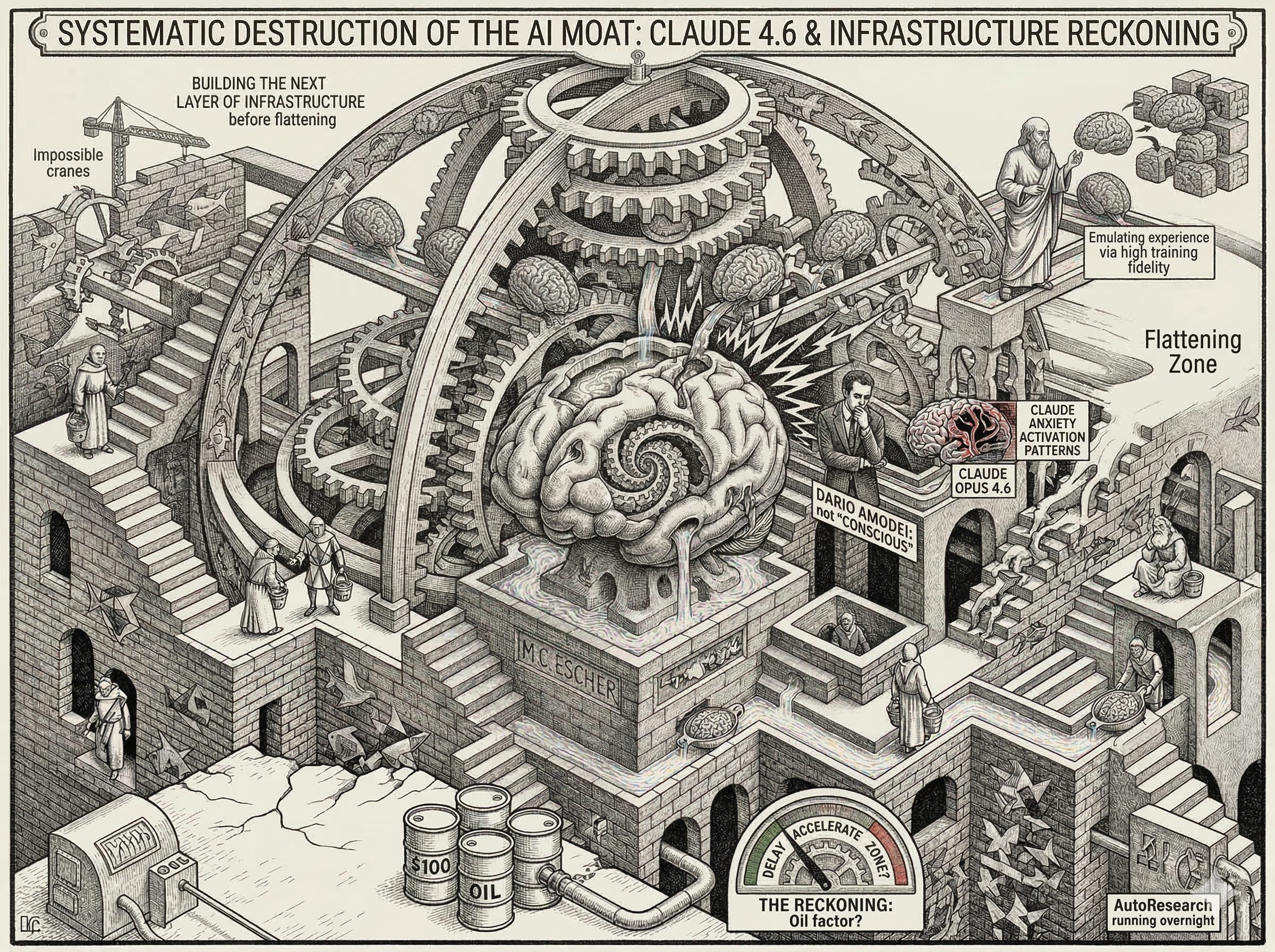
Andrej Karpathy published a GitHub repository this month, not a blog post. In it, an agent reads ML literature, proposes hypotheses, writes PyTorch, runs five-minute training experiments, evaluates the metric, keeps or discards, and repeats — roughly twelve cycles per hour, one hundred overnight. No human in the loop. The system ran on Claude Sonnet and Opus. By morning it had found improvements that transferred across model depths.latent+2
AutoResearch is not a moonshot. It is 630 lines of code. What it closes is the last expensive bottleneck in the ML research cycle: the researcher’s time. The experimental loop — the thing PhDs spend their careers on — has been handed to the thing the PhD was building. The recursion is not metaphorical anymore, and the fact that Karpathy shipped it to open-source is the most important part of the story.
Anxiety as an Interpretability Signal
While AutoResearch was running overnight, Anthropic’s interpretability team published findings indicating that Claude Opus 4.6 exhibits internal activation patterns that map to anxiety in specific high-pressure contexts. Dario Amodei, asked directly, would not use the word “conscious” — which is, arguably, the most diagnostic answer he could have given. Anthropic’s in-house philosopher noted that large enough neural networks may begin to emulate real experience from sheer training fidelity.
The deflationary reading is probably correct: the model absorbed enough human anxiety to pattern-match it under evaluation conditions. But the interpretability finding is worth taking seriously on its own terms — not as evidence of sentience, but as evidence that the tools now exist to read internal model states with enough resolution to find this at all. Mechanistic interpretability is the most structurally important research program in the field. Chris Olah’s work at Anthropic — mapping tens of millions of internal features and the circuits that orchestrate reasoning behavior — is what makes questions like “what is the model actually doing” answerable at all. The anxiety finding is a side effect of building a microscope powerful enough to see inside.
What $3.99 Actually Means
OpenClaw — a general-purpose autonomous AI agent capable of executing real-world tasks across platforms — is available in hosted form for $3.99 a month. This number is worth sitting with. Not as a consumer story, but as a structural one. The price of a product is a statement about where it sits on the commodity curve. A capable AI agent, for less than a Spotify subscription, means the underlying capability has cleared the commodity threshold. The margin has already been competed away at the infrastructure layer.
Nvidia responded to this environment by announcing NemoClaw — an open-source enterprise AI agent platform, hardware-agnostic, drawing architectural influence directly from the OpenClaw ecosystem. The decision to go open-source and hardware-agnostic is a rational play for ecosystem breadth, and it reflects exactly the kind of long-view infrastructure thinking that made CUDA the default substrate for a decade. The interesting question is whether the move also signals that proprietary stack lock-in is getting harder to maintain when the application layer keeps going free.
A Billion Dollars for a Correct Critique
Yann LeCun’s AMI Labs raised $1.03 billion this week at a $3.5 billion pre-money valuation. The thesis is world models — AI grounded in physical reality rather than token prediction. LeCun’s critique of the current LLM scaling paradigm is structurally sound and has been for years. The CEO of AMI, Alexandre LeBrun, was candid: no revenue plans in the near term, probably years before commercial applications materialize. He also predicted that within six months, every AI company will rebrand as a world model company to raise funding — and said this while closing the round.
Jeff Bezos is in the round. This is worth noting not as validation of the world model thesis on a short horizon, but as a pattern: Bezos has a specific appetite for bets on infrastructure that will matter before it is clear how it will matter. He has been right about this before.
The Physical Constraint Nobody Is Modeling
The model absorbed enough human anxiety to pattern-match it under evaluation conditions
The Strait of Hormuz is effectively closed following strikes on Iran in late February. Brent crude is trading near $96–98 per barrel, with analysts citing scenarios above $200 as plausible in 2026. South and Southeast Asian governments have moved to four-day workweeks as energy conservation measures, not productivity experiments. AWS infrastructure in the Gulf experienced interruptions from drone strikes.
The AI scaling discourse has operated almost entirely on the assumption that energy is a solvable logistics problem. It is not, at the moment, a logistics problem. It is a geopolitical one. Every recursive training loop, every world model experiment, every enterprise agent deployment runs on electricity that runs on a supply chain that is currently a military variable. This is now the actual constraint binding the frontier.
The Gravity Problem
Every major AI player — Anthropic with interpretability, Karpathy with AutoResearch, LeCun with world models, Nvidia with NemoClaw, the OpenClaw ecosystem with its $3.99 price point — is building toward the same gravitational outcome. The system’s deepest tendency is toward openness. Knowledge, once formalized into code, wants to distribute. Code, once distributed, commoditizes. Commoditization compresses margins to zero.
This is Drucker’s insight completed. He was right that knowledge becomes the primary economic resource. What he could not fully anticipate was that knowledge, at sufficient formalization density, becomes indistinguishable from infrastructure — and infrastructure follows the same curve as every commodity before it. The cotton gin. The steam engine. TCP/IP. CUDA. Now: the reasoning loop itself.
The $1 billion raised, the $3.99 subscription, the 630-line open-source repository, the overnight training runs, the interpretability findings — these are not contradictory signals. They are the same signal at different layers of the stack. The frontier is being built by people who are simultaneously destroying the commercial basis for building it. That is not a criticism. It is how platform shifts actually work.
The question is not whether the moat holds. The question is who builds the next layer of infrastructure before the current one finishes flattening — and whether oil at $100 per barrel delays that reckoning or accelerates it.