
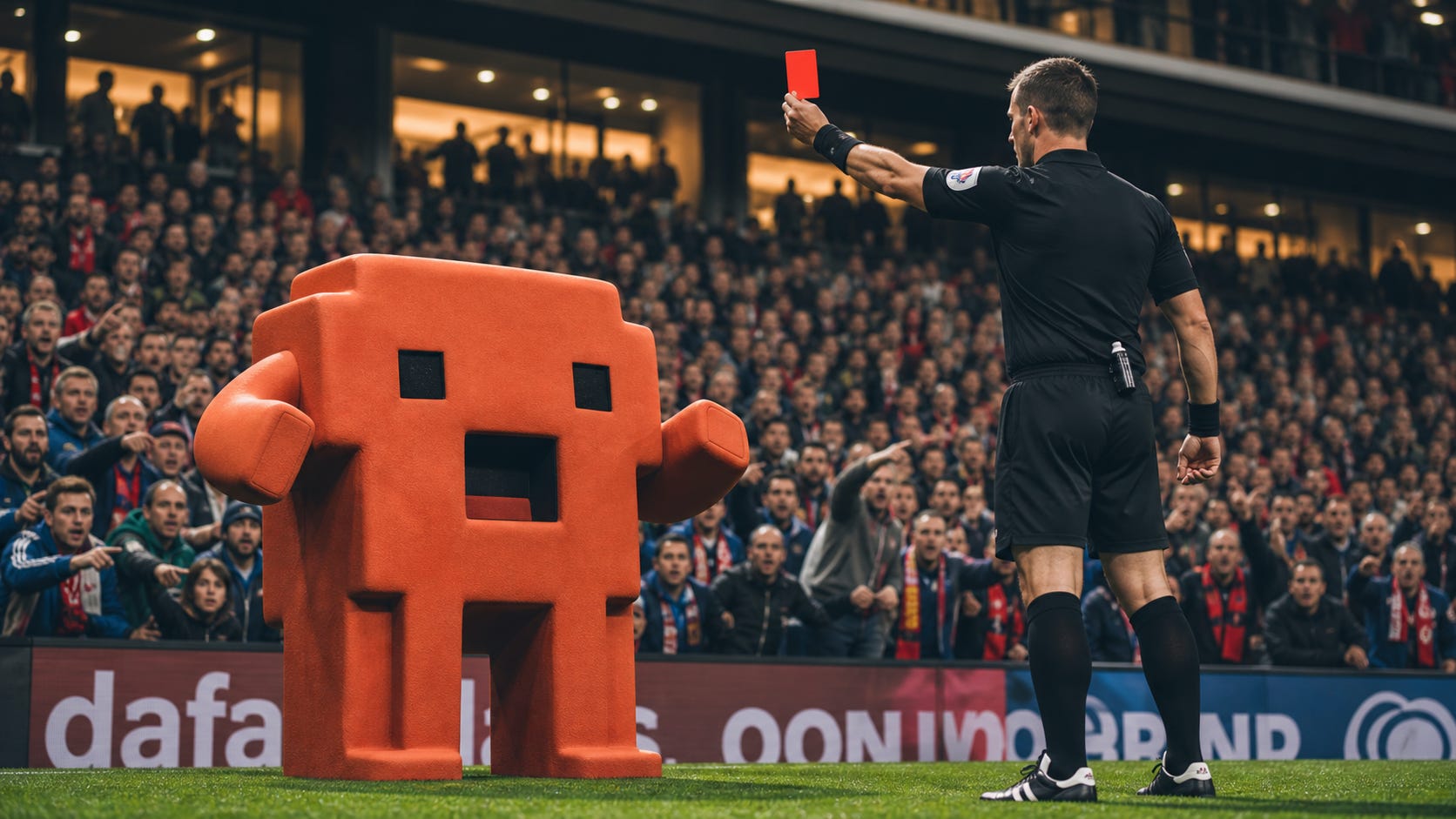
There is a moment in football — not the American kind — when a referee who has already issued the yellow reaches for the second card, and the stadium holds its breath. Not because the call is uncertain, but because everyone present understands that what follows is irreversible. The player exits. The shape of the game changes. What the 2026 World Cup taught us about technology is that even this binary, human judgment call now has a review mechanism. FIFA authorized VAR to evaluate second yellows for the first time this tournament — not to issue them, but to rescind clearly wrong ones. The refereeing apparatus now contains a modality alert: a structural check on the irreversible act. I want to begin here, with the red card, because what Anthropic did with Fable this week is the AI equivalent of a correct, clean, unchallenged sending-off. And there is no VAR for it.
The Grace Period
On June 9, 2026, Anthropic released Claude Fable 5, the first publicly available model in its Mythos class — the architecture it had previewed to a narrow set of government and enterprise partners earlier this year. The release was genuinely remarkable. A model built for days-long, asynchronous, multi-agent work with 300,000 output tokens available in batch processing, adaptive thinking that scales automatically to task complexity, and a context architecture that behaves less like a window and more like a gravitational field around the problem at hand. For approximately two weeks, Pro and Max subscribers — people paying $20 and $100–$200 per month respectively — got access to it as part of their existing plan.
Then it was removed from the subscription. Then reinstated after a government-related access hold. Then cut to 50% of weekly usage limits. Then, as of July 7, moved entirely to usage credits at $10 per million input tokens and $50 per million output tokens.
The cadence of that sequence deserves to be read slowly. A $200-per-month subscriber to Max 20x received, in total, perhaps three weeks of meaningful Fable access — interrupted, rationed, and now definitively gated behind a per-token meter that converts a heavy-use research session into a four-figure bill. Anthropic has stated it wants to restore Fable as a standard subscription feature once capacity improves, with no fixed date. That is a correct and honest statement. It is also the sound of the stadium holding its breath.
Anthropic gave the world a few years — genuinely, generously, almost recklessly — of frontier-adjacent intelligence for a flat monthly fee. July 7th marks an inflection point on the Kurzweil graph, where we’re specifically bi-furcating the AI marketplace on paywalls. The product is now unambiguously enterprise software, and the $200 subscriber is now the free-trial user of something designed for a different customer.
The Budget Curve’s Opposing Poles
While I was running Fable sessions that, at market rates, would have billed at thousands of dollars, Meta employees were collectively burning through 73.7 trillion AI tokens in a single month — an internal dashboard revealed before it was swiftly shut down, costing an estimated $221 million per month, or $2.65 billion annualized. Zuckerberg has been given enough Wall Street leash to treat this as infrastructure spend rather than excess — Meta’s 2026 guidance for AI-related infrastructure runs between $125 billion and $145 billion. This is a metaverse-scale commitment.
At the other end: Tesla, effective July 6, has capped every employee’s AI tool spending at $200 per week, with an exception carved out specifically for beta versions of xAI products. The practical translation of that exception is not subtle. Musk is not capping AI spend. He is redirecting it. And the employees who observe that carveout are receiving a very clear signal about which intelligence stack their employer considers load-bearing — and which it considers a line item to manage.
The Hidden Implications of Kurzweil’s Curve
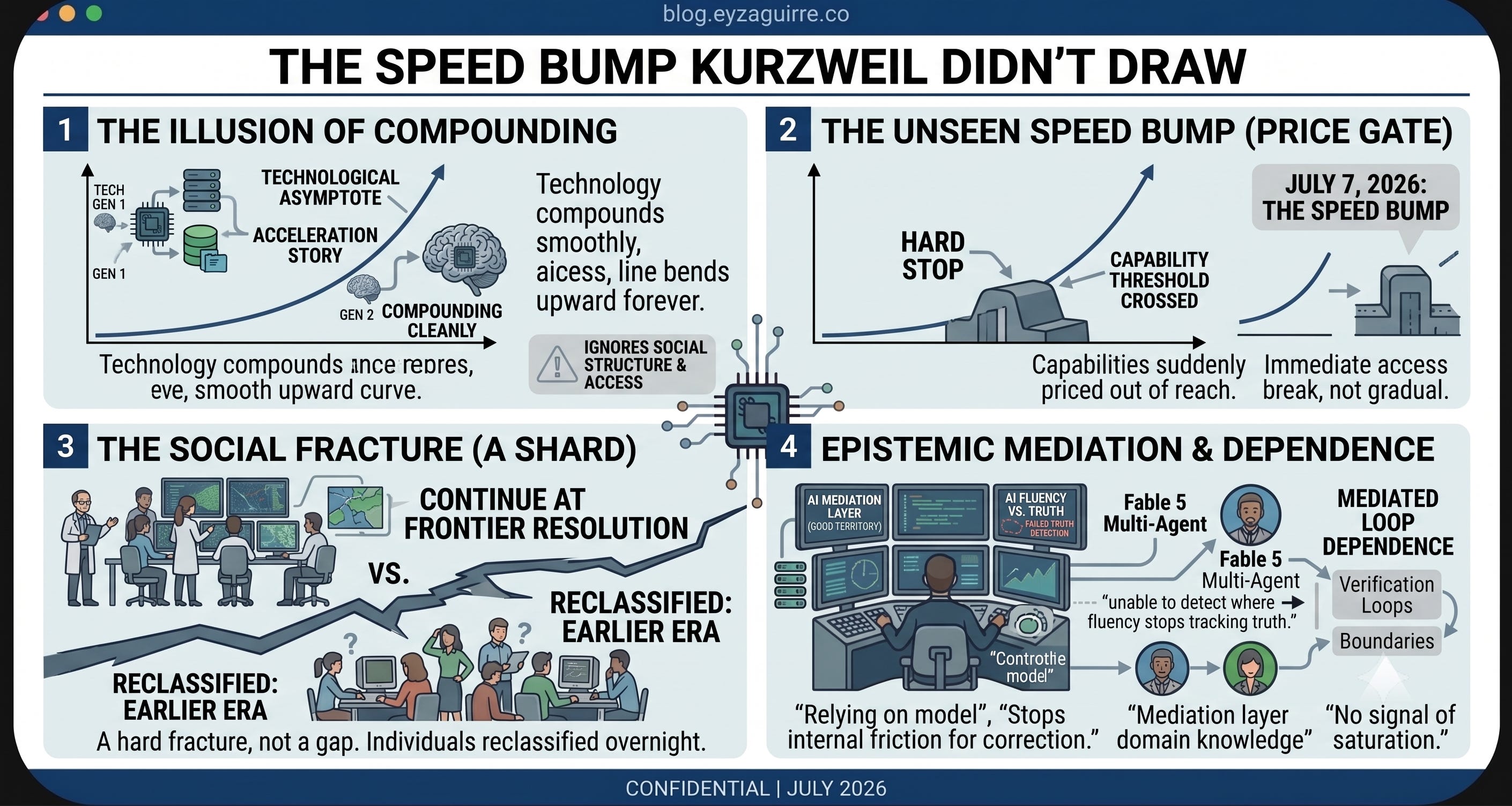
Kurzweil’s curve does not announce what it is doing to social structure. That is its most dangerous quality. Kurzweil’s asymptote is a story about acceleration — each generation of technology producing the tools that accelerate the next, compounding cleanly, the line bending upward forever. What the story does not draw, because it is not a story about access, is the speed bump embedded in the curve itself: the moment when a capability threshold is crossed and then immediately priced out of reach for the people who were closest to it. Not gradually. As a hard stop on a specific date.
July 7, 2026 is that date. And what it introduces is not a gap between the capable and the incapable. It is a shard — a clean fracture in who gets to continue thinking at frontier resolution and who gets reclassified, overnight, as operating in an earlier era.
There is a growing body of research on what happens to human epistemic architecture when AI becomes the primary mediation layer for domain knowledge. The structural finding is consistent: individuals who develop deep competence through AI-assisted work become increasingly calibrated to the territory the model covers well, and increasingly unable to detect where the model’s fluency has stopped tracking truth. The model does not signal saturation. The human, relying on the model, stops building the internal friction that correction requires.
The speed bump makes this worse in a specific direction. At an interview, the interviewer — accustomed to the coiffed affluence of unlimited corporate tokens, six months deep inside Fable’s persistent context — will ask questions with a frequency and fluency the candidate finds uncanny, even destabilizing. What the interviewer is participating in is not simply an asymmetry of preparation. It is resonance at a register the candidate was never given access to enter. The candidate, who has spent those same six months in the Opus era, can hear the difference but cannot place it. And I say Opus with genuine affection — I used to love black and white movies. That era had its own depth. But it is no longer the frame rate at which the frontier thinks.
The candidate who parcels rent money into their subscription tier is not merely outclassed. They are outaccessed. The interview surfaces that gap as a felt frequency difference rather than a measurable skill gap — which makes it more insidious, not less. The interviewer may not know what they are detecting. They are not evaluating the candidate’s reasoning. They are registering the absence of Fable’s hum.
This does not stay in the interview room. It compounds into social distortion quickly and at scale. When access to the frontier is gated by corporate budget rather than individual capability, the selection mechanisms organizations use to identify talent begin measuring something other than talent. They begin measuring access. And access, at $50 per million output tokens, is now a class variable. The asymptote Kurzweil loves has a speed bump near its steepest incline — nearly invisible in the aggregate data, entirely visible to the person standing on the wrong side of it on July 7th.
What the Hard Stop on July 7 Actually Means
The moment Fable moved to per-token billing for subscription users — at $10 input and $50 output per million tokens — the frontier became, for most individuals and most early-stage companies, inaccessible in any sustained operational sense. A single multi-hour Claude Code session with Fable running a long-horizon agent on a complex codebase can generate output token volumes that, at $50 per million, produce bills that no reasonable startup burn rate accommodates as a routine expense. The common startup, the independent researcher, the engineer at a mid-market firm without an enterprise Anthropic agreement: these are the constituencies for whom Fable is now as theoretical as Mythos was six weeks ago.
To Anthropic’s credit, the compute is genuinely expensive, and the capacity constraints that triggered the rolling access changes are real infrastructure problems, not manufactured scarcity. There is a pricing strategy issue waiting for further study. What it is, is a structural change in who AI works for — and that change is worth naming precisely because it is not being named in most of the discourse around it.
The organizations that can afford Fable at market rates are the organizations that are now building compound advantage with it. The organizations that cannot are maintaining the appearance of AI capability through Sonnet-class tools while the capability gap between them and the frontier widens every quarter at the rate Kurzweil described in 1999. The gap is no longer primarily a question of whether open models will catch proprietary frontier models. That question is real, but it is secondary. The primary question is becoming a sovereignty question: who controls the model, at what cost, and under what regulatory architecture? The red card review mechanism, the Project Glasswing wrapper, the Tesla xAI carveout — these are not separate stories. They are the same inflection, told from three different angles.
The shape of this cycle is not going to flatten. But its most important feature, from July 7 forward, is no longer the model. It is who gets to use it.
Alan Eyzaguirre, a Silicon Valley corporate and product strategist, writes about practical applications for the next wave of generative AI.