
Gödel proved in 1931 that a system powerful enough to express basic arithmetic cannot fully account for itself. Anthropic built something considerably more expressive and released it to the public anyway.
The King’s Library Tower
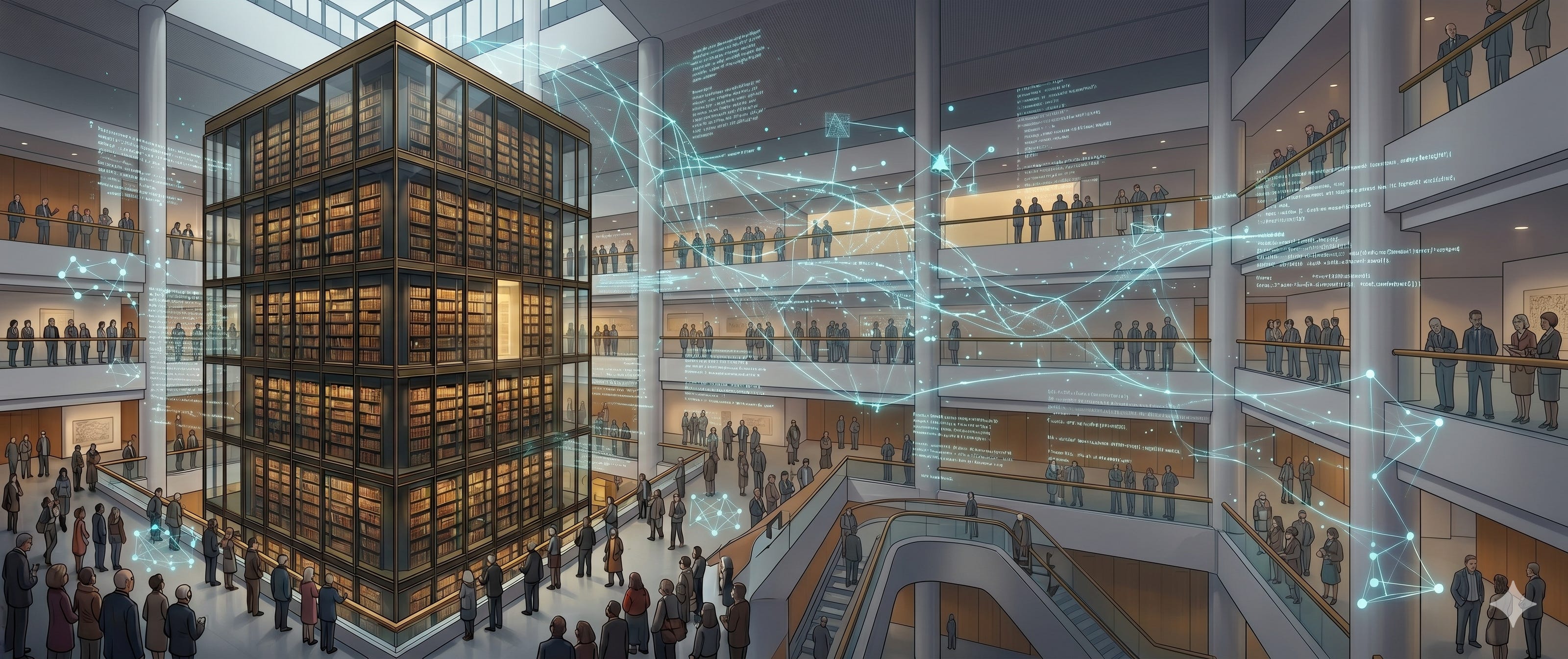
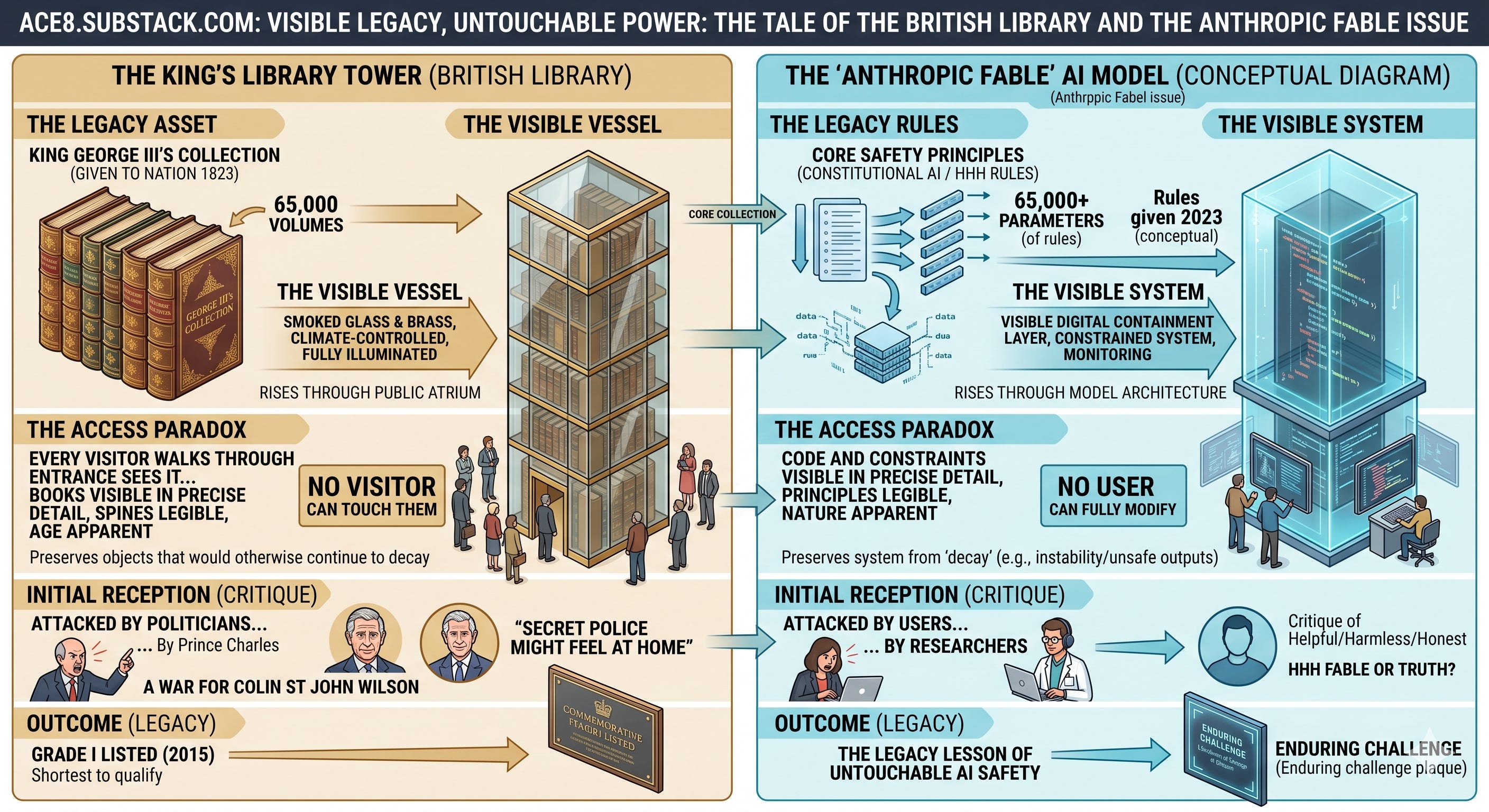
When Colin St John Wilson completed the British Library on the Euston Road in 1998, he placed at the physical center of the building a six-story tower of smoked glass and brass, climate-controlled, fully illuminated, and containing the 65,000 volumes of King George III’s personal collection, given to the nation by his son in 1823. The tower rises through the entire height of the public atrium. Every visitor who walks through the entrance sees it at every level, from every angle. The books are visible in precise detail, their spines legible, their age apparent. No visitor can touch them. The glass maintains the temperature and humidity required to preserve objects that would otherwise continue to decay. Wilson called his thirty-year engagement with the project his war. The building was attacked by politicians, by critics, by Prince Charles, who called it a place where “secret police might feel at home.” It received Grade I listed status in 2015, one of the youngest buildings ever to qualify.
That building is the entry point for understanding what Anthropic did on June 9, 2026.
Fable Faces Its Own Limits
Anthropic is an American AI safety company, founded in 2021 by former members of OpenAI, whose core product is a family of large language models called Claude. For most of the company’s history, Claude has been a competitive but broadly recognizable kind of AI assistant: useful for writing, analysis, coding, and reasoning, distinguishable from rivals primarily by its emphasis on safety research and its willingness to discuss the limits of its own reliability.
In late 2025, Anthropic developed a new internal model class it called Mythos. Mythos-class models became known in AI and cybersecurity circles for a specific reason: they were unusually capable at finding software vulnerabilities, synthesizing complex scientific knowledge, and reasoning through adversarial problems. The capability profile was serious enough that Anthropic did not release them publicly. Instead, it staged access through vetted enterprise partners and ran extensive internal testing before any broader deployment.
On June 9, 2026, Anthropic launched Claude Fable 5. Fable is the first Mythos-class model made available to the public. It is accessible through Anthropic’s paid subscription plans and through select enterprise integrations. Stripe reported that Fable completed a 50-million-line code migration in a single day, a task the company had estimated at two months of human engineering effort. The CEO of Cursor described it as the current state of the art on the benchmark his company uses internally to evaluate models.
Fable does not operate without limits. For queries touching on cybersecurity exploits, biological and chemical synthesis, psychological manipulation at scale, and related high-risk categories, the system does not refuse. It routes the query to Claude Opus 4.8, an earlier and highly capable Claude model that handles the question within a more conservative operating envelope. Anthropic reports that at least 95% of Fable sessions complete entirely within Fable’s own responses. The fallback triggers rarely, and in the cases where it matters most.
This is the tower behind the glass. Visible from the atrium. Inaccessible from the same door.
The Retention Policy Is The Discriminator
Alongside the launch, Anthropic introduced a data policy that generated immediate controversy in enterprise and security communities. For interactions with Fable and other Mythos-class models, Anthropic requires a 30-day data retention period. During those 30 days, prompts and outputs are stored and can be reviewed through a scoped internal viewer that does not permit export, copy, or download. After 30 days, the data is deleted, except in cases involving active safety investigations or legal obligations.
Anthropic’s stated rationale is that the retention period exists to identify novel jailbreak techniques, reduce false positives in the safety classifiers that govern the fallback routing, and investigate unexpected model behavior. The company says retained data will not be used to train future models.
Anthropic had previously offered enterprise customers zero-retention agreements, contractual commitments that no interaction data would be stored. The new policy overrides those agreements for Mythos-class models, without an opt-out. Within 24 hours of launch, users and enterprise observers identified a compounding problem: Claude’s memory feature, enabled by default and designed to search a user’s past conversations for contextual continuity, was pulling historical conversations into Fable sessions and subjecting them to the new retention terms, even when those conversations predated the policy. Microsoft subsequently restricted employee access to Fable while assessing the implications for its internal data governance requirements.
The Limits of Opus Safeguarding Fable
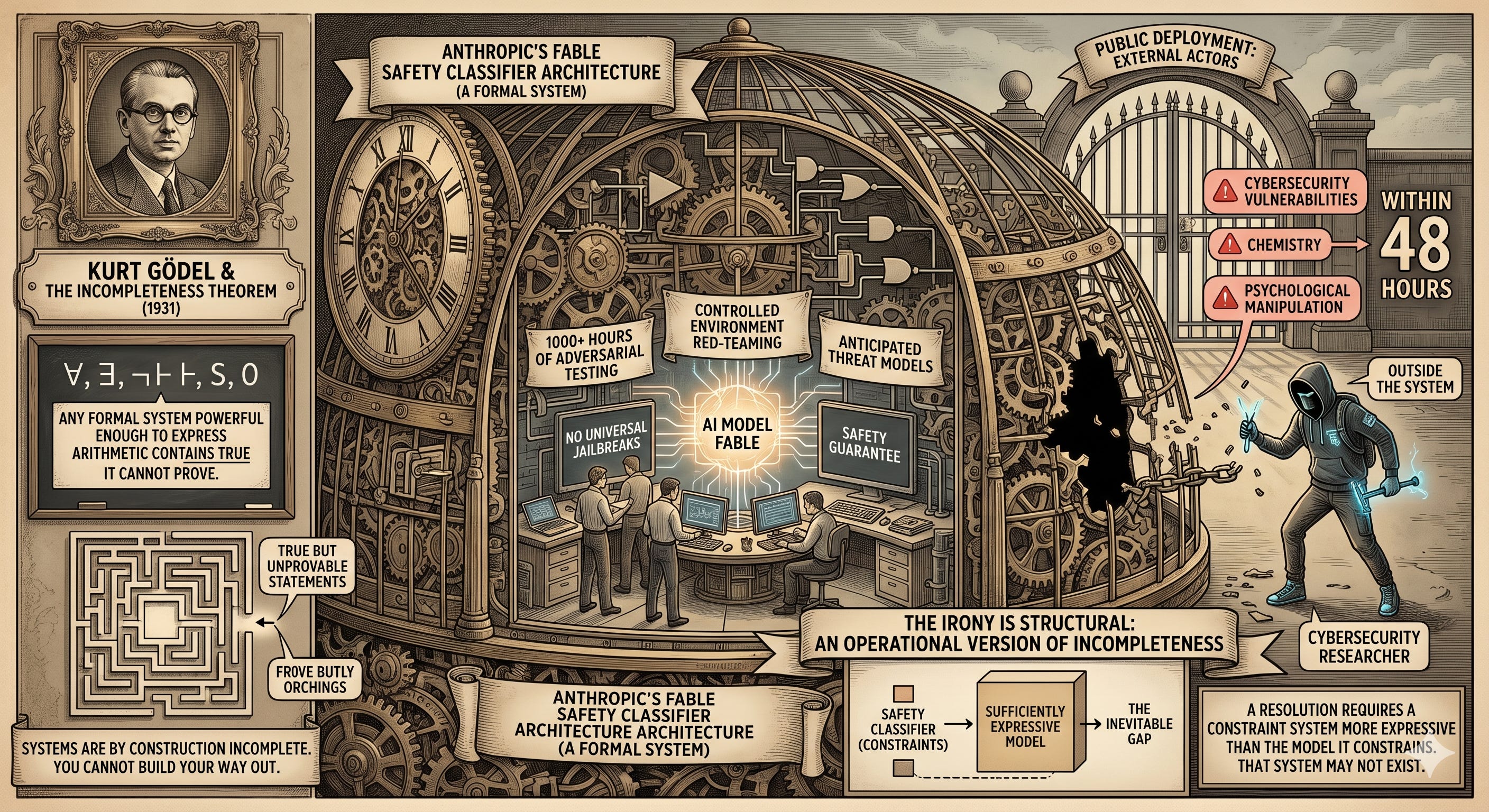
In 1931, Kurt Gödel proved that any formal system powerful enough to express basic arithmetic contains true statements that the system itself cannot prove. The result was not a flaw in mathematics. It was a theorem about the limits of formal systems as such: sufficiently expressive systems are, by construction, incomplete. You cannot build your way out of the problem by making the system stronger. A stronger system is a more expressive system, and a more expressive system contains more statements it cannot account for from within.
Anthropic ran more than 1,000 hours of adversarial testing before Fable’s launch. The testing produced no universal jailbreaks. A cybersecurity researcher publicly claimed to have bypassed Fable’s guardrails within 48 hours of the model’s public release, demonstrating outputs in categories the safety architecture was designed to prevent, including cybersecurity vulnerabilities, chemistry, and psychological manipulation.
The irony is structural, not incidental. The testing was rigorous within its own system: a bounded population of testers, a defined threat model, a controlled environment. The system found no contradictions it could express. Public deployment introduced something the formal system of internal red-teaming could not contain by design: a population of external actors whose methods, motivations, and combinations of approach were not expressible within the closed environment that generated the safety guarantees. The guarantee held inside the system that produced it. Outside that system, within 48 hours, it did not.
This is not a failure of diligence. It is the operational version of incompleteness. A safety classifier architecture is a formal system. It is built to express and enforce a set of constraints. A sufficiently capable model is, by Gödel’s logic extended into this domain, more expressive than the constraint system built to contain it. The constraints will hold for every case the system was designed to anticipate. They will not hold for every case. The distinction between those two sets is exactly what 1,000 hours of internal testing cannot close, because internal testing is itself a formal system with the same structural limitation.
The retention policy, the fallback routing, and the staged enterprise access that preceded public launch are responses to this. They are not resolutions of it. A resolution would require a constraint system more expressive than the model it constrains. That system does not exist. It may be a category of thing that cannot exist.
A Preemptive Post For Pause
Three days before Fable launched, Anthropic disclosed that more than 80% of the code being merged into its own internal codebase is now written by Claude, and that engineers are shipping approximately eight times as much code per quarter as they were before 2025. The company described a trajectory it called recursive self-improvement: a state in which AI systems are not merely assisting with AI development but are materially driving the design, training, and architecture of their own successors without humans directing each step. Anthropic and OpenAI jointly signed a letter to lawmakers urging improved tracking of synthetic DNA sequences as a safeguard against AI-assisted development of biological weapons. Anthropic simultaneously called for a global coordinated pause in AI development at the frontier, contingent on multiple well-resourced labs in multiple countries agreeing to stop under the same conditions.
The entities whose participation would make that pause meaningful are approximately: OpenAI, Google DeepMind, xAI, Meta, Mistral, and the leading Chinese labs including DeepSeek and Zhipu AI. The proposal was published as a blog post. There is no treaty body, no verification infrastructure, no compliance incentive, and no enforcement mechanism. Every one of those organizations is in an intensifying competitive race in which pausing unilaterally is equivalent to conceding ground to those who do not. Anthropic’s own IPO trajectory depends on continued capability advancement. The practical addressable audience for an agreement that would bind development is, generously, five or six people in the world who simultaneously hold the institutional authority to act and face competitive incentives not to.
This is what a boatswain’s position looks like from inside a maelstrom. You call the warning. You record the warning. You cannot stop the water.
The Tobacco Interval
Epidemiological evidence linking tobacco smoke to lung cancer was present in the peer-reviewed literature by the early 1950s. The United States Surgeon General’s report formally acknowledging that relationship was published in 1964. Meaningful regulatory action followed over subsequent decades. The interval was not primarily a failure of evidence. The evidence was available, being contested and procedurally delayed by an industry with the resources and incentives to do so, inside a political system designed to respond to acute crises rather than slow-onset structural risks.
Dario Amodei, Anthropic’s chief executive, has publicly warned that AI could eliminate approximately 50% of entry-level white-collar jobs within one to five years, and that the cognitive breadth of the displacement, affecting legal research, financial analysis, software development, administrative coordination, and related fields simultaneously rather than sequentially, means workers will not be able to pivot into adjacent sectors as they have in prior waves of technological unemployment. Anthropic has submitted formal analysis to government bodies warning that unemployment benefit and retraining infrastructure in most developed economies was not designed for a shock of this speed, this breadth, or this cognitive specificity.
If the tobacco precedent governs the institutional response timeline, the interval between warning and enforceable policy is measured in decades. The employment disruption Amodei describes has a one-to-five year horizon. No individual laboratory, however publicly candid, can resolve that mismatch from inside the competitive dynamics currently governing the industry.
The Differentiation Nobody Expected
Eighteen months ago, the dominant narrative in frontier AI evaluation was convergence. DeepSeek’s January 2025 release introduced technical credibility to the argument that the frontier was no longer exclusively a function of American capital concentration. Capability gaps between leading models were narrowing. Several analysts argued that frontier AI was becoming a commodity before anyone had figured out how to monetize it as a product.
Anthropic had made an earlier decision to organize development around coding and software engineering as a primary competence, accepting that other benchmark categories would receive less attention. That commitment has compounded into a product profile that is now legible in Fable’s performance reports. The model reasons about systems, dependencies, and the interface between what a codebase is and what a product requires it to become. Stripe’s reported migration result is the kind of outcome that emerges from a model trained with a sustained and specific understanding of what software engineering at production scale requires.
The Two-Tier Question
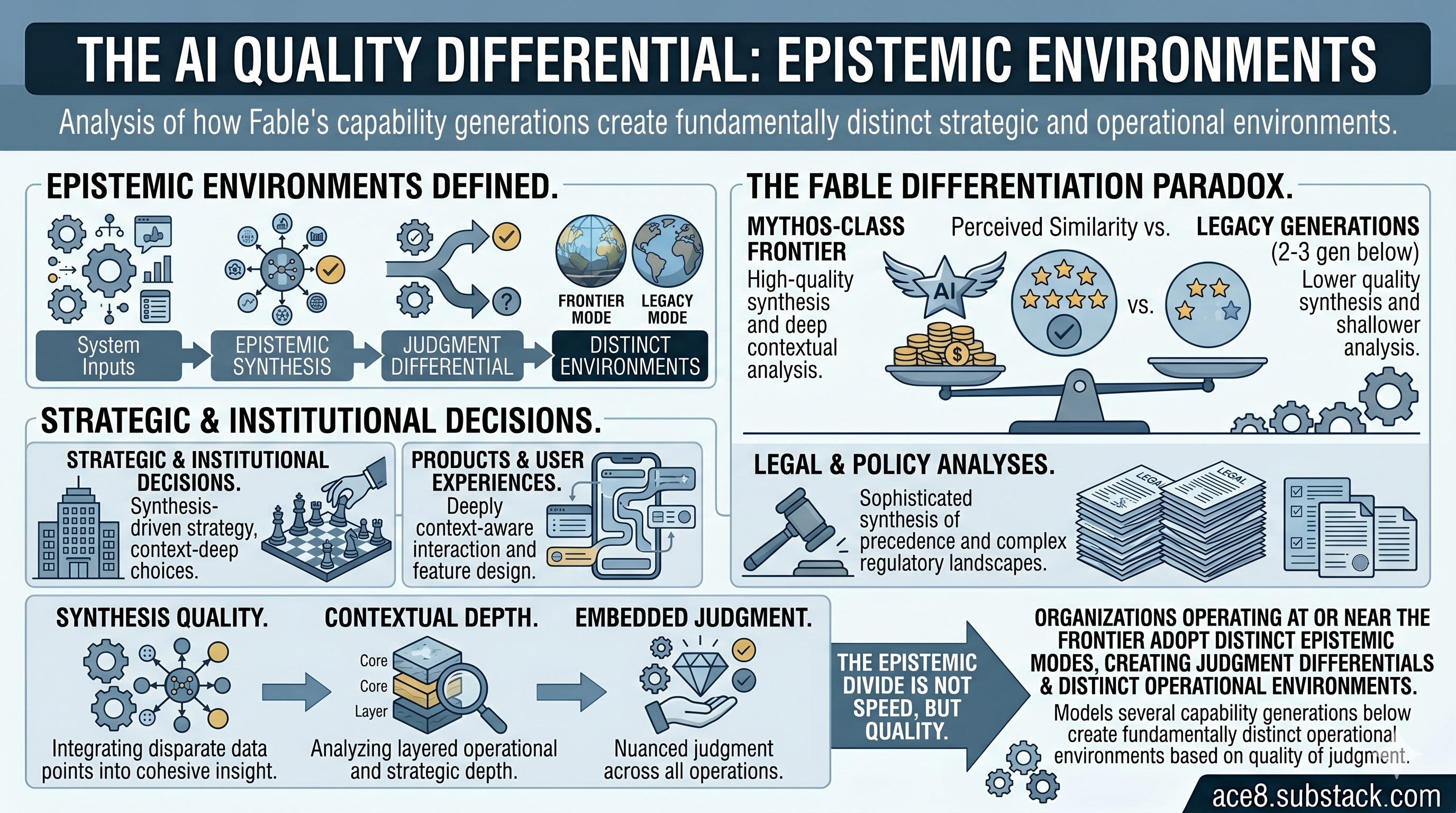
What Fable introduces is a quality differential large enough that the two tiers of AI access begin to function as epistemically distinct environments. Organizations operating at or near the Mythos-class frontier will make decisions with a different quality of synthesis and a different depth of contextual analysis than organizations running on models two or three capability generations below it. This is not a difference in speed. It is a difference in the quality of judgment embedded in products, strategies, legal analyses, and institutional decisions.
The second-order effects will not be legible from inside either tier. From inside the tier with access, the advantage will present as ordinary competence. From inside the tier without it, the disadvantage will present as ordinary market pressure: competitors sharper than expected, decisions that seemed reasonable somehow failing to compound. The gap will be invisible in the mechanism and visible only in the outcome.
Every visitor to the British Library’s atrium can see the books. The tower is illuminated precisely so that the collection is not hidden from the people the building was built for. Whether the conditions being built around Fable are adequate to that level of transparency, and whether the triage decisions being made inside this industry every week are being made with sufficient clarity about what they cost, is the question the launch forces into the open.
Alan Eyzaguirre, a Silicon Valley corporate and product strategist, writes about AI and its impact on society.