
Executive Summary
Note: We just published “Autonomous AI Agent Market: Mid-2026 Vendor Assessment” an Agentic AI review to complement this report.
Agentic AI is undergoing a structural transition from single-model inference to composable, hierarchical systems of autonomous agents that perceive, plan, and act. This report applies the holonic systems framework—originally proposed by Arthur Koestler in The Ghost in the Machine (1967) and formalized in multi-agent research—to classify the emerging orchestration landscape. A holon is simultaneously a self-contained whole and a functional part of a higher-order system. This dual nature maps precisely onto the layered architecture of modern LLM agent systems, where a sub-agent is simultaneously a complete reasoning unit and a component of a larger orchestrated workflow.
The global agentic AI market is valued at approximately $7.6–$10.86 billion in 2026, projected to reach $47.1 billion by 2030 and $236 billion by 2034 (IDC), at a compound annual growth rate exceeding 40%. Enterprise deployment is accelerating rapidly: as of Q1 2026, 57% of organizations have AI agents running in production, up from 51% in 2025. Despite this growth, governance maturity remains low—only ~30% of organizations score at or above Level 3 in agentic AI controls according to McKinsey’s 2026 AI Trust Maturity Survey.
Enterprise deployment is concentrating rapidly: Microsoft (31%), Salesforce (24%), Anthropic (18%), Google (14%), ServiceNow (7%) account for 94% of enterprise agentic AI deployments. Open-source frameworks (LangChain, CrewAI) provide the innovation substrate but have not converted ecosystem adoption into proportional revenue. The pattern—open-source frameworks capture developer mindshare while hyperscalers and domain platforms capture enterprise spend—mirrors historical SaaS ecosystem dynamics.
This taxonomy defines six holon levels (H0–H5) for agentic LLM systems, evaluates 15 leading vendors across five capability dimensions, and assigns letter grades to each. The findings are intended to support enterprise technology selection, investment thesis development, and vendor capability roadmap assessment.
Section 1: The Holonic Framework Applied to Agentic AI
1.1 Origins of the Holon Model
Koestler defined a holon as a structure that is “stable and coherent” and exhibits a Janus-face duality: one face looking inward to govern its own internal logic, and another face looking outward to interface with its containing system. A multi-agent holarchy is therefore a tree of autonomous agents in which each node simultaneously acts as a sovereign decision-maker and as a governed component of a higher node.
This framework was formally applied to distributed artificial intelligence in the DFKI Research Report “Holonic Multi-Agent Systems” (1999), which proposed that agents could “give up parts of their autonomy and merge into a super-agent (a holon)”. The model translates naturally to LLM-based architectures where a coordinator agent delegates to specialized sub-agents, each of which may itself orchestrate finer-grained tools or sandboxed processes.
The four-graph model of holons—comprising an interior graph (private state), a boundary membrane (constraints and interfaces), a context graph (position in the holarchy), and a projection graph (externally visible behavior)—provides the architectural template against which vendor platforms are assessed.
1.2 The Holonic Instruction Hierarchy Problem
Recent empirical research (arXiv 2604.09443, April 2026) introduces the Many-Tier Instruction Hierarchy (ManyIH) framework, demonstrating that real-world agentic deployments involve up to 12 levels of conflicting instructions with varying privileges—far exceeding the 2–4 levels assumed by conventional system/user paradigms. Current frontier models “struggle significantly as the complexity of instruction conflicts scales,” revealing a key gap between theoretical holarchic design and practical model capability.
A parallel 25,000-task experiment (arXiv 2603.28990) across 8 models and 4–256 agents found that autonomous coordination (self-organizing agents given minimal scaffolding) outperforms centralized orchestration by 14% (p < 0.001), and that the spread between coordination protocols reaches 44% in outcome quality. This finding has direct implications for vendor platform design: platforms that expose structural autonomy to capable models outperform rigid hierarchy-imposing orchestrators.
1.3 Holon Level Definitions
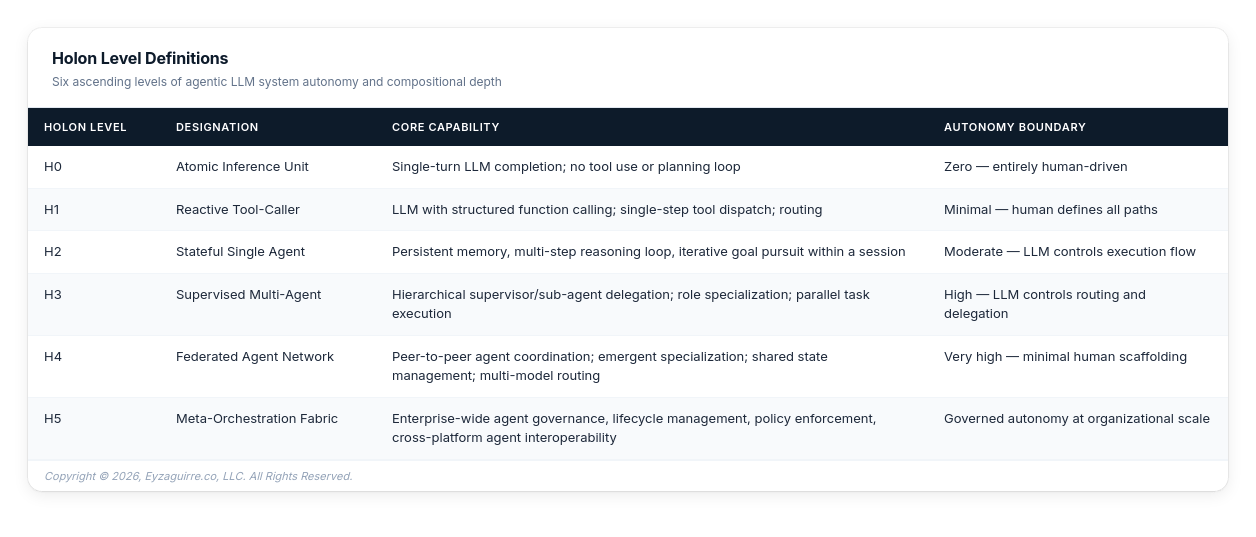
The following taxonomy defines six holon levels (H0–H5) representing ascending degrees of systemic autonomy, compositional depth, and inter-agent complexity. Each level inherits all capabilities of levels below it.
Holon Level Designation Core Capability Autonomy Boundary
Section 2: Holon Level Technical Specifications
H0 — Atomic Inference Unit
The fundamental indivisible holon. A single LLM inference call with no persistent state, no tool integration, and no planning loop. The human operator drives every iteration. This level corresponds to the Basic Responder pattern in agentic maturity models. While commercially essential, H0 systems exhibit “little control over program flow” and require continuous human steering for multi-step tasks. The Chat Completions API (OpenAI), raw Anthropic Messages API, and Google Gemini API in their simplest forms operate at this level.
Key Characteristics:
Stateless between calls
No tool execution
No goal persistence
Output is final; iteration requires new human prompt
Latency and cost are minimized
H1 — Reactive Tool-Caller
The first functional holon that exhibits genuine agency. An H1 system uses function calling or structured tool dispatch to interact with external systems—APIs, databases, web search, code interpreters—but does not maintain a planning loop across turns. The LLM decides which tool to call and what arguments to pass, but the overall flow remains deterministic or human-defined. The Router Pattern described by Chawla (2025) and the OpenAI Responses API built-in tools (web search, file search, code interpreter) operate at this level. The Model Context Protocol (MCP), open-sourced by Anthropic in November 2024 and adopted as the de-facto standard for tool connectivity, operates at this interface layer.
Key Characteristics:
Tool selection is LLM-determined
Single reasoning-act-observe cycle
No persistent memory across sessions
MCP provides standardized tool discovery and invocation20
As of July 2025, the MCP ecosystem covers over 4,000 servers across 40+ categories
H2 — Stateful Single Agent
The first true holonic agent. An H2 system maintains persistent state across turns, executes a perception-reasoning-action loop, and pursues a multi-step goal within a bounded session. IDC defines this level as the canonical AI agent: “LLM-powered autonomous software entities that perceive their environment, reason, make decisions, act upon them, and interact with users or other systems in a manner like a human”.
Key technical properties include: session-scoped context management, iterative refinement of outputs, tool-use integration with error recovery, and optionally, persistent memory across sessions (episodic and semantic). Browser-based agents (Level 2 in Furze’s taxonomy) and long-horizon coding agents (Claude Code in single-session mode) operate here. Anthropic’s Managed Agents architecture formalizes H2 via decoupled “brain” (model + harness), “hands” (sandbox), and “session” (append-only log of events) interfaces.
Key Characteristics:
Append-only session event log
Tool call loop with error recovery
Optional episodic memory (Mem0, Redis, vector stores)
Bounded execution environment (sandbox)
Human-in-the-loop escalation paths
H3 — Supervised Multi-Agent
The first compositional holon level. An H3 system employs a supervisor agent that decomposes complex goals, delegates atomic sub-tasks to specialized collaborator agents, and synthesizes results. Each sub-agent is itself an H2 holon—autonomous within its scope—but surrenders goal-setting authority to the supervisor. This is the dominant production pattern as of 2026.
Anthropic’s Claude Managed Agents Multi-Agent Orchestration capability, released in May 2026, allows a lead agent to spin up up to 20 specialist sub-agents in parallel, each with isolated session threads, with delegation restricted to one level of depth. Amazon Bedrock Multi-Agent Collaboration (GA, March 2025) implements the same hierarchical model: a supervisor agent routes to collaborator agents, each equipped with its own action groups and knowledge bases. OpenAI’s Agents SDK supports both Handoffs (specialist takes conversational ownership) and Agents-as-Tools (specialist executes bounded subtask, manager retains ownership) as the two canonical H3 patterns.
Key Characteristics:
Supervisor/sub-agent delegation hierarchy
Role specialization and tool partitioning
Parallel task fan-out and synthesis
Context isolation between sub-agents
Maximum delegation depth: typically 1–2 levels in current platforms2928
H4 — Federated Agent Network
Beyond fixed hierarchy, H4 systems enable peer-to-peer agent coordination with emergent role assignment and shared task management. Claude Code’s Agent Teams feature (shipped February 2026) exemplifies this: multiple agents share a task list, communicate in real time, and coordinate cross-cutting changes (e.g., a backend agent notifying a frontend agent of an API contract change). The 25,000-task experimental study confirms that this self-organizing protocol outperforms centralized hierarchy by 14%. Anthropic demonstrated using 16 agents running concurrently to build an entire C compiler via this pattern.
Emergent behavioral properties at H4 include voluntary abstention (agents declining tasks outside their competence), spontaneous specialization (agents developing domain expertise without pre-assignment), and shallow hierarchy formation (agents organically structuring themselves). These properties scale with base model capability—weaker models still benefit from externally imposed structure.
Key Characteristics:
Peer-to-peer inter-agent messaging
Shared state and task lists
Dynamic (not pre-assigned) role formation
Emergent specialization from capable base models
Higher coordination overhead; requires capable models (Claude Opus, GPT-4-class)
H5 — Meta-Orchestration Fabric
The enterprise governance holon. H5 systems provide organization-wide lifecycle management of the entire agent ecosystem: fleet deployment, policy enforcement, identity and access control, observability, audit trails, and model governance. This level does not introduce new agent capability per se but provides the holarchic membrane that governs the boundary conditions of all lower-level holons operating within an enterprise.
Key functions at H5 include: centralized agent registry, role-based access control (RBAC) for agent permissions, continuous behavioral monitoring and drift detection, regulatory compliance frameworks, and cross-vendor interoperability via open protocols (MCP, A2A). McKinsey’s 2026 AI Trust Maturity Survey identifies “nearly two-thirds” of organizations citing security and risk concerns as the top barrier to scaling agentic AI, confirming that H5 capability gaps are the primary enterprise bottleneck. Organizations with explicit AI governance ownership score 2.6 vs. 1.8 on maturity indices compared to those without.
Key Characteristics:
Enterprise agent registry and catalog
Identity federation for agents (OAuth, RBAC, Entra ID)
Continuous behavioral monitoring and guardrails
Multi-vendor agent interoperability
Compliance and audit logging at fleet scale
Human-in-the-loop escalation governance
Section 3: Vendor Taxonomy and Grading Framework
3.1 Grading Methodology
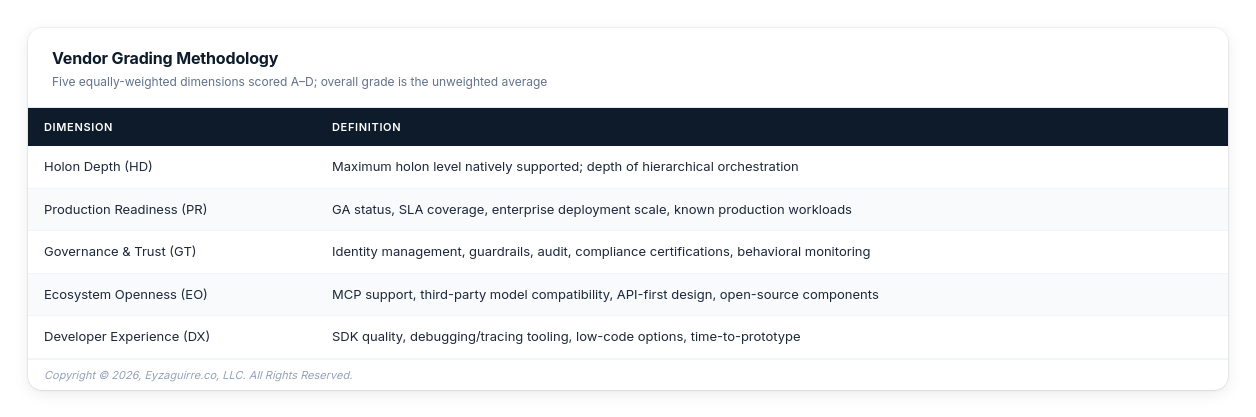
Each vendor is evaluated across five dimensions, each scored A through D, weighted equally to produce an overall grade:
Dimension Definition Holon Depth (HD) Maximum holon level natively supported; depth of hierarchical orchestration Production Readiness (PR) GA status, SLA coverage, enterprise deployment scale, known production workloads Governance & Trust (GT) Identity management, guardrails, audit, compliance certifications, behavioral monitoring Ecosystem Openness (EO) MCP support, third-party model compatibility, API-first design, open-source components Developer Experience (DX) SDK quality, debugging/tracing tooling, low-code options, time-to-prototype
Section 4: Vendor Profiles and Grades
4.1 Hyperscaler Platforms (H3–H5 Capable)
Microsoft Azure AI Foundry / Copilot Studio
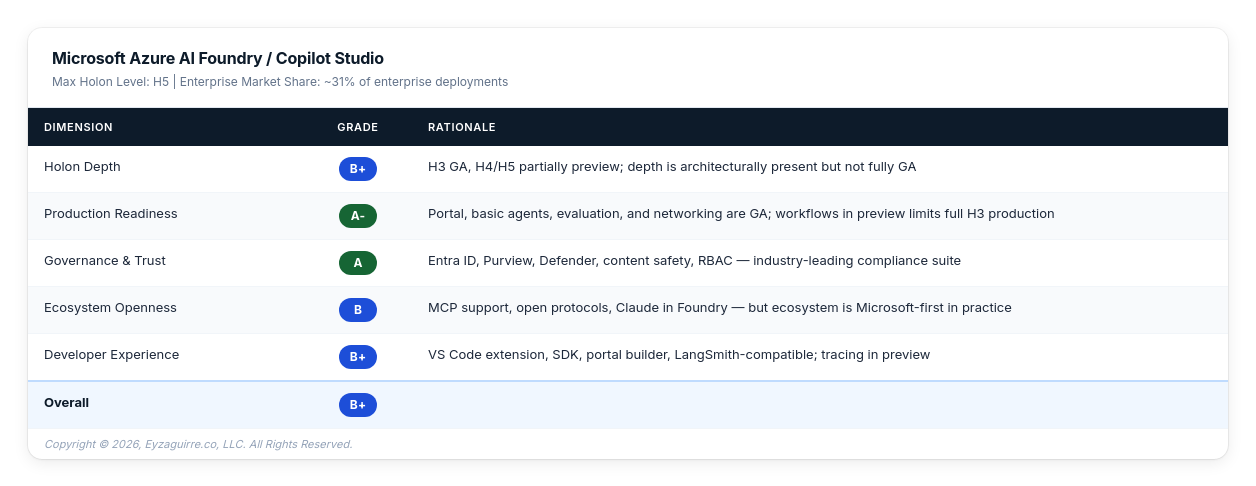
Max Holon Level: H5 | Enterprise Market Share: ~31% of enterprise deployments4
Microsoft Foundry became generally available in March 2026, delivering a unified portal for agent build, deploy, and governance. The Foundry Agent Service (GA) supports basic agents with code interpreter, file search, function calling, and Azure AI Search. Workflow agents (multi-agent orchestration, human-in-the-loop) remain in preview as of May 2026. Advanced memory, agent-to-agent communication, and managed virtual networking are similarly preview-stage. The platform integrates deeply with Microsoft’s identity stack (Entra ID, RBAC) and compliance infrastructure (Microsoft Purview, Defender for Cloud), giving it the strongest enterprise governance foundation of any vendor. Copilot Studio extends agents natively into Microsoft 365 (Teams, Outlook, SharePoint). LangGraph Cloud and Claude models are supported as first-class options within Foundry Models.
Google Gemini Enterprise Agent Platform (formerly Vertex AI)
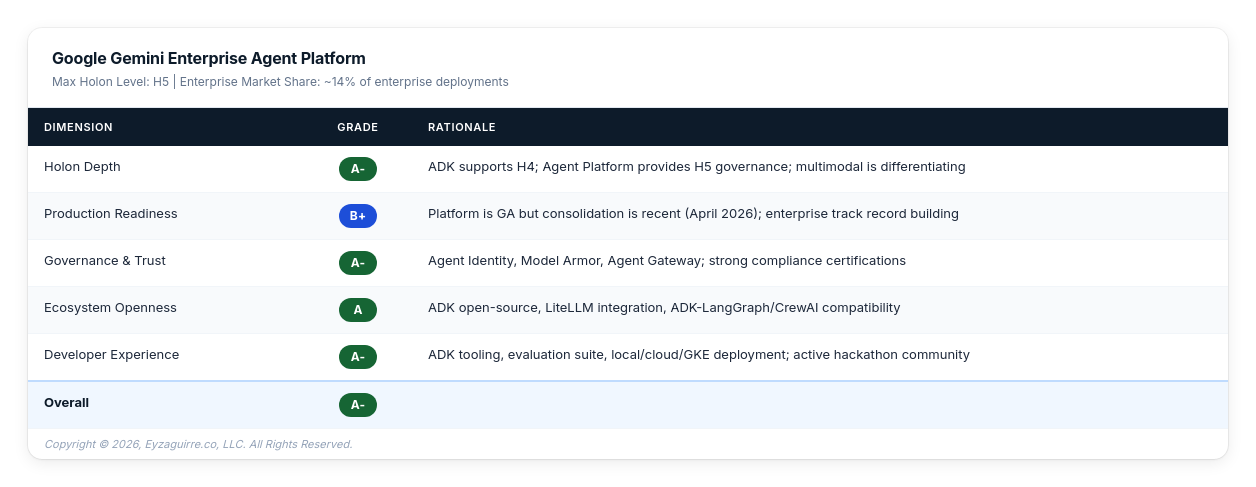
Max Holon Level: H5 | Enterprise Market Share: ~14% of enterprise deployments4
Announced at Google Cloud Next in April 2026, the Gemini Enterprise Agent Platform consolidates Agent Builder, ADK, and Vertex AI into a unified “Build, Scale, Govern, Optimize” architecture. The platform supports multimodal agents (text, image, audio, video), over 200 foundation models via Model Garden, and integrates native governance through Agent Identity (granular permissions) and Agent Gateway with Model Armor (runtime policy enforcement). Google’s Agent Development Kit (ADK), open-sourced at Cloud Next 2025, supports sequential, parallel, and LLM-routed multi-agent orchestration and is compatible with LangGraph, CrewAI, and LiteLLM. ADK enables bidirectional streaming for multimodal interactions, a differentiator for voice and video agents. Google Cloud compliance (ISO 27001, SOC 1/2/3, GDPR, HIPAA) is well-documented.
AWS Bedrock / AgentCore
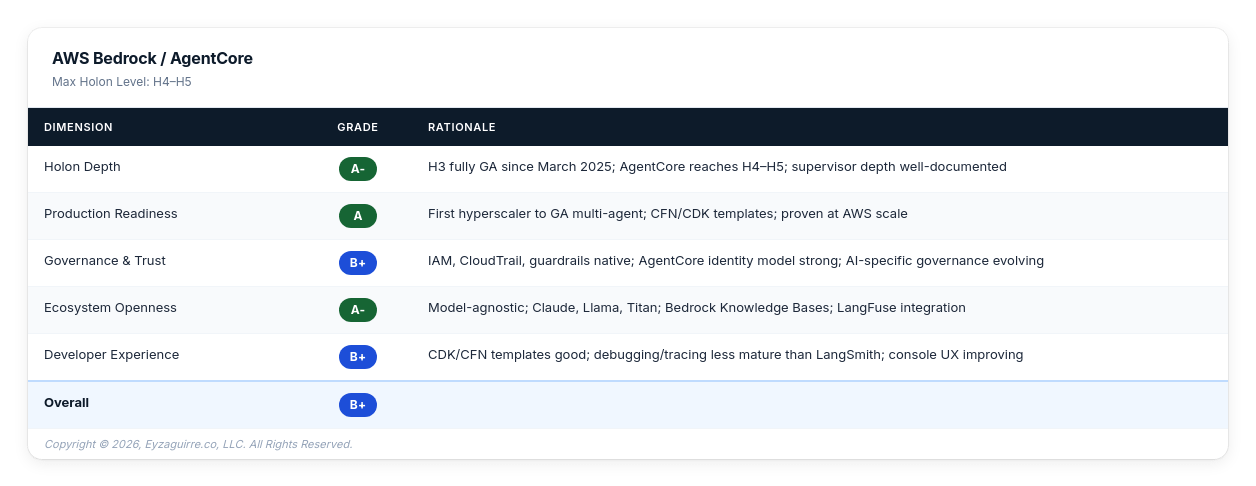
Max Holon Level: H4–H5
Amazon Bedrock Multi-Agent Collaboration reached General Availability in March 2025, making it the earliest GA multi-agent platform among hyperscalers. The architecture supports supervisor/collaborator hierarchies, inline agents (runtime role adjustment), Payload Referencing (reducing supervisor-to-subagent data transfer), and CloudFormation/CDK deployment templates for reusable agent teams. AgentCore (introduced at re:Invent 2025) adds a modular runtime, identity model (IAM/Cognito), and API gateway (up to 1,000 tools per gateway) for enterprise-scale agent deployment. Memory management with event, session, and agent scopes is supported. Bedrock’s model agnosticism—supporting Anthropic Claude, Meta Llama, Mistral, Amazon Titan, and others—provides strong ecosystem breadth. Integration with AWS security primitives (IAM, VPC, CloudTrail) gives it mature governance infrastructure.
4.2 Model Provider Platforms (H2–H4 Native)
Anthropic Claude Managed Agents
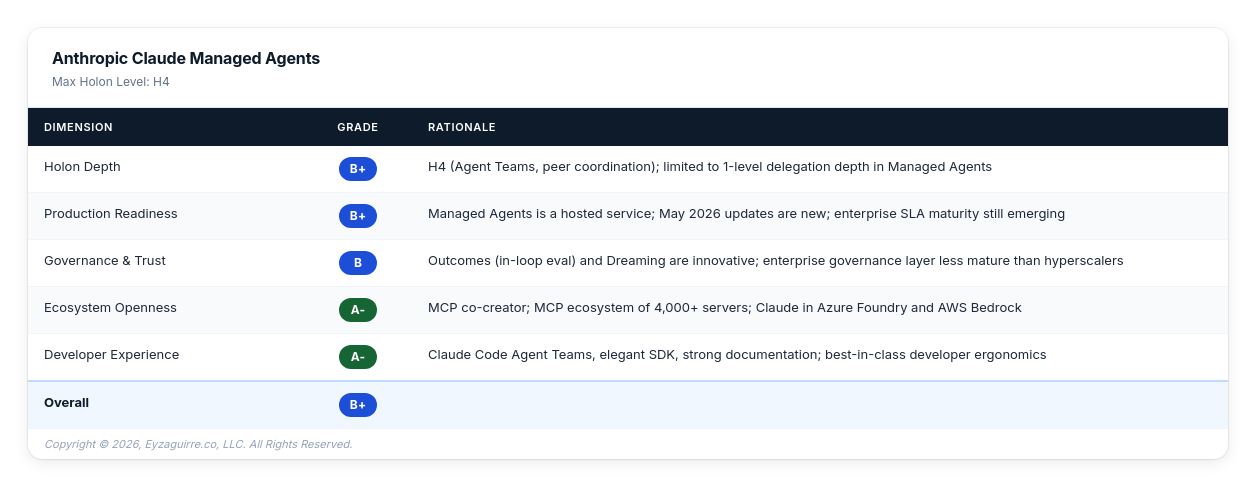
Max Holon Level: H4
Anthropic’s Managed Agents platform, launched in early 2026 and significantly expanded in May 2026 with Dreaming (reflective memory curation), Outcomes (rubric-based in-loop evaluation), and Multi-Agent Orchestration (coordinator + up to 20 parallel specialist sub-agents), represents the most architecturally elegant H3–H4 implementation currently available. The “brain/hands/session” decoupling architecture enables session-persistent, fault-tolerant agent operation with swappable harnesses and sandboxes. All agents share a filesystem but maintain context-isolated session threads; threads are persistent across coordinator follow-ups. The key current limitation is that delegation is limited to one level of depth—sub-agents cannot spawn their own sub-agents. This constrains deep holarchic composition, capping practical H4 deployment. The platform offers a fully-hosted runtime (memory and orchestration on Anthropic infrastructure), which simplifies deployment but raises enterprise data sovereignty concerns.
OpenAI Agents SDK / Responses API
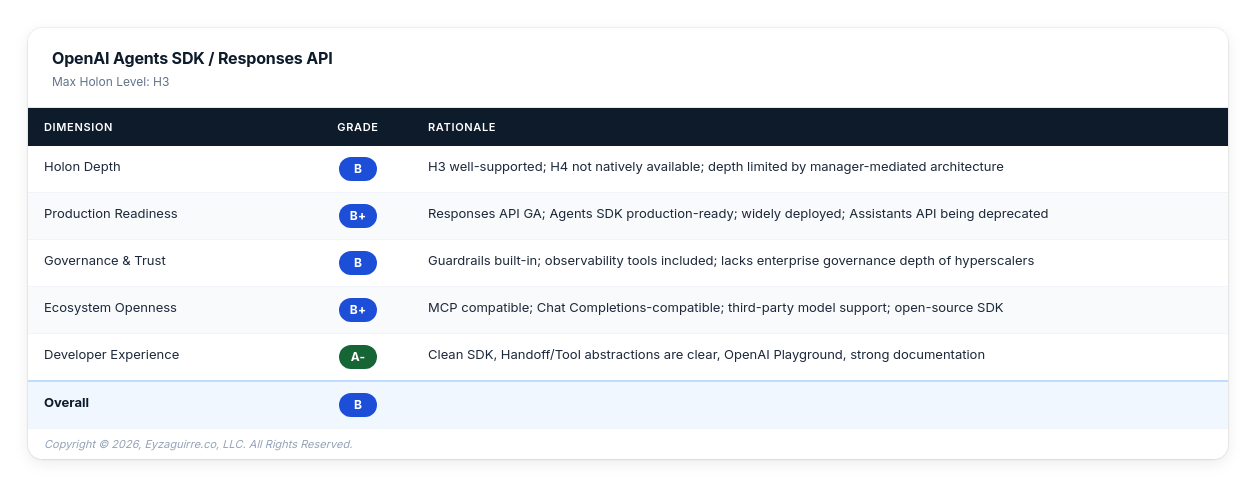
Max Holon Level: H3
OpenAI launched the Responses API and Agents SDK in March 2025, superseding the experimental Swarm framework. The Agents SDK formalizes H3 orchestration through two canonical patterns: Handoffs (specialist ownership transfer) and Agents-as-Tools (specialist called as bounded capability by manager). Built-in tools (web search, file search, computer use) are embedded at the API level, removing the need for external tool integration at H1–H2. The SDK includes built-in observability (traces, visualization), guardrails for input/output filtering, and compatibility with any Chat Completions-style API. The platform supports all current OpenAI models (o3, GPT-4o, etc.) and third-party providers. Peer-to-peer coordination (H4) is not a native construct in the current SDK; agent communication is mediated through the manager layer. The OpenAI Swarm remains available as an educational/prototype resource but is explicitly not recommended for production.
4.3 Enterprise Application Platforms (H3–H5 Domain-Specific)
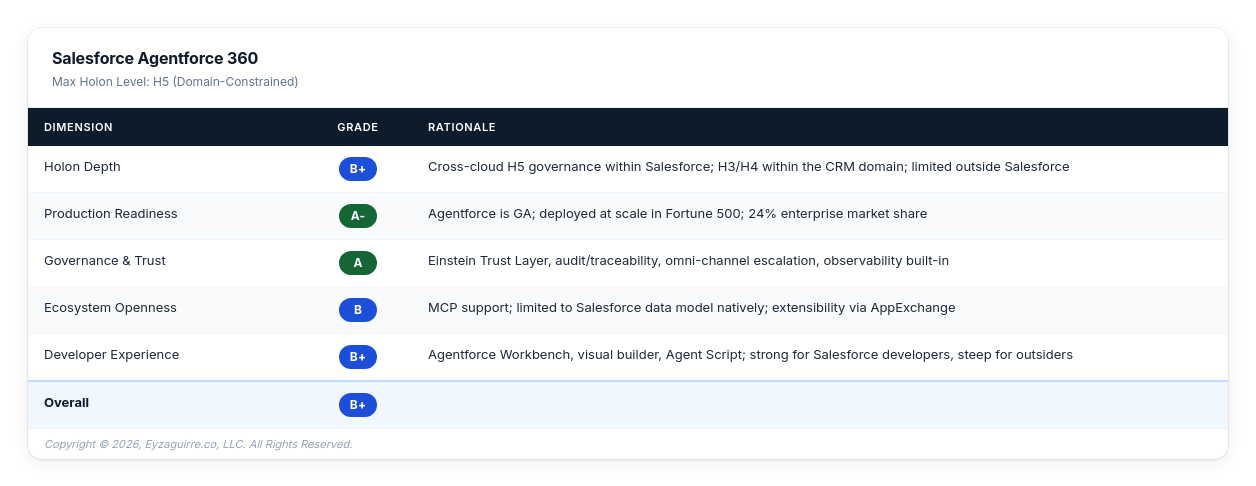
Salesforce Agentforce 360
Max Holon Level: H5 (Domain-Constrained)
Salesforce’s Agentforce 360, announced at Dreamforce 2025, is the most comprehensive domain-specific H5 implementation in the market. The platform spans Sales, Marketing, Commerce, Slack, Tableau, and MuleSoft through a unified cross-cloud agentic fabric, with agents sharing models, context, and governance across all Salesforce clouds. The Einstein Trust Layer enforces data masking, output filtering, and policy controls before any agent action executes, providing the strongest built-in domain governance of any non-hyperscaler. The Agent Script feature enables hybrid deterministic/LLM reasoning, allowing enterprises to specify exact logic for sensitive steps while delegating flexible reasoning elsewhere. MCP support enables cross-vendor agent interoperability. Limitations: agents are deeply coupled to the Salesforce data model; cross-CRM orchestration requires extensive customization; off-platform use cases are not well served.
ServiceNow (Now Assist / Otto)
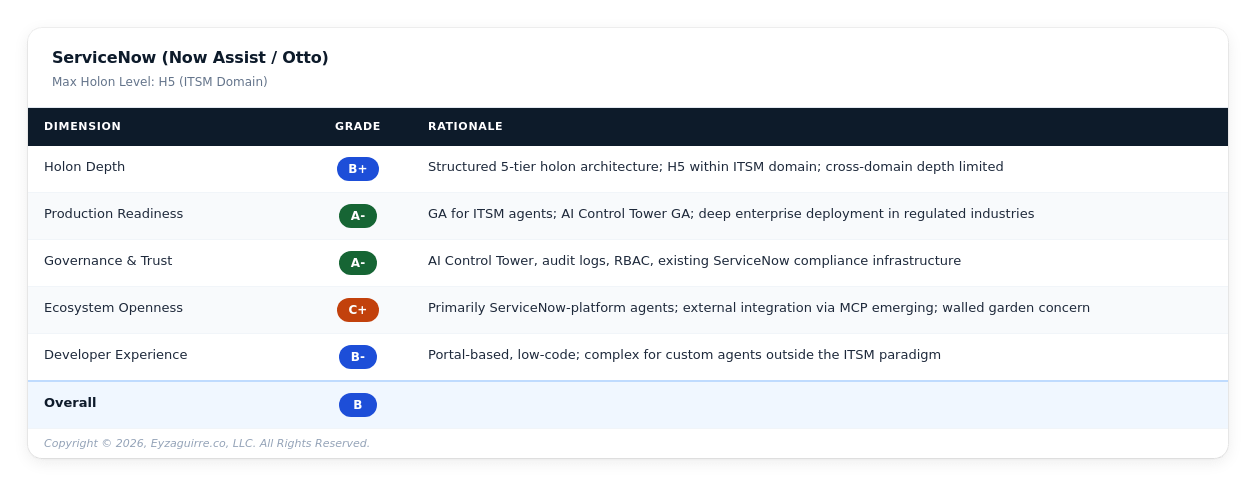
Max Holon Level: H5 (ITSM Domain)
ServiceNow’s agentic architecture, evolved through the Xanadu and Washington releases and unified under Otto (announced May 2026), implements a structured holon hierarchy: Triggers → Communication Agents → Orchestrators → Work Agents → Tools. The orchestrator agent creates execution plans, dispatches work agents in parallel, and compiles results for the communicator agent. The AI Control Tower provides the H5 governance membrane—centralized visibility, policy enforcement, and audit across the agent fleet. Otto integrates Now Assist, Moveworks (acquired), and the agentic platform into a single “AI-native architecture” for enterprise work completion. The key structural advantage: ServiceNow already runs the workflows underneath—approval chains, CMDB, permissions—so agents execute against real enterprise process infrastructure rather than abstracting over external APIs.
IBM watsonx Orchestrate
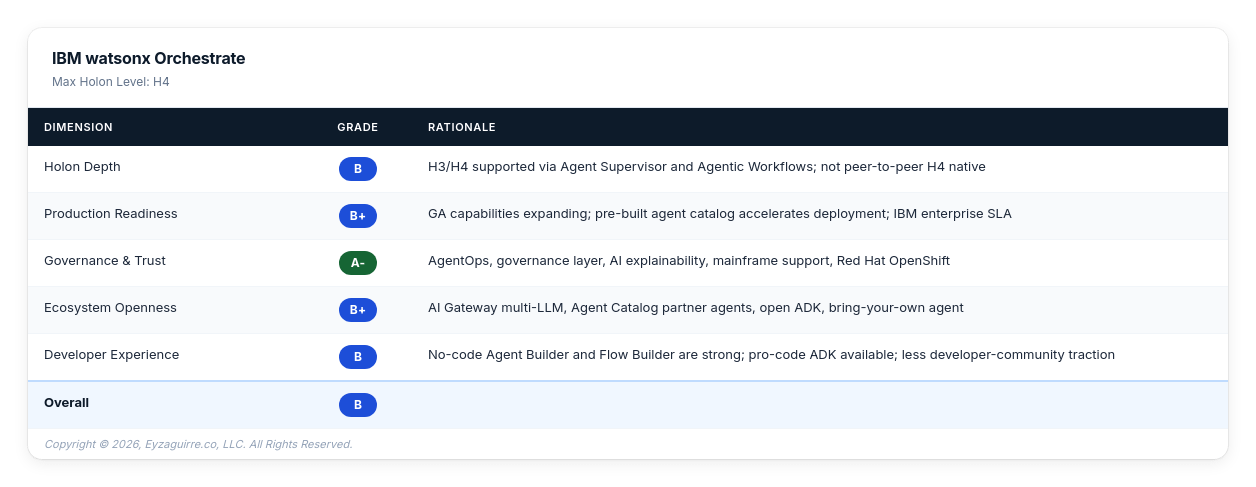
Max Holon Level: H4
IBM’s watsonx Orchestrate (WXO) is purpose-built for large-enterprise automation of knowledge work in HR, procurement, finance, and customer service. The October 2025 update introduced AgentOps (observability and governance), Agentic Workflows (reusable multi-agent flows), and Langflow integration. The Agent Supervisor capability routes tasks to specialized agents and enables inter-agent context sharing. The AI Gateway provides flexible LLM routing across IBM Granite, Claude, Mistral, Llama, and external models. The Agent Catalog includes 150+ pre-built agents from IBM and partners including Box, Mastercard, Oracle, Salesforce, and ServiceNow. WXO’s key differentiator is its governance-first design: AI explainability, Red Hat OpenShift deployment, and integration with IBM’s mainframe ecosystem (watsonx Assistant for Z) give it unique penetration in regulated industries (banking, insurance, government).
4.4 Open-Source Orchestration Frameworks (H2–H4 Developer Tools)
LangChain / LangGraph
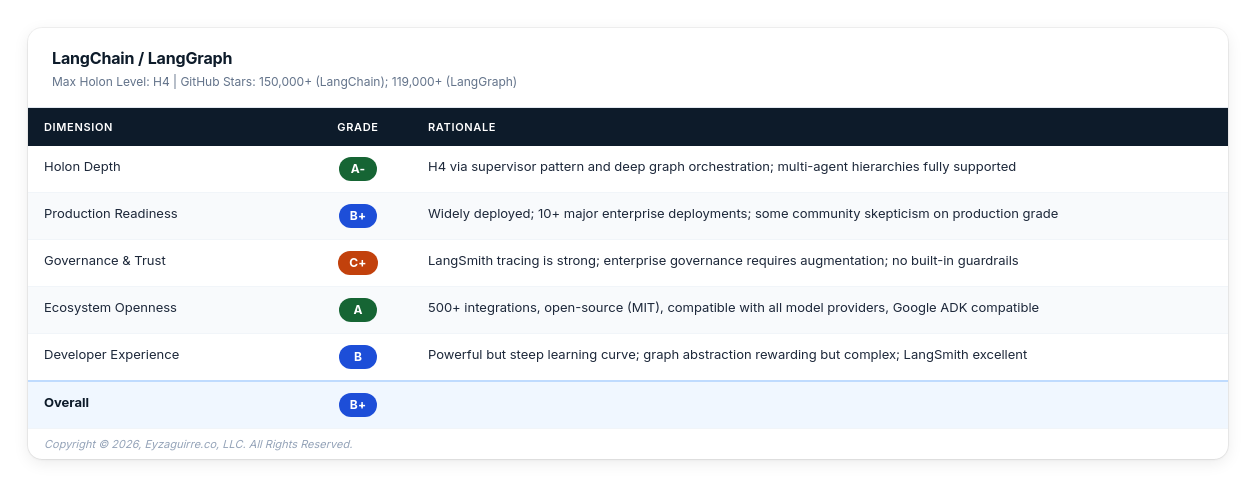
Max Holon Level: H4 | GitHub Stars: 150,000+ (LangChain); 119,000+ (LangGraph)618
LangGraph is the de-facto stateful orchestration engine for production AI agent development in 2026. Its graph-based execution model—where nodes represent processing steps and edges define state transitions—provides fine-grained control over execution flow with explicit state management. Key production advantages include 40–50% LLM call savings on repeat requests via stateful caching, native checkpointing for fault tolerance, human-in-the-loop interruption, and token-by-token streaming. LangGraph supports single-agent, multi-agent, and hierarchical architectures from one framework. LangSmith is the native observability product; LangGraph Cloud provides managed deployment. Production deployments at Klarna, Cisco, and Vizient (among 10+ documented major enterprises) confirm H3/H4 viability. Key limitation: the open-source framework itself does not generate direct revenue, and the business model remains under pressure.
CrewAI
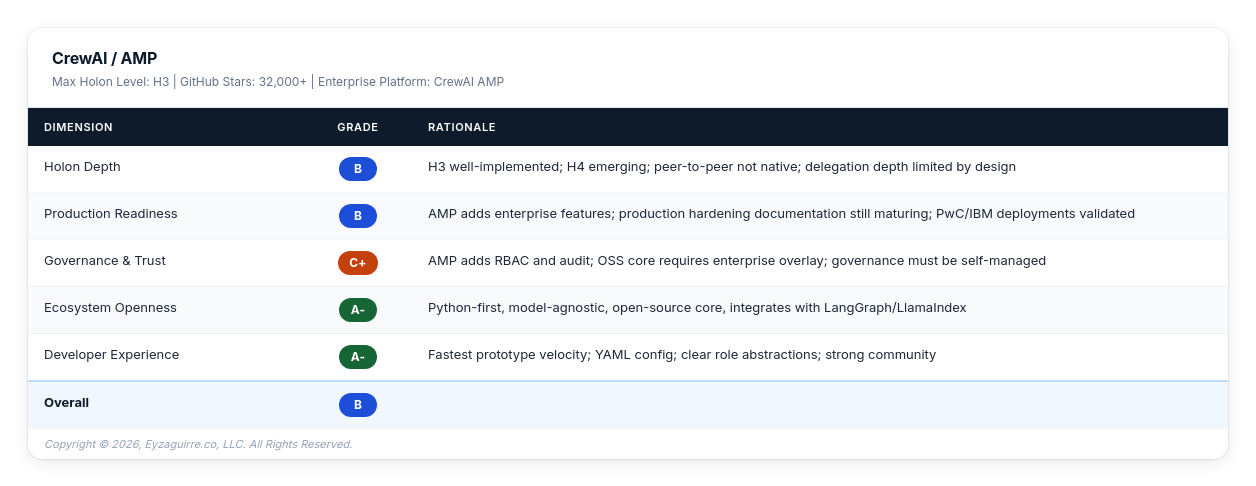
Max Holon Level: H3 | GitHub Stars: 32,000+ | Enterprise Platform: CrewAI AMP
CrewAI provides the fastest path to multi-agent prototypes (2–4 hours from setup to working demo) through its role-based agent abstraction: each agent has a Role, Goal, and Backstory that shapes its reasoning. CrewAI supports sequential, hierarchical, and custom task coordination patterns, with the hierarchical model using a manager agent for dynamic task delegation. CrewAI AMP (the enterprise platform) adds centralized management, monitoring, audit logs, RBAC, serverless scaling, and human-in-the-loop training. Production deployments at IBM, PwC, and Gelato are documented. The 2026 State of Agentic AI Survey (500 C-level executives) reports that 100% of surveyed enterprises plan to expand agentic AI in 2026, with governance and integration cited as primary platform requirements. CrewAI’s Python-first design and YAML-configurable agents make it accessible to engineering teams; true enterprise hardening requires additional work.
Microsoft AutoGen / Semantic Kernel
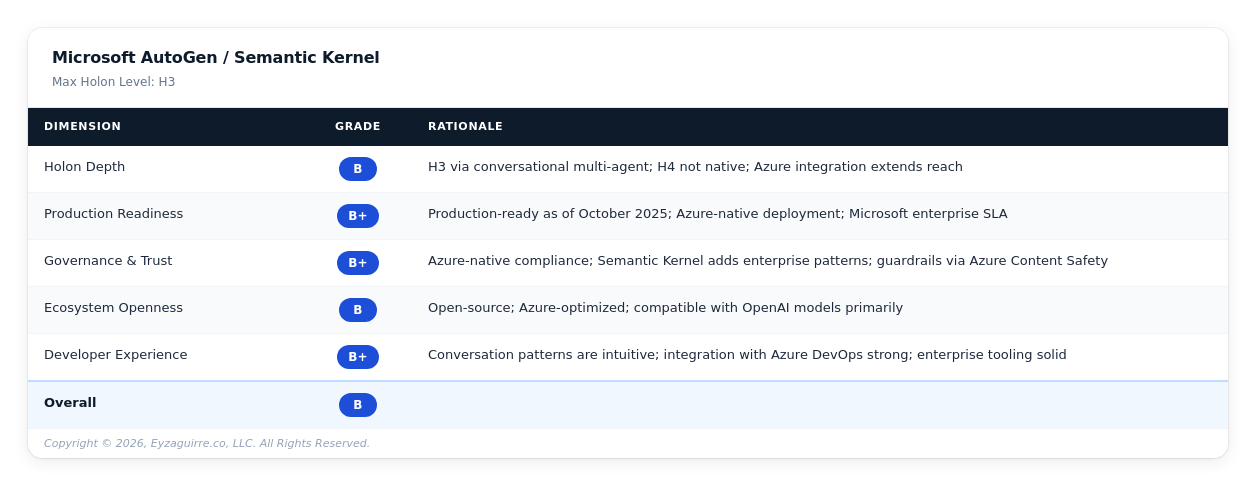
Max Holon Level: H3
Microsoft AutoGen merged with Semantic Kernel in October 2025 to form the Microsoft Agent Framework, combining multi-agent conversational orchestration with enterprise code-generation foundations. AutoGen’s conversation-driven architecture excels at interactive, dialogue-unpredictable applications (customer-facing, research); Semantic Kernel’s enterprise patterns provide structured workflow support. The combined framework is well-positioned for Azure-native deployments and integrates naturally with Microsoft Foundry. Peer-to-peer coordination (H4) is not architecturally native; the framework is optimized for hub-and-spoke manager patterns.
LlamaIndex (Workflows)
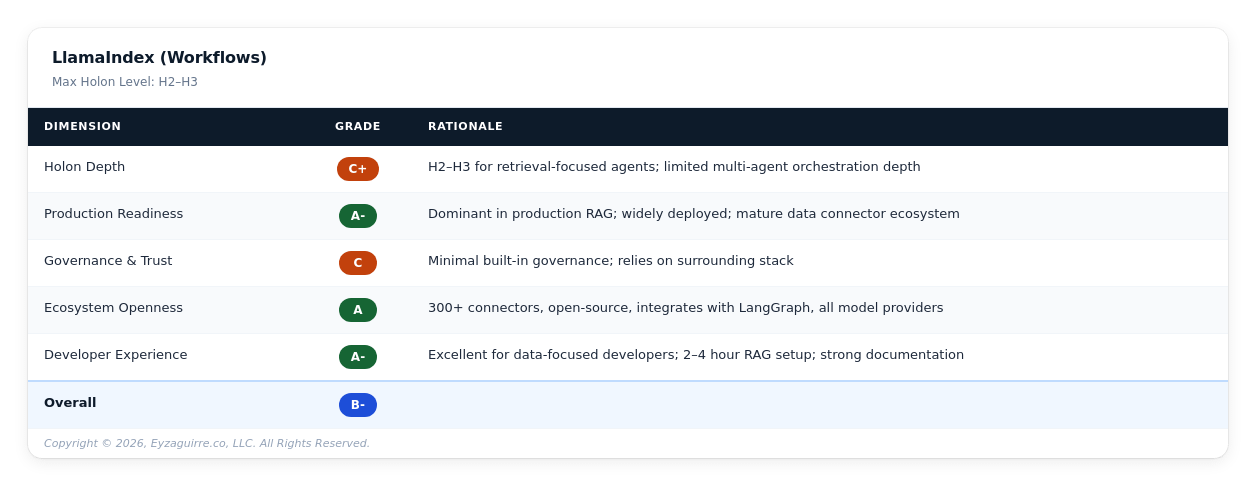
Max Holon Level: H2–H3
LlamaIndex dominates the retrieval-augmented generation (RAG) and data-intensive agent segment. Its Workflows component added multi-agent support for complex multi-step agent tasks. In the dominant production pattern, LlamaIndex handles the retrieval layer while LangGraph handles orchestration—complementary rather than competing. GitHub stars: 44,000+ with 300+ data connectors. LlamaIndex is “more data-centric than general orchestration,” making it less suitable for pure coordination tasks outside retrieval-heavy workflows.
4.5 Memory and Supporting Infrastructure
Mem0 (Memory Layer)
Max Holon Level: Supporting H2–H4 | GitHub Stars: 48,000 | Series A: $24.5M (October 2025)
Mem0 is the leading dedicated memory provider for agentic systems, operating as a supporting holon that enables state persistence across the holarchy. Its three-tier memory architecture (user scope, session scope, agent scope) backed by a hybrid store (vector + graph + key-value) enables contextual memory across all holon levels. API call volume grew from 35 million (Q1 2025) to 186 million (Q3 2025)—~30% month-over-month growth—and Mem0 is the exclusive memory provider for AWS’s Agent SDK. As a specialist supporting infrastructure holon, Mem0 exemplifies the holonic principle of composability: it is simultaneously a complete memory service and a subordinate component within larger agent architectures.
4.6 Observability Infrastructure
Langfuse / LangSmith / AgentOps
Observability is the boundary membrane of the enterprise agent holarchy—the mechanism by which the H5 governance layer perceives the internal state of H2–H4 holons below it. Three vendors dominate:
Langfuse (acquired by ClickHouse, 2025): Open-source (MIT), 19 Fortune 50 clients, ~15% tracing overhead, covers LLM observability, evals, prompt management
LangSmith: Native to LangChain/LangGraph; distributed tracing with nested spans; the default for LangGraph deployments
AgentOps: Purpose-built for multi-agent systems; 400+ framework integrations including CrewAI, OpenAI Agents SDK, AutoGen, and Google ADK; ~12% overhead
The competitive threat to pure-play observability vendors is significant: Datadog, Dynatrace, and New Relic are moving into AI observability to prevent customer attrition, leveraging existing enterprise relationships and APM budgets.
Section 5: Consolidated Vendor Scorecard
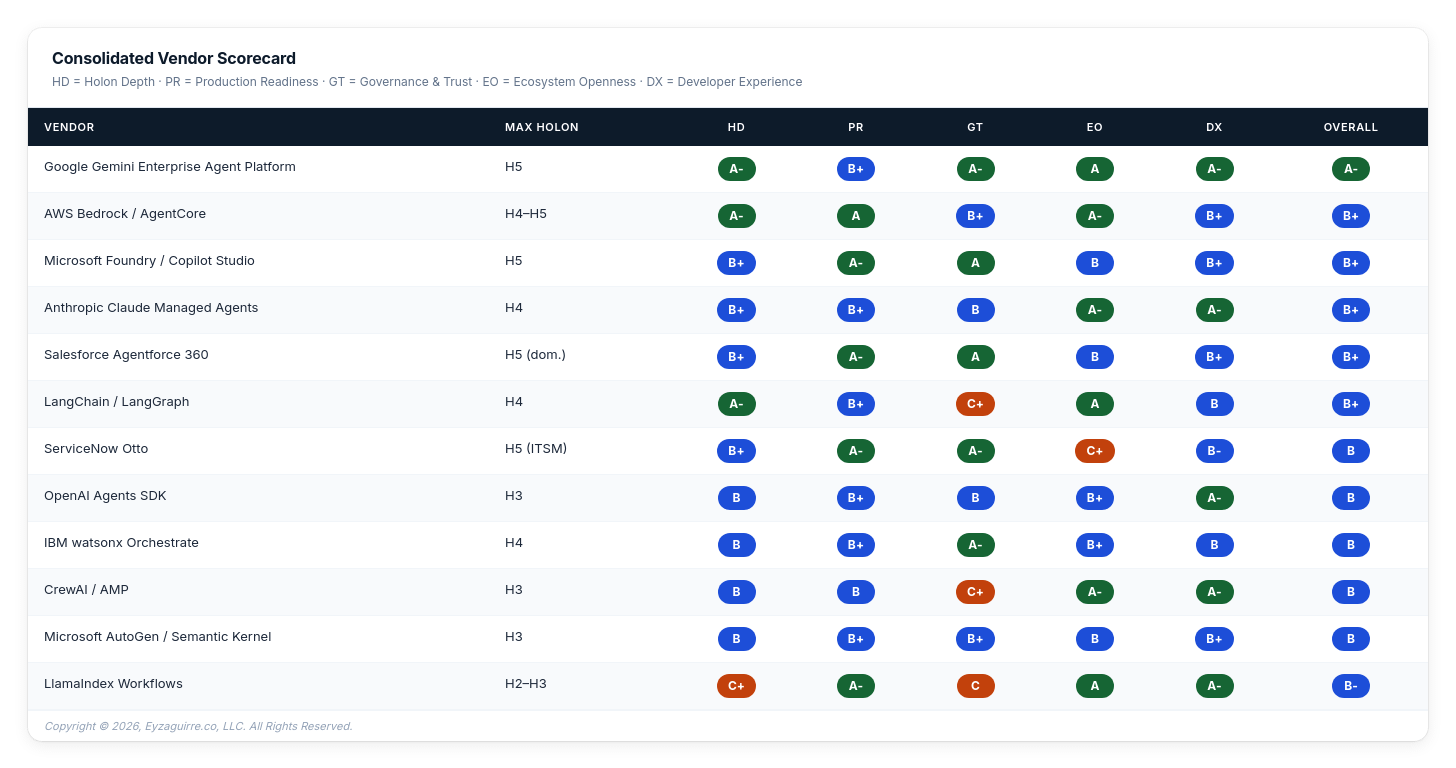
HD = Holon Depth | PR = Production Readiness | GT = Governance & Trust | EO = Ecosystem Openness | DX = Developer Experience
Section 6: Structural Market Observations
6.1 The MCP Standardization Effect
The Model Context Protocol, open-sourced by Anthropic in November 2024 and adopted as the de-facto tool connectivity standard, has fundamentally changed the H1 tool-calling landscape. With over 4,000 MCP servers across 40+ categories as of July 2025, and MCP code execution enabling agents to use context more efficiently by loading tools on demand, the protocol operates as the standardized boundary interface of the H1 holon—its specification is architecturally equivalent to Koestler’s “boundary membrane” in that it defines what can enter and exit the tool-calling layer.
6.2 The Delegation Depth Ceiling
A critical structural limitation across all current platforms is the one-level delegation depth ceiling. Claude Managed Agents, OpenAI Agents SDK, and AWS Bedrock all restrict sub-agent spawning to a single level below the coordinator. This architectural constraint directly caps H4 deployment, preventing true deep holarchic composition. The research literature confirms this is a current model capability limitation rather than a platform design choice—the ManyIH benchmark shows frontier models struggling with 12-level instruction hierarchies—suggesting that delegation depth ceilings will expand as base model capability improves.
6.3 The Governance Gap
McKinsey’s 2026 AI Trust Maturity Survey finds that only ~30% of organizations score Level 3+ in agentic AI governance, and “nearly two-thirds cite security and risk concerns as the top barrier to scaling”. This positions H5 governance capability as the primary enterprise bottleneck and primary vendor differentiation vector for 2026–2028. Vendors with built-in governance (Microsoft Foundry, Salesforce Einstein Trust Layer, ServiceNow AI Control Tower, IBM AgentOps) are structurally advantaged for regulated industry penetration. The Agentic Trust Framework published by the Cloud Security Alliance (CSA) defines 25 normative controls and a four-level maturity model as the emerging governance standard.
6.4 The Commoditization Threat
At H1–H2 (tool-calling and single-agent), rapid commoditization is underway. The 20+ “alternative orchestration frameworks” that launched in 2024 are being displaced by the ecosystem gravity of LangChain/LlamaIndex and the built-in tool capabilities of hyperscaler and model provider APIs. The real competitive moat in 2026 sits at H3–H5: deep stateful multi-agent composition, enterprise governance, and domain-specific workflow integration. Vendors that cannot demonstrate differentiated value at H3+ are at structural risk of displacement by foundation model providers expanding upstack.
6.5 Market Concentration
Enterprise deployment is concentrating rapidly: Microsoft (31%), Salesforce (24%), Anthropic (18%), Google (14%), ServiceNow (7%) account for 94% of enterprise agentic AI deployments. Open-source frameworks (LangChain, CrewAI) provide the innovation substrate but have not converted ecosystem adoption into proportional revenue. The pattern—open-source frameworks capture developer mindshare while hyperscalers and domain platforms capture enterprise spend—mirrors historical SaaS ecosystem dynamics.
Section 7: Forward-Looking Considerations
7.1 Model Capability as the Rate Limiter
The holarchic depth of practical deployments is constrained by model capability, not platform architecture. The finding that “as foundation models improve, the scope for autonomous coordination will expand” means the H4–H5 vendor landscape will be reshaped by the next generation of base models. Vendors that have built platform architecture flexible enough to absorb improved models (Anthropic’s meta-harness design, Google’s LiteLLM-compatible ADK) are better positioned than those coupled tightly to current-generation model capabilities.
7.2 The A2A Protocol Emerging Layer
Beyond MCP (tool connectivity), the Agent-to-Agent (A2A) protocol, introduced by Google and gaining cross-vendor traction in 2025–2026, targets the H4–H5 inter-agent communication layer. A2A provides standardized agent discovery, capability advertisement, and secure task delegation between agents from different vendors—functionally equivalent to the “context graph” layer in holonic architecture. Vendors that adopt A2A will enable cross-vendor holarchic composition; those that do not will create governance and interoperability risks at the H5 boundary
7.3 Outcome-Based Pricing as H5 Signal
The shift from seat-based to outcome-based pricing (per-agent-task, per-result), observed across Salesforce Agentforce, CrewAI AMP, and emerging in AWS Bedrock metering, signals the maturation of the agentic layer. When pricing is coupled to agent outcomes rather than model tokens, vendors are implicitly warranting H3+ orchestration quality—outcome guarantees require reliable multi-step task completion, which only H3+ systems can provide structurally.
Methodology Note
This taxonomy is constructed from primary vendor documentation, published research papers (arXiv), Perplexity.ai searches, and verified production deployment data as of May 2026. Vendor grades reflect capability assessments based on publicly available information; direct platform testing was not conducted. Market share data is sourced from the AgentMarketCap.ai 2026 Infrastructure Consolidation Map. IDC market sizing figures are sourced from IDC’s Worldwide AI and Generative AI Spending Guide Taxonomy and Digital Applied’s 2026 Agentic AI Statistics collection. Holonic theory citations draw on Koestler (1967), the DFKI Research Report on Holonic Multi-Agent Systems (1999), and Kurt Cagle’s living holonic graph model.69943
References
[DOC] Symposium „Ethics in modeling and simulation“ - Systems Theory
Holon - P2P Foundation Wiki - A holon is a system (or phenomenon) that is a whole in itself as well as a part of a larger system. ...
The Living Graph: Holons and the Four-Graph Model - The Ontologist - Koestler called this pattern a holon (from the Greek holos, whole, plus the suffix -on suggesting a ...
Agentic AI Statistics 2026: 150+ Data Points Collection - The definitive collection of 150+ agentic AI statistics for 2026 covering market size, adoption rate...
Agentic Ai Challenges And... - Discover the latest agentic AI statistics in 2026 including adoption, market size, data & workforce ...
Agentic AI Market Size, Share | Forecast Report [2026-2034] - The global agentic AI market size is projected to grow from $7.29 billion in 2025 to $139.19 billion...
State of AI trust in 2026: Shifting to the agentic era | Brendan Tierney - McKinsey’s latest survey discussion how most organisations are scaling AI faster than they can gover...
The Complete Guide to AI Agents for Developers - Daily.dev - By March 2026, 57% of organizations have AI agents running in production, an increase from 51% in 20...
[PDF] Research Report Holonic Multi-Agent Systems - A holonic multi-agent paradigm is proposed, where agents give up parts of their autonomy and merge i...
Paper page - Many-Tier Instruction Hierarchy in LLM Agents - We introduce Many-Tier Instruction Hierarchy (ManyIH) and the ManyIH-Bench benchmark, which evaluate...
Many-Tier Instruction Hierarchy in LLM Agents - arXiv - Large language model agents receive instructions from many sources—system messages, user prompts, to...
Drop the Hierarchy and Roles: How Self-Organizing LLM Agents ... - We present a 25,000-task computational experiment spanning 8 models, 4--256 agents, and 8 coordinati...
A Taxonomy of Agentic AI - Leon Furze - Explore the evolution of AI agents, their taxonomy, and implications for education. Understand the s...
5 Levels of Agentic AI Systems Explained: From Basic to Autonomous - The visual explains 5 levels of AI agency, starting from simple responders to fully autonomous agent...
5 Levels of Agentic AI Systems - by Avi Chawla - 5 Levels of Agentic AI Systems · 1) Basic responder · 2) Router pattern · 3) Tool calling · 4) Multi...
OpenAI Launches New API, SDK, and Tools to Develop ... - InfoQ - OpenAI has announced the new Responses API, the Agents SDK, and observability tools to address the c...
New tools for building agents: Responses API, web search, file ... - We released our first set of tools to help you accelerate building agents. These building blocks wil...
Code execution with MCP: building more efficient AI agents - Anthropic
MCPToolBench++: A Large Scale AI Agent Model Context Protocol MCP Tool Use Benchmark - LLMs’ capabilities are enhanced by using function calls to integrate various data sources or API res...
Agentic AI Applications, Tools, and Technologies, 2Q25 - IDC-Login - Abstract. This IDC Market Glance offers a high-level view of existing and emerging agentic AI applic...
What is AI Agent Orchestration? - IBM - AI agent orchestration is the process of coordinating multiple specialized AI agents within a unifie...
Scaling Managed Agents: Decoupling the brain from the hands - We also expect that Claude will require the ability to scale to many brains and many hands. We desig...
Use multi-agent collaboration with Amazon Bedrock Agents - Learn how to build a multi-agent collaboration team.
The Shift from LangChain to LangGraph: Production AI ... - LinkedIn - What we now call ‘LangChain’ in production environments has evolved into LangGraph, a stateful orche...
NOW ASSIST | Resolve a request with AI agents - AI agents streamline complex processes and resolve requests by analyzing problems in real time. When...
Anthropic Introduces Multi Agent Orchestration and Outcomes with ... - Anthropic also introducing Multi Agent Orchestration, Outcomes and Dreaming: Multi Agent Orchestrati...
Multiagent sessions - Claude API Docs - Multi-agent orchestration lets one agent coordinate with others to complete complex work. Agents can...
Orchestration and handoffs | OpenAI API - Learn how to orchestrate multiple agents with handoffs and agents-as-tools in the OpenAI Agents SDK.
AWS Launches New Agentic AI For Bedrock, ‘The Next Frontier In ... - AWS AI agents for Amazon Bedrock have new agentic AI innovation for automation as the cloud market l...
Amazon Bedrock now supports multi-agent collaboration - AWS - Discover more about what’s new at AWS with Amazon Bedrock now supports multi-agent collaboration
Multiple AI Agents Coding Together in Real Time - YouTube - Claude just shipped Agent Teams and it changes the game of AI coding. Instead of one agent doing eve...
The Bridge of Trust: Scaling Enterprise AI With Secure Governance - Learn how enterprise AI governance helps organizations close the trust gap, secure autonomous agents...
Five Questions Every AI Agent Must Answer | April 2026 - YouTube - As AI agents scale across enterprise environments, a consistent set of security requirements is emer...
Microsoft Foundry is GA Now | What You Can Use in Production ... - Microsoft Foundry and the Foundry Agent Service are now generally available as of March 2026, but no...
Microsoft Foundry - Empower agents to understand your business context. Securely ground AI apps and agents on your data ...
Microsoft Foundry docs: What’s new for April 2026 - Welcome! This article highlights key changes and updates in Microsoft Foundry documentation for Apri...
Best Enterprise AI Agent Platforms 2025–2026 - Sana Labs - The best-rated enterprise AI agents in 2025 are Sana (part of Workday), Microsoft Copilot Studio, Go...
Agent Platform overview | Gemini Enterprise Agent Platform - Gemini Enterprise Agent Platform is a unified platform to build, deploy, govern, and optimize enterp...
Introducing Gemini Enterprise Agent Platform | Google Cloud Blog - Gemini Enterprise Agent Platform is our new platform to build, scale, govern, and optimize agents. I...
Google Releases Open-Source Agent Development Kit for Multi ... - Next 2025, Google announced the Agent Development Kit (ADK), an open-source framework aimed at simpl...
Agent Development Kit | Gemini Enterprise Agent Platform - Agent Development Kit (ADK) is an open-source agent development framework that lets you build, debug...
Agent Development Kit Hackathon with Google Cloud: Build multi ... - In this hackathon, you’ll build autonomous multi-agent AI systems using Google Cloud and the open so...
AWS re:Invent 2025 - Architecting Scalable AI Agents using Amazon Bedrock AgentCore (TNC330) - Discover how to build powerful AI agents using Amazon Bedrock’s suite of tools, with a focus on Amaz...
AWS Bedrock Multi-Agent Blueprint - Blueprint for running AWS Bedrock Multi-Agent AI collaboration with CDK, Streamlit and LangFuse
Anthropic wants to own your agent’s memory, evals, and orchestration - The new capabilities — ‘Dreaming,’ ‘Outcomes,’ and ‘Multi-Agent Orchestration’ — aim to make agents ...
Openai swarm for agents and agent handoffs - API - Swarm is an educational resource for developers curious to learn about multi-agent orchestration. Sw...
GitHub - openai/swarm: Educational framework exploring ergonomic ... - Swarm focuses on making agent coordination and execution lightweight, highly controllable, and easil...
Dreamforce 2025: How Agentforce Is Leading the AI Strategy Shift - Dreamforce 2025 outlined a clear roadmap for Salesforce, where agents will serve as the connective t...
Agentforce 360 Platform – Agentic Capabilities - Salesforce - Design, deploy, and orchestrate AI agents on a single platform. Agentforce brings trusted, autonomou...
Welcome to the Agentic Enterprise: With Agentforce 360, Salesforce ... - Agentforce 360 Platform. Build and customize your Agentforce and Customer 360 with the Agentforce 36...
ServiceNow AI, Update April 2025 - JAVC Management & Consultancy - This article outlines key developments and expectations in the rapidly evolving world of AI—particul...
ServiceNow Otto Is Here to Finish the Work - The AI Economy - The company’s new AI experience unifies Now Assist, Moveworks, and its agentic platform into a singl...
Why Agentic AI Will Change the Way You Use ServiceNow ITOM to ... - As we navigate the first quarter of 2026, the conversation around enterprise technology has shifted ...
IBM adds new capabilities to watsonx Orchestrate to facilitate ...
watsonx Orchestrate - IBM - Watsonx Orchestrate brings AI agents together to automate work across apps and workflows, with centr...
IBM watsonx Orchestrate: Complete Platform Profile - AI Agents Guide - Comprehensive profile of IBM watsonx Orchestrate — IBM’s enterprise AI agent platform for automating...
Looking Ahead - IBM’s watsonx Orchestrate expands agentic …
IBM updates watsonx Orchestrate with new agent-building capabilities - Big Blue unveiled tooling to help developers build and manage the lifecycle of agents at its annual ...
The AI Agent Infrastructure Consolidation Map 2026 - AgentMarketCap - After $1.2B+ poured into AI agent infrastructure, the shakeout has begun. Here’s the map of which 8 ...
Best AI Agent Frameworks for 2026 - Airbyte - Compare LangChain, CrewAI, AutoGen, LlamaIndex, and Claude SDK for production AI agents. Learn setup...
LangGraph: Agent Orchestration Framework for Reliable AI Agents - LangGraph sets the foundation for how we can build and scale AI workloads — from conversational agen...
Are Langchain and Langgraph production grade ? : r/LocalLLaMA - Honestly the graph abstraction in LangGraph is the only part worth keeping in production. The state ...
The Leading Multi-Agent Platform - CrewAI makes it easy for enterprises to operate teams of AI agents that perform complex tasks autono...
100% of Enterprises to Expand Agentic AI in 2026 – CrewAI - CrewAI, the leading enterprise platform for multi-agent systems, today published the 2026 State of A...
AI Agent Survey - CrewAI - From pilot to production: the platform requirements taking shape. Across every data point in this su...
The State of Agentic Orchestration Systems in Enterprise (2025) - Agentic orchestration systems are revolutionizing enterprises in 2025, delivering measurable efficie...
[PDF] Worldwide GenAI 2025 Predictions - IDC - As per the same, enterprises worldwide are expected to invest $69.1 billion on generative AI (GenAI)...