
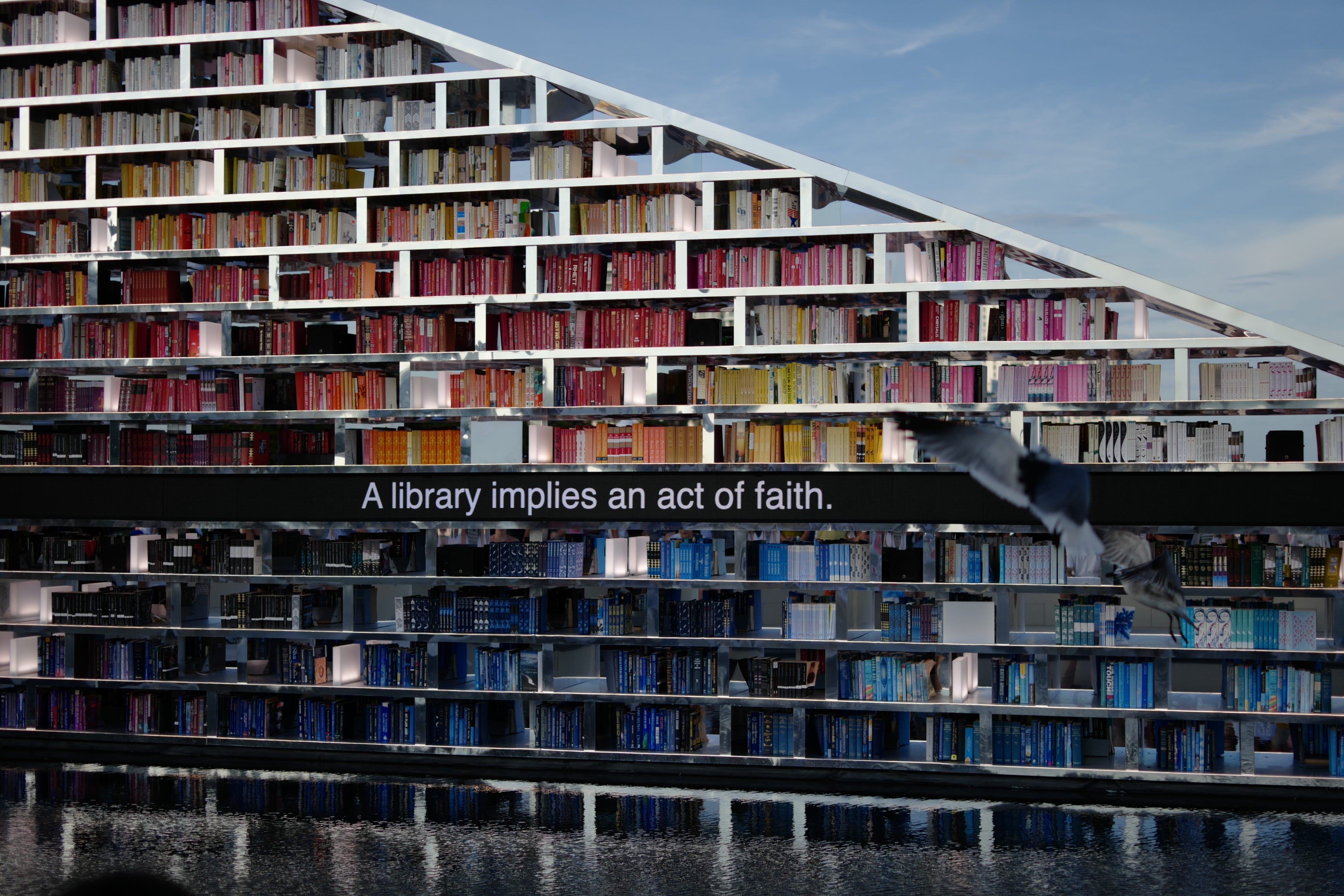
From the boardwalk at Miami Beach, Library of Us looks almost improbable: a tall triangular tower of books turning slowly above a shallow pool of water, lit from within so that it glows against the dark ocean. People crowd the edges with their phones, but as you step closer the noise drops away. You climb onto the rotating platform, sit on one of the stools, and only then notice that you’re moving too, carried along in a slow orbit.
The structure holds around 2,500 books Es Devlin credits as formative—poets, theorists, novelists, playwrights—stacked on three faces of shelving that rise above you like a paper cliff. Along the base, a narrow LED band scrolls short passages from 250 of those books while Devlin’s recorded voice reads them aloud. You are surrounded by fragments: a sentence here, half a thought there, reshuffled into a continuous strand that never quite resolves into a single statement. The work doesn’t explain itself. It lets you sit inside someone else’s lifelong reading list and notice what that does to your own.
Devlin has described the installation as a portrait made of books, an externalized image of how a person is built from what they read—and equally from what they haven’t read yet. That idea runs straight through Umberto Eco’s notion of the “anti‑library”: the shelf as a record not of what you know, but of everything that remains unknown. Eco’s point, picked up later by Nassim Nicholas Taleb, is that unread books are not failures; they are a physical reminder that the space of possible knowledge is always larger than what you’ve managed to capture. In Library of Us, that reminder isn’t theoretical. There is visibly more here than any one visitor will touch, and the installation itself only exists for this one Art Week before being dismantled and the books sent out into schools and public collections. Your time with it is bounded twice over: by your own schedule and by the piece’s short life.
That double finitude lands differently in a year when so much of our attention is on systems that promise the opposite. Elsewhere, text from many of these same authors has been scraped, tokenized, and folded into models that can now generate plausible arguments, translations, and riffs on demand. The language we use around those systems is full of reach: scaling knowledge, extending reasoning, preserving patterns beyond the limits of any one mind. Standing inside Library of Us puts a hand on the brake. The books here are not vectors; they are objects that will yellow, warp, fall apart. The structure is not an eternal monument; it is a one‑week arrangement of plywood, steel, and paper that leaves only memories, documentation, and a changed distribution of books behind.
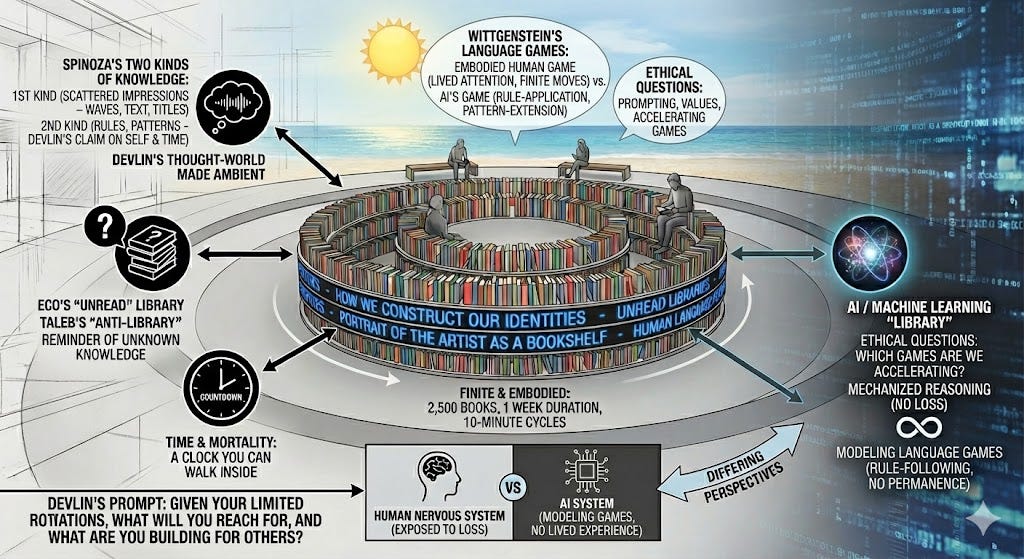
Seen from that vantage point, Spinoza’s old distinction between kinds of knowledge feels unexpectedly contemporary. For him, the first kind of knowledge comes from scattered, sensory impressions—what we bump into, what we overhear, the surface facts of experience. The second kind is what happens when we begin to see rules: the pattern behind the fragments, the function that connects them. In the Miami installation, you can feel both at once. The titles on the shelves, the sound of the waves, the lines of text flickering by on the LED strip—these are the first kind, the raw input. The realization that Devlin is using this to make a claim about how selves are constructed, about memory, about influence and time—that’s the second kind, the sense of an underlying grammar.
Wittgenstein’s lectures at Cambridge, with their obsession over games and rules, add another layer. He argued that what counts as a “reason” or a “move” makes sense only within a particular game—within a form of life where the rules are shared. Calculus, for him, was not a mirror of reality but a game we have learned to play with symbols. Writing out the digits of an irrational number like pi is a kind of rule‑following: we know how to go on, and that is what makes the activity meaningful. In Library of Us, you are inside a different kind of game. The rules are simple: the platform turns every ten minutes; the books remain available to be picked up; the fragments of text continue to scroll; Devlin’s voice loops. Visitors enter, sit, read, photograph, leave. Meaning emerges from how you decide to move within that constrained system and how you connect what you hear to what you’ve lived.
That matters right now because AI systems have become extraordinarily good at playing certain language games. They can infer the pattern in a list and extend it, imitate the rhythm of an argument, propose the next step in a proof or plan. In Spinoza’s terms, they operate in territory that looks like the second kind of knowledge: rule‑application, pattern‑extension, “if this, then that.” In Wittgenstein’s terms, they are models that are very good at going on in the way a particular language game tends to go on. It is tempting to see that and feel that something essential has shifted—that what used to be our private human capacity for reason has now been externalized and scaled.
Yet Library of Us keeps pulling the lens back to the first kind. The experience of the work is stubbornly embodied: the way the stool’s slow turn alters your sight lines, the momentary eye contact with someone across the triangle, the decision to stand up or stay seated when you’ve completed a rotation. Those micro‑choices sit outside any formal rule system. They belong to the messy category of lived attention, mood, fatigue, curiosity, boredom. No sequence of tokens can fully stand in for that, even if it can describe it convincingly after the fact.
These notions warn against mistaking maps for territories, rules for realities. Eco reminds us that most of the map will always be blank from our individual point of view; the anti‑library is there to keep us honest about that. Spinoza insists that better understanding of rules does not free us from being finite modes in a wider nature; it just makes our finitude more intelligible. Wittgenstein suggests that our sense of what counts as a good reason is rooted in shared practices that themselves are not deduced from first principles. Put back into the context of AI, these are all quiet correctives to the fantasy that building ever more capable systems will somehow grant us the permanence or completeness our own lives lack.

This is where questions about prompting and platforms begin to look less like technical puzzles and more like ethical ones. Prompting is, at its core, a very compressed way of stating what matters: what you want, what you fear, what you are optimizing for. When you ask a system to “reason,” you are implicitly defining which game you are inviting it to play. Are you asking for speed, for persuasion, for harmony, for disruption? Each of those choices encodes a value, even if it’s never written down as such. The danger is that in chasing more “verticality and horizontality”—more domains, more tools, more continuity—we forget to ask whether the game we are accelerating is one we actually believe in.
In contrast, Library of Us is very clear about its game. It gathers a finite set of influences, shows you that they are more than you can absorb, and then disappears. It distributes its contents into public institutions rather than hoarding them. It does not claim to preserve Devlin’s “self” in a permanent way; instead, it stages one week of encounter and then trusts that whatever matters will be carried forward in changed readers, in new associations, in quiet shifts of perspective. The work doesn’t promise endurance; it models generosity and letting go.
Connecting that back to why we build AI systems at all, the piece suggests a different metric of success. If permanence is off the table—if no amount of computation makes an individual life less finite—then the question becomes: what kinds of temporary experiences, tools, and structures are worth creating, knowing they will be used by people who are passing through? This has less to do with outliving ourselves and more to do with enriching the time we have, broadening who gets to participate in which games, and staying honest about how small each of us remains relative to the whole.
In that light, Library of Us stops feeling like a summary of big ideas and starts reading as a very precise prompt aimed at all of us: given your own limited rotations, what will you actually reach for on the shelf, and what are you building so that others have more to reach for when you’re gone?