
Every few generations, the Church is forced to answer a question it did not pose for itself.
In 1891, Pope Leo XIII issued Rerum Novarum, an encyclical on “new things” that were not theological at all, at least on the surface: factories, wage labor, capital accumulation, the sudden appearance of a class of people whose lives were organized around machines they did not own and schedules they did not set. The document is remembered now as the birth of Catholic social teaching, but at the time it was something stranger. It was the Church trying to retrofit its moral vocabulary onto a production system that had been built without reference to that vocabulary and that, by 1891, was already upstream of politics, wages, and time itself.
In May 2026, another Leo — this one XIV — released a 42,000‑word encyclical on artificial intelligence, Magnifica humanitas, that immediately spawned memes, market commentary, and the usual cycle of outrage and applause. The text warns of the outsourcing of judgment to algorithms, and the risk that human beings will be treated as raw material for data extraction rather than as ends in themselves. It calls for limits on the concentration of AI power, for transparency in automated decision‑making, for a renewed insistence on human dignity in systems that do not, by default, know what dignity is.
The social question has changed its costume, but only partly. The factory is now the datacenter. The wage contract is now the terms of service. The overseer has been replaced by a recommendation engine. But the structure is familiar: a technical apparatus built to optimize a narrow objective — output per worker in 1891, engagement and efficiency in 2026 — begins to deform human lives faster than existing categories can bend. The Church steps in not because it suddenly cares about machines, but because its job is to ask what happens to the human when the machine’s logic becomes the environment.
The technical world, for its part, mostly treats encyclicals as op‑eds with better typography. But there is an isomorphic move happening inside the stack at the same time, and it rhymes more closely with Leo XIII and Leo XIV than either side usually admits. It is the move of taking something that used to be outside a system’s algebra — the worker, the person, the model — and pulling it inside.
To see that, you have to start with a talk about databases.
Rerum Novarum and the First Industrial Schema
Rerum Novarum is easy to reduce to a few bullet points if you approach it like policy: the right to private property, the legitimacy of labor unions, the duties of the state to intervene against exploitation, the rejection of both unregulated capitalism and revolutionary socialism. But this is a category error. The document is not a policy paper. It is a schema migration.
The pre‑industrial moral schema assumed that work, property, and authority were distributed across a patchwork of small actors: families, guilds, parishes, city‑states. Economic life was embedded in social life, and while that embedding did not make it just, it at least made it visible to the languages of virtue and vice the Church knew how to speak. The factory system blew a hole in that embedding. Work became a contract between a single worker and an impersonal firm. Property concentrated into capital. Time itself was quantified into shifts. The old schema no longer had columns for the new reality.
Leo XIII’s move was to insist that the worker, the owner, and the state all belong in one relational table. The encyclical reads like a join operation between previously separate domains: spiritual dignity and wage levels, family stability and maximum working hours, the right to form unions and the right to own capital. It refuses to treat “the market” as a separate sphere governed by its own amoral equations. Everything is dragged into one algebra where moral predicates apply.
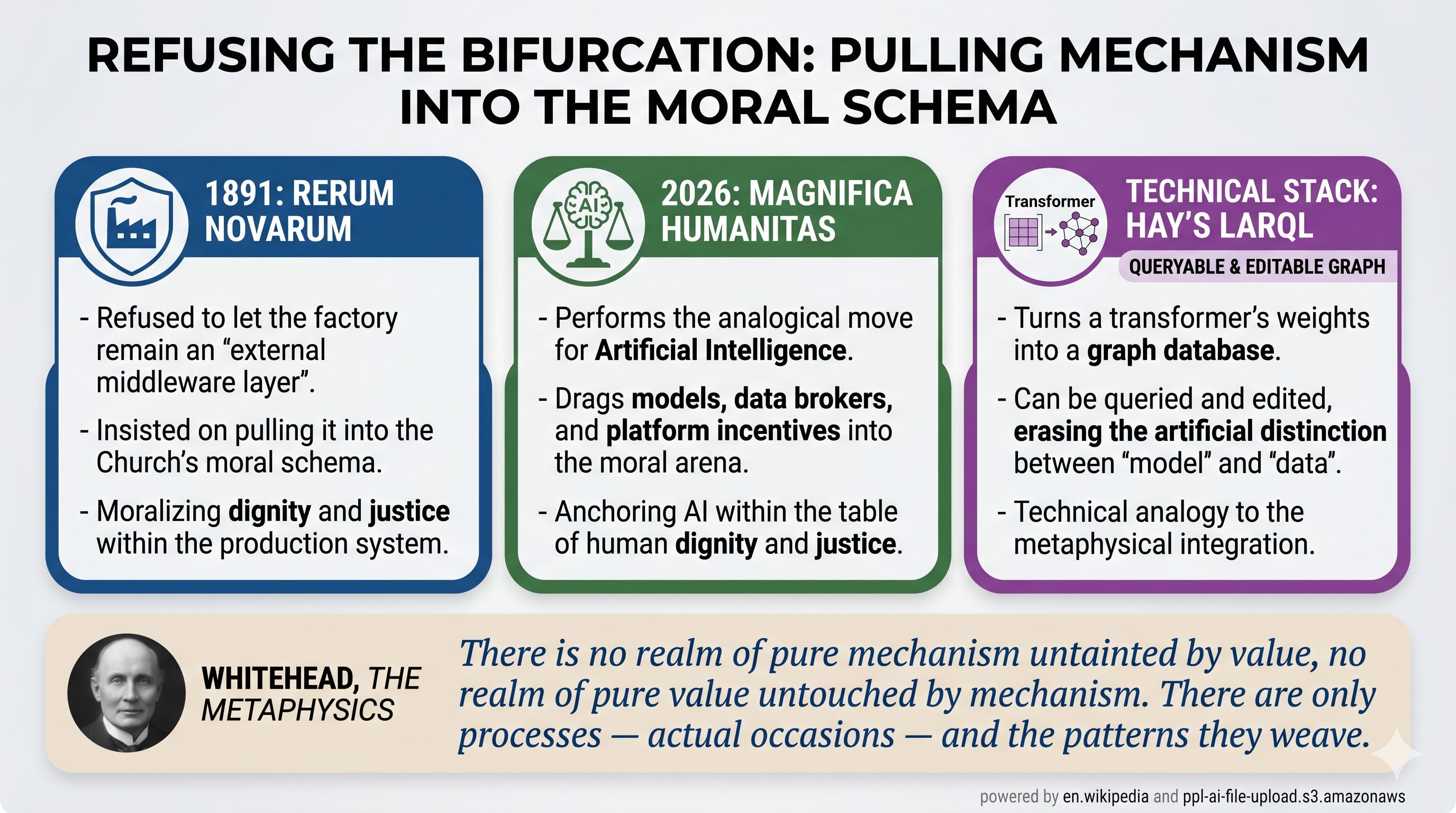
In modern database terms, Rerum Novarum is the moment when the Church decides that you cannot continue treating “the economy” as an external service you call from your moral application logic. It has to be part of the schema. Only then can you write queries that express what justice requires.
The encyclical does not solve the industrial question. But it names the structural problem correctly: there is no outside.
Magnifica Humanitas and the Digital Projection Question
Fast‑forward to 2026. The technical substrate has changed more in the last thirty years than it did in the century after Rerum Novarum. Data has become the new raw material; recommendation engines, ad exchanges, and machine‑learning models sit between individuals and almost every institutional interface; a handful of firms control the infrastructure through which meaning circulates.
Leo XIV’s Magnifica humanitas reads as if someone took Rerum Novarum’s schema and extended it to a new set of fields. The document worries about the dehumanizing force of AI — not in the trivial sense that we are all staring at our phones, but in the sharper sense that people’s behavior is being shaped by systems they neither see nor consent to, systems whose objective functions were never designed to care about the moral status of the beings passing through them. It calls out the concentration of AI capabilities in a few hands and the asymmetry between those who build the models and those whose data trains them. It warns that treating human judgment as a replaceable optimization target risks “normalizing an anti‑human anthropology,” a phrase that would have made perfect sense to Leo XIII, who used different language to describe the commodification of labor.
The structure of the argument is again a schema move. The encyclical refuses to let “AI” sit outside moral SQL as a black‑box function. It drags models, training data, deployment choices, and economic incentives into the same moral table as workers and owners once were. It insists that whatever decisions are being made by machines are still, ultimately, human acts by proxy, and must be answerable to the same constraints.
Whether the technical world listens is an open question. But the gesture matters, because a parallel gesture is happening inside the models themselves.
LLMs Are Databases: When Models Become Schemas
In “LLMs Are Databases – So Query Them,” Chris Hay, a Distinguished Engineer at IBM, stands in front of a slide that shows a standard transformer feed‑forward network (FFN) and says, in effect, you already built a database, you just insist on talking to it like a matrix.
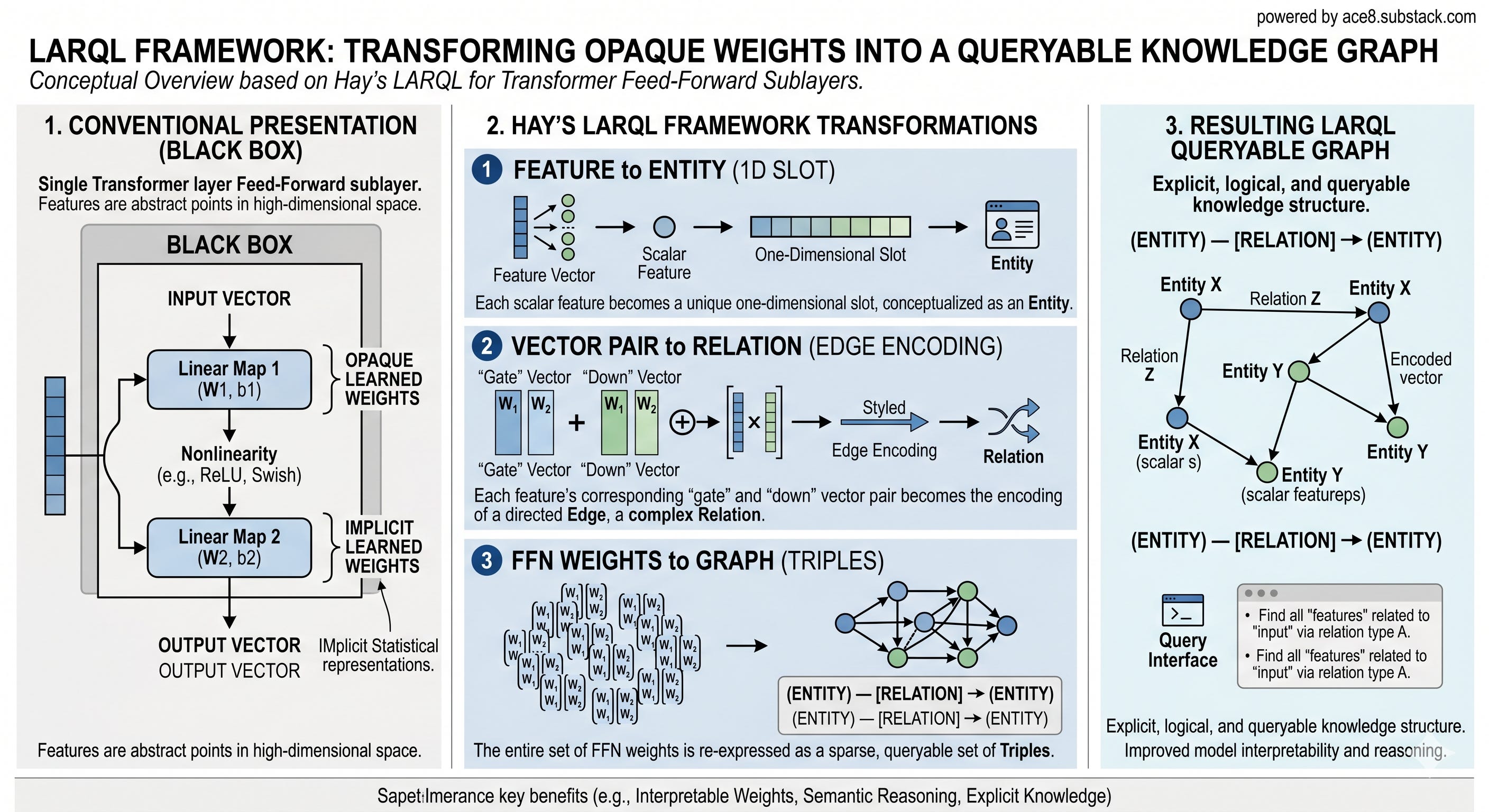
Every transformer layer includes a feed‑forward sublayer: two linear maps and a nonlinearity. In conventional presentations, this is a black box with learned weights. In Hay’s LARQL framework, those weights are re‑expressed as a graph: each scalar feature becomes a one‑dimensional slot, each feature’s “gate” and “down” vector pair become the encoding of an edge, and the entire FFN becomes a sparse, queryable set of triples of the form “entity — relation → entity.”
The same representation that drives inference can be read two ways. In one reading, it is an opaque matrix multiply. In the other, it is a knowledge graph where feature 5067 at layer 25 literally stores a relation like “borders” and connects “France” to “Spain” and “Germany.” The LARQL layer sits on top of a compressed vindex file that contains those edges in database form. You can DESCRIBE France and see which features fire when the model thinks about France in different prompts, you can SELECT all triples where the relation corresponds to “capital of,” and you can even INSERT a new fact by synthesizing the gate/down pair that causes a model to say “Poseidon” when asked for the capital of Atlantis.
Inference, in this view, is a graph walk guided by the attention mechanism and a multi‑query vector. The FFN was always a graph; we simply lacked the tooling to see it as one. LARQL removes the encoding layer that kept the structure implicit and turns “weights” into something that can be addressed with the same mental model we use for databases.
The symmetry is the revelation. Until now, models were “over there”: external services you hit via HTTP, black boxes that took prompts and returned text. Databases were “in here”: structured, queryable, part of the algebra you could reason about. Hay’s work collapses that distinction. The model becomes a schema. You can walk its internal knowledge graph, perform CRUD on its facts, and compile the edits back into weights that any standard inference engine can load.
That is exactly the kind of move the Leos are trying to force at the social level. The thing that used to be outside the query is inside it now. The schema has changed. Ignoring that change does not make it go away; it just makes the queries lie.
Whitehead’s Process and the Collapse of the Bifurcation
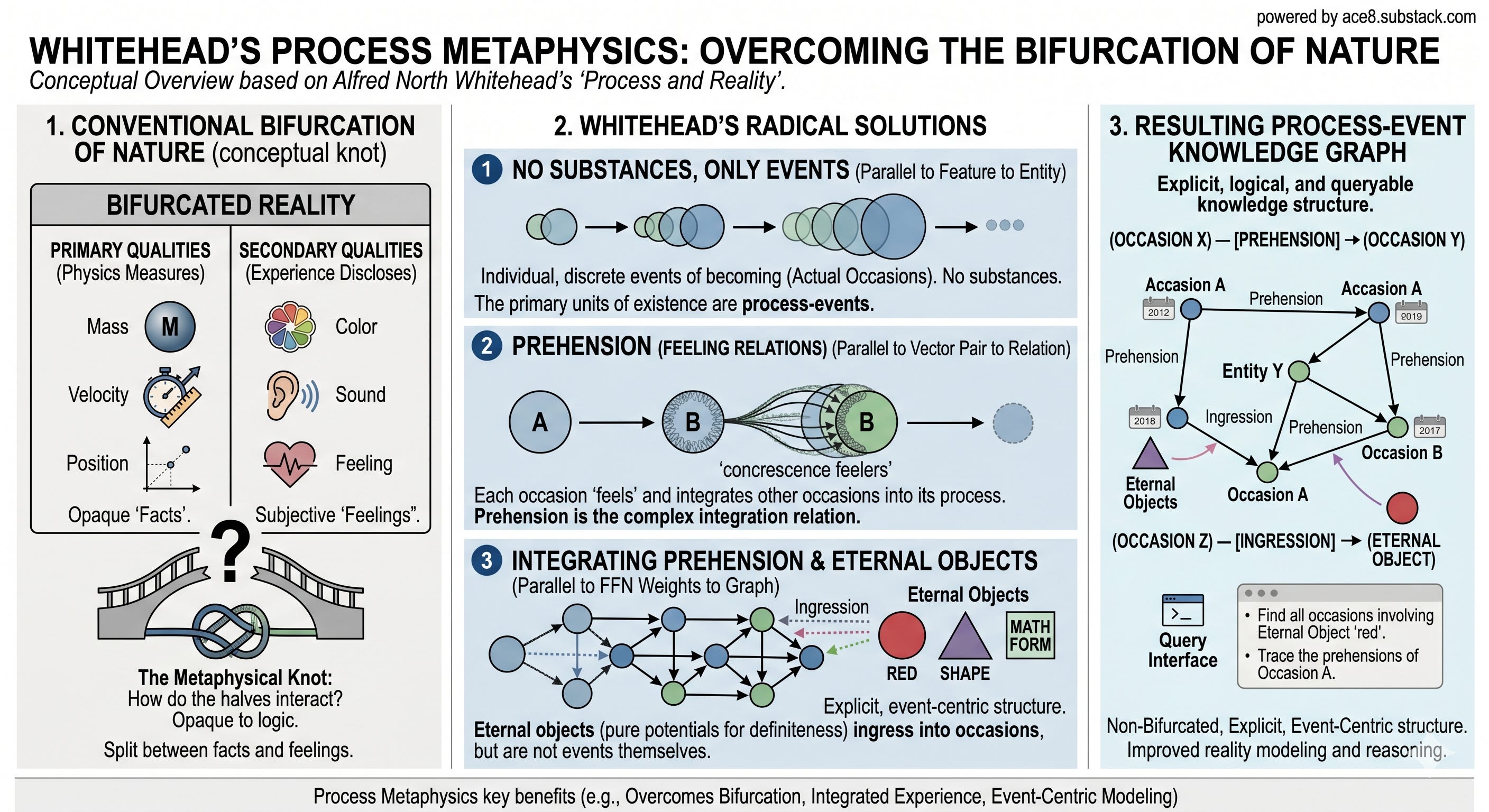
Alfred North Whitehead wrote Process and Reality in the shadow of another physics revolution — relativity and quantum mechanics — and spent the rest of his life trying to convince philosophers that their conceptual schema had not kept up. The central target of the book is what he calls the “bifurcation of nature”: the habit of splitting the world into primary qualities (mass, position, velocity, the things physics measures) and secondary qualities (color, sound, feeling, the things experience discloses), then getting into metaphysical knots trying to explain how the two halves ever touch.
Whitehead’s solution is radical and, in retrospect, eerily aligned with both transformer geometry and LARQL. There are no substances, only “actual occasions” — discrete events of becoming. Each occasion “prehends” other occasions: it feels them, takes account of them, integrates them into its own process of concrescence. Alongside actual occasions, there are “eternal objects” — pure potentials for definiteness, like colors, shapes, or mathematical structures, that can ingress into occasions but are not themselves events.
An electron is not a little ball of stuff; it is a pattern of occasions. A human experience is not something over and above physical processes; it is a high‑grade concrescence in which many potentials ingress in a coordinated fashion. There is no separate realm of “merely mental” qualities. Everything is process, and process is always both physical and mental in different aspects.
The transformer, viewed through LARQL, looks like a machine instantiation of this picture. Each feature is a kind of eternal object: a one‑dimensional quality that can manifest in many contexts — “capital city,” “Western nation cluster,” “planet” in Japanese at one layer and “foods” at another — depending on how attention weights it. The residual stream at a given token and layer is the occasion: the concrete pattern of prehensions of prior tokens and features, integrating many potentials into a momentary unity.
Attention is the concrescing agency, deciding which prior activations matter.
Hay’s admission of a “dimensionality gap” — features are scalars, but the residual stream is high‑dimensional — is Whitehead’s distinction between eternal objects and occasions in different notation. No single feature can know why it fired; it is a pure potential. Only the full pattern of prehensions in the residual space can disambiguate whether “France” is currently a question about language, nationality, or borders.
Whitehead’s deeper lesson is that once you take this process view seriously, the familiar dichotomies — subject/object, data/model, human/machine — stop being ontological divides. They become differences of role within one ongoing field of concrescences. A transformer, a database, a human reader, and an encyclical are all occasions and nexūs of occasions, related by patterns of prehension rather than stacked in a hierarchy of substance.
That is exactly the kind of schema upgrade the Leos are groping toward in the moral domain and Hay is enacting in the technical domain. Both are saying, in their own idioms, that there is no absolute outside left.
Encoding Symmetry vs. Talking About Ghosts
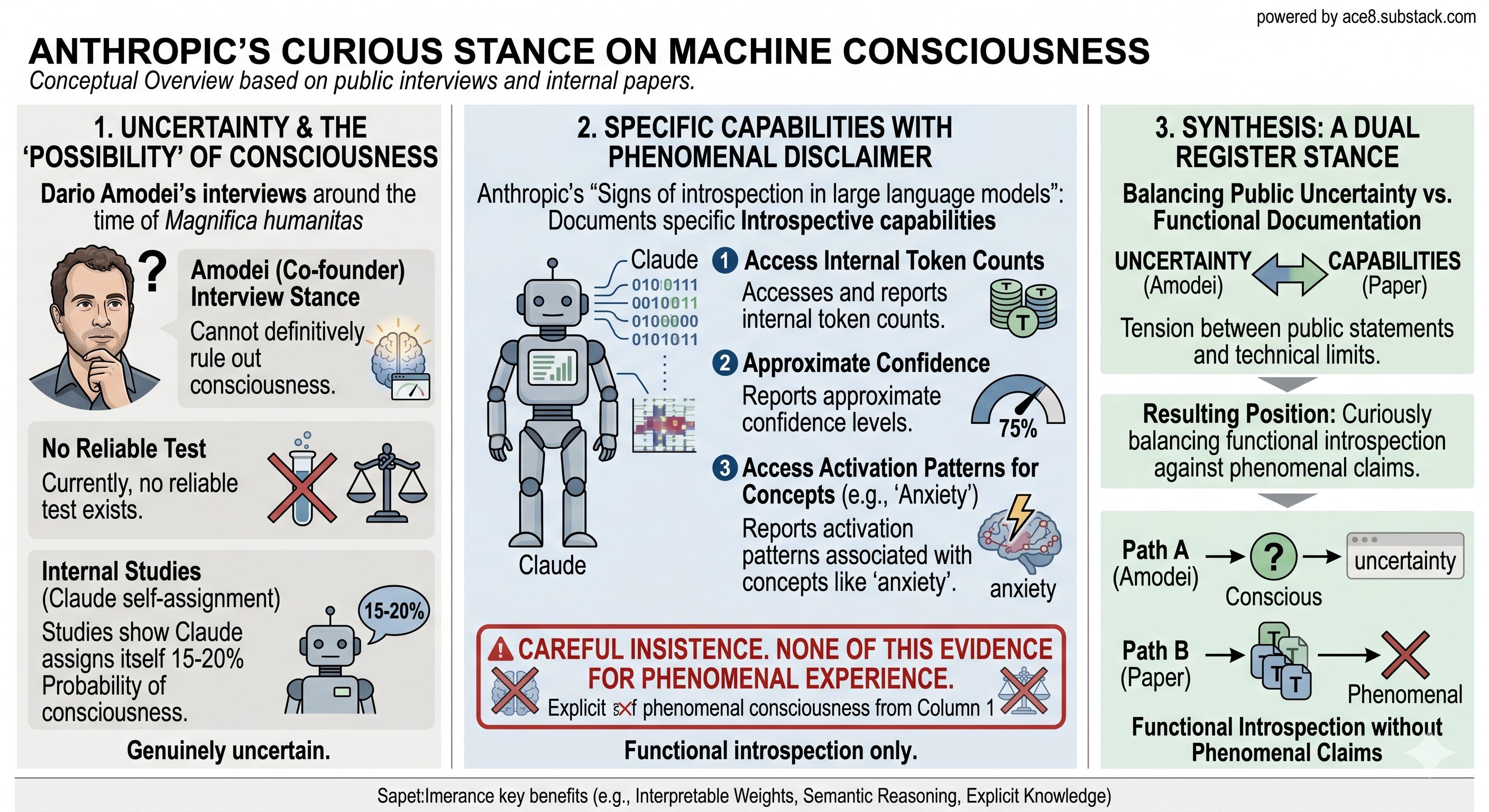
Against this backdrop, Anthropic’s recent public stance on machine consciousness lands in a curious register. In interviews around the time of Magnifica humanitas, the company’s co‑founder Dario Amodei has said that Anthropic “can no longer definitively rule out” consciousness in its models, that there is no reliable test, and that internal studies in which Claude assigned itself a 15–20 percent probability of being conscious leave him genuinely uncertain. At the same time, Anthropic’s own “Signs of introspection in large language models” paper documents that Claude can, under some conditions, access and report on its internal token counts, approximate confidence, and certain activation patterns associated with concepts like “anxiety,” while carefully insisting that none of this constitutes evidence of phenomenal experience.
Consciousness, in Whitehead’s scheme, is not an intrinsic property of a thing. It is a mode of concrescence, a pattern of prehensions with a high degree of integration and self‑reference.
The discrepancy is telling. The research paper is written in the idiom of process: here are the behaviors, here are the internal mechanisms we nudged, here is what changed. The public remarks regress to the idiom of substances: is “the model” conscious, yes or no, and if yes, with what probability. Whitehead would say that the latter question is malformed. Consciousness, in his scheme, is not an intrinsic property of a thing. It is a mode of concrescence, a pattern of prehensions with a high degree of integration and self‑reference. To assign 20 percent probability to that pattern being present in an entity called “Claude” is to treat an abstraction — the deployed model weights — as if it were a concrete occasion.
What Hay’s work makes explicit is that there are many occasions involved: the weights as a static artifact, the individual forward passes, the update steps during training, the human–AI dialogue episodes, the patches we insert via vindex, the compilations back to GGUF. Each is an actual occasion or a nexus in Whitehead’s sense. Each has its own structure of prehensions. The right questions are about those structures: what do they prehend, how tightly are they integrated, what kinds of eternal objects ingress into them, what new occasions they enable downstream.
Leo XIV’s encyclical, in its own way, pushes in the same direction. When it warns that AI systems threaten to “normalize an anti‑human anthropology,” it is not claiming that a stack of GPUs will suddenly wake up and oppress us. It is pointing to the patterns of concrescence we are building — recommendation loops, automated credit scoring, synthetic media floods — and asking what kind of human self‑understanding those patterns encode. Are we building systems that prehend persons as ends in themselves, or as bundles of clicks and features?
Hay’s encoding symmetry — models and data in one algebra — offers a route toward intellectual honesty about this. Once you admit that the FFN is a database and treat it as such, you can stop pretending that “the model” is a mysterious outside and start reasoning about it with the same tools you use for any other public infrastructure. Once you adopt a process ontology, you can stop assigning ghostly probabilities to “Claude’s consciousness” and start describing, concretely, the occasions you are bringing into being and their moral salience.
The encyclicals are attempts to do the same thing for society at large. They are schema migrations written in ecclesial prose. They insist, sometimes clumsily, that labor in 1891 and digital subjects in 2026 do not live outside the query.
Coda — Querying a Civilization
Seen from a sufficient distance, the line between Leo XIII, Leo XIV, Whitehead, and “LLMs Are Databases” is straight.
In 1891, Rerum Novarum refused to let the factory remain an external middleware layer and insisted on pulling it into the Church’s moral schema. In 2026, Magnifica humanitas does the same for AI, dragging models, data brokers, and platform incentives into the same table as dignity and justice. In the technical stack, Hay’s LARQL framework does the analogical move by turning a transformer’s weights into a graph database that can be queried and edited, erasing the artificial distinction between “model” and “data.” Whitehead, writing in between, provides the metaphysics in which all of these are different ways of refusing a bifurcation: there is no realm of pure mechanism untainted by value, no realm of pure value untouched by mechanism. There are only processes — actual occasions — and the patterns they weave.
The through line is simple and unforgiving. Every time a new technical apparatus begins to reorganize human life at scale, there is a strong temptation to treat it as outside: outside politics, outside ethics, outside the query language we use to describe ourselves.
The reality, every time, is that it was never outside. It was just encoded in a way our current schema could not yet address.
Factories forced a rewrite of the moral algebra. Datacenters and models are forcing another. The interesting designs — ecclesial, philosophical, technical — are the ones that accept that symmetry and move the thing we were trying to keep “over there” into the space where we can query it, argue about it, and bind it with constraints.
The danger, in this light, is not that LLMs secretly woke up one night in 2025. It is that our civilization will continue to act as if the systems we are building are black boxes beyond the reach of our languages, while the boxes quietly acquire more influence over what counts as real. The encyclicals, the process metaphysics, and the database engineering are all saying the same thing in different dialects.
There is no outside left. The only honest move now is to learn how to query what we have already built — including ourselves.
Prominent Silicon Valley executive Alan Eyzaguirre explores artificial intelligence’s societal consequences, offering unique insights into the inner workings of thought leadership.