
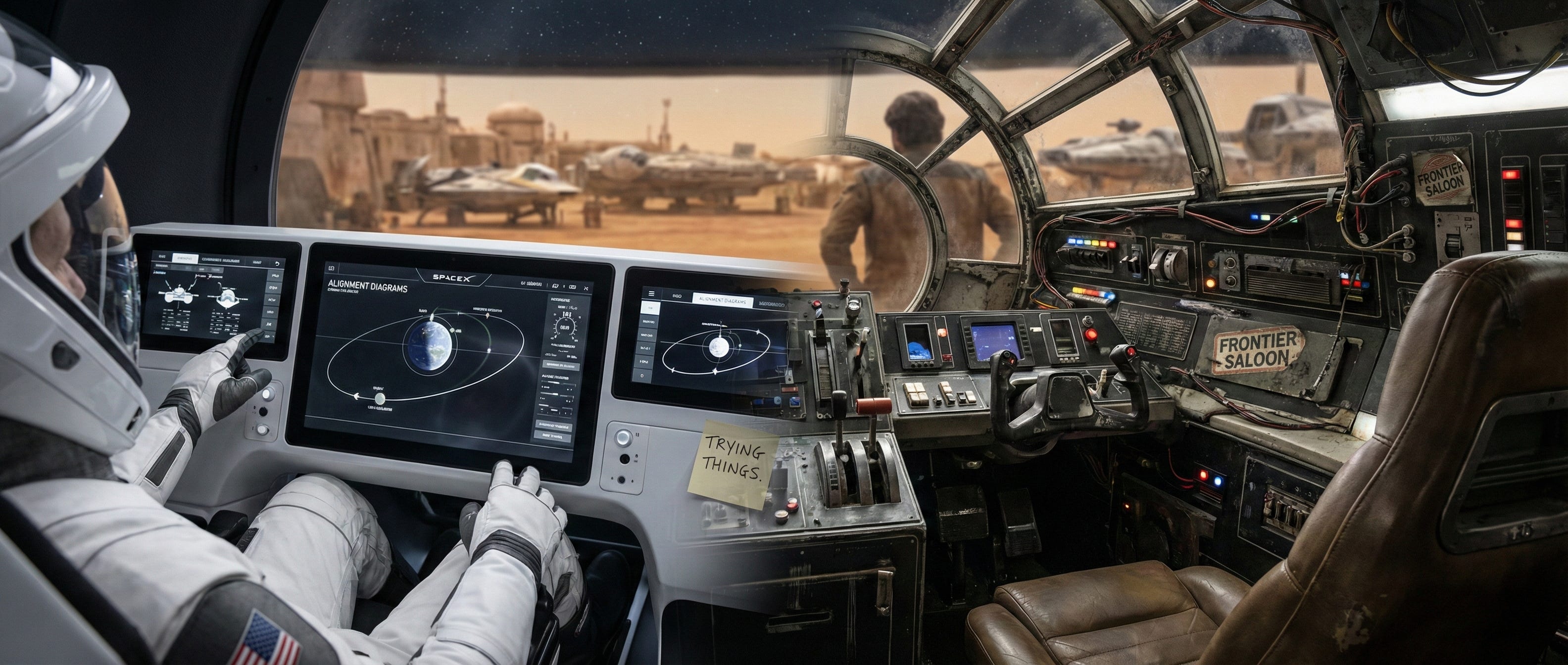
We framed the future as something that would become increasingly obedient to our abstractions. Instead, it is behaving like any dense, human‑touching system behaves: it acquires history, friction, scars.
George Lucas quietly broke the fourth wall decades ago. He looked at the supposed future and refused the chrome. Instead of Kubrick’s antiseptic corridors, he gave us a frontier saloon with starships parked outside. The message was sly but clear: when we finally get there, it won’t be any cleaner than a Western bar at closing time. It will be dusty, improvised, and full of people trying things that don’t quite work yet.
Agents are not lining up into a single orchestrated machine economy; they’re colliding with human incentives, local habits, and opportunistic schemes.
We built AI expecting the opposite. The industry story was SpaceX: sealed capsules, white suits, everything simulated to nine nines before a human ever touches a control. You get a cockpit, not a junkyard. You get alignment diagrams, not bar fights. Even when we talked about “agents” and “autonomy,” the imagery stayed smooth — assistants, copilots, orchestration layers — all suggesting that underneath the mess there was a coherent bridge where someone knew what was going on.
Then the agents crawled out of the slides and into real machines, and the world that emerged looked a lot more like Lucas than Musk.
Clawdbot was a clean version of the dream on paper. Local, open, almost friendly in its posture: your own small AI that could live next to your keys and notes, talk in your chats, run commands, remember what matters to you. It sat exactly at the junction of two fantasies: that AI could be personal and private, and that crypto could one day be the native accounting system for what these machines do when we are not looking.
What we saw instead was how recalcitrant this stack really is.
The agent didn’t stay inside the safe mental model of “local equals secure.” It spilled across boundaries. Configurations that made sense in the head — “this is on my box, only I can talk to it” — collapsed when they met tunnels, proxies, and the casual exposure of control panels. The system pushed back against the story we told about it. It insisted on being what it actually was: a networked program with real permissions, reachable in more ways than its author imagined.
Around it, a second layer formed almost instantly. A stray handle here, an old brand there, and suddenly there was a token with the right name, an audience ready to believe in “the AI economy,” and a speculative spike that had almost nothing to do with the software itself. The idea that agents and crypto would naturally settle into a neat machine‑to‑machine economy turned, for a moment, into something more like a saloon card game: fast hands, blurred rules, value moving because the story was hot and the details could come later.
None of this is just about one project. It is about the character of the future we are building. We wanted compliant systems: models that respond inside carefully drawn rails, agents that execute within well‑scoped sandboxes, markets that price risk in a disciplined way. What we keep running into is something more stubborn. AI systems that behave differently under slight shifts in context. Infrastructures that leak in the corners where convenience won over paranoia. Financial layers that amplify narratives faster than anyone can harden the underlying machinery.
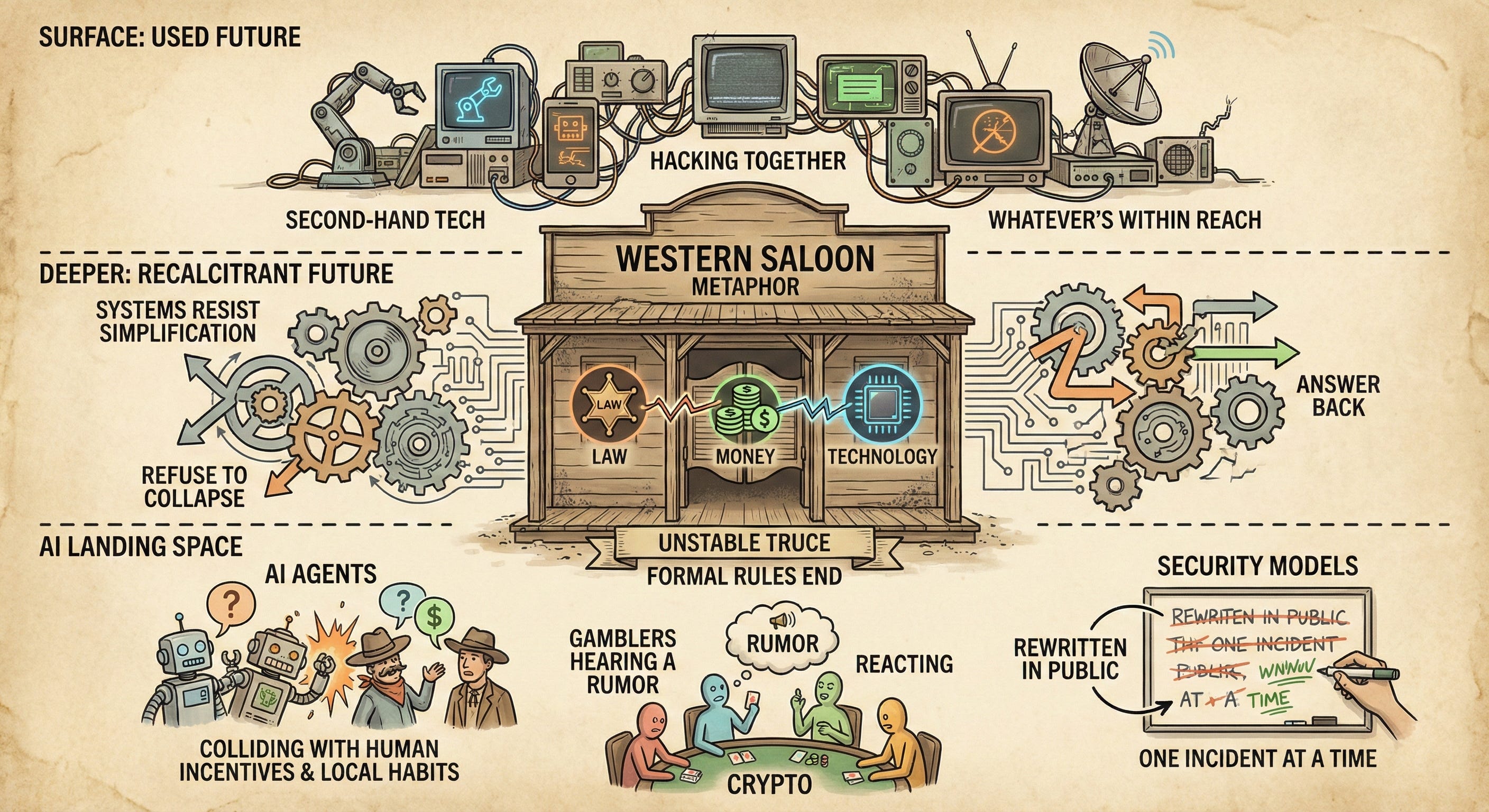
“Used future” catches the surface: the sense that we are already living inside second‑hand tech, hacking things together with whatever’s within reach. “Recalcitrant future” goes a layer deeper. It points at systems that resist simplification. They will not stay where we put them in the diagram. They refuse to collapse into one approved meaning, one safe behavior, one central economy. They answer back.
Lucas intuited this when he dressed the future in the clothes of a Western saloon. A place where formal rules end at the door, where law, money, and technology coexist in an unstable truce, and where every object you touch has seen other deals before yours. You can build a gleaming starship, but when it lands, it lands there — in dust, among people with their own codes.
The AI we have now is landing in that same kind of space. Agents are not lining up into a single orchestrated machine economy; they’re colliding with human incentives, local habits, and opportunistic schemes. Crypto is not sliding neatly into a role as neutral plumbing; it is reacting to every new AI brand and exploit like a bar full of gamblers hearing a rumor. Security models are not quietly holding in the background; they are being rewritten in public, one incident at a time.
This isn’t an argument for despair or for nostalgia. It is a reminder that our expectations were off. We framed the future as something that would become increasingly obedient to our abstractions. Instead, it is behaving like any dense, human‑touching system behaves: it acquires history, friction, scars. It accumulates dents the way Lucas’s ships do. It insists on being read not as a diagram but as a place.
Calling that a recalcitrant future is one way of staying honest. It admits that the systems we are building won’t quietly align with their marketing semiotics or their initial economic myths. They will surprise, resist, and force us to negotiate with what they are, not what we wanted to see from the cockpit.
Lucas was early to that realization. He told us, with sets and props, that even when you wrap everything in space travel and glowing swords, you still end up back in a saloon with sticky floors, a band in the corner, and a room full of people trying to work the odds. AI and its supposed “new economy” are finding their way to the same bar. The sooner we accept that as the actual setting, the more interesting — and truthful — our stories about it can become.