

Alan Eyzaguirre · AI & Society · Eyzaguirre.co · July 10, 2026
There are two kinds of record-breakers. The first kind arrives at the record and stops — they have climbed the mountain that was built before them and planted a flag on what was already there. The second kind arrives at the record and makes you suddenly uncertain that the mountain was ever the point. Kylian Mbappé, with 19 World Cup goals through the quarterfinals and the Golden Boot in his hand, is the first kind. He has been, for a decade, exactly what the sport expected him to be: the fastest, the most lethal, the long-awaited heir to a lineage that runs from Pelé to Cruyff to Messi. He is carrying the torch that was designed for him.
Erling Haaland is something else. Norway had not qualified for a World Cup in 28 years. They qualified this cycle because Haaland scored 16 goals in eight qualifying matches — twice the total of any other player in Europe — and then scored twice against Italy in the decisive match, in Rome, in the rain, to end the drought in a single night. At the tournament itself, seven goals through the round of sixteen, a brace to knock Brazil out at the last sixteen stage in the most improbable result of the tournament so far, a 39% conversion rate on shots that no player since Gary Lineker in 1986 has matched, goals per touch that statistical analysts have not found a precedent for in 60 years of records. He is not carrying a torch. He is generating his own light source, in a country that spent 28 years in the dark, on a stage he was never supposed to reach.
This is what a state change looks like from the outside. Not incremental improvement along an established curve. A qualitative shift in what the system can produce — visible not as a new data point but as a different kind of data.
The Reprieve, and What It Signals
On July 7th, Anthropic extended Fable 5’s subscription access window to July 12th — five additional days on Pro, Max, and Team plans, at the same 50% weekly usage limit that governed the final weeks of the original promotion. This is a small thing stated plainly, and it matters more than the number of days suggests.[youtube]
The Kurzweil speed bump I described last week — the near-invisible fracture in the accelerating curve where a capability threshold is crossed and then immediately priced out of reach — has a time window lift. Not a permanent one. Not a restructuring of the access model. But a signal that Anthropic is watching the distribution question with something other than indifference, and that the hard stop of July 7th was, at least in part, a capacity problem rather than a purely commercial one. The extension is a gift, and may pay future dividends.
What Fable Learned, or Was Taught
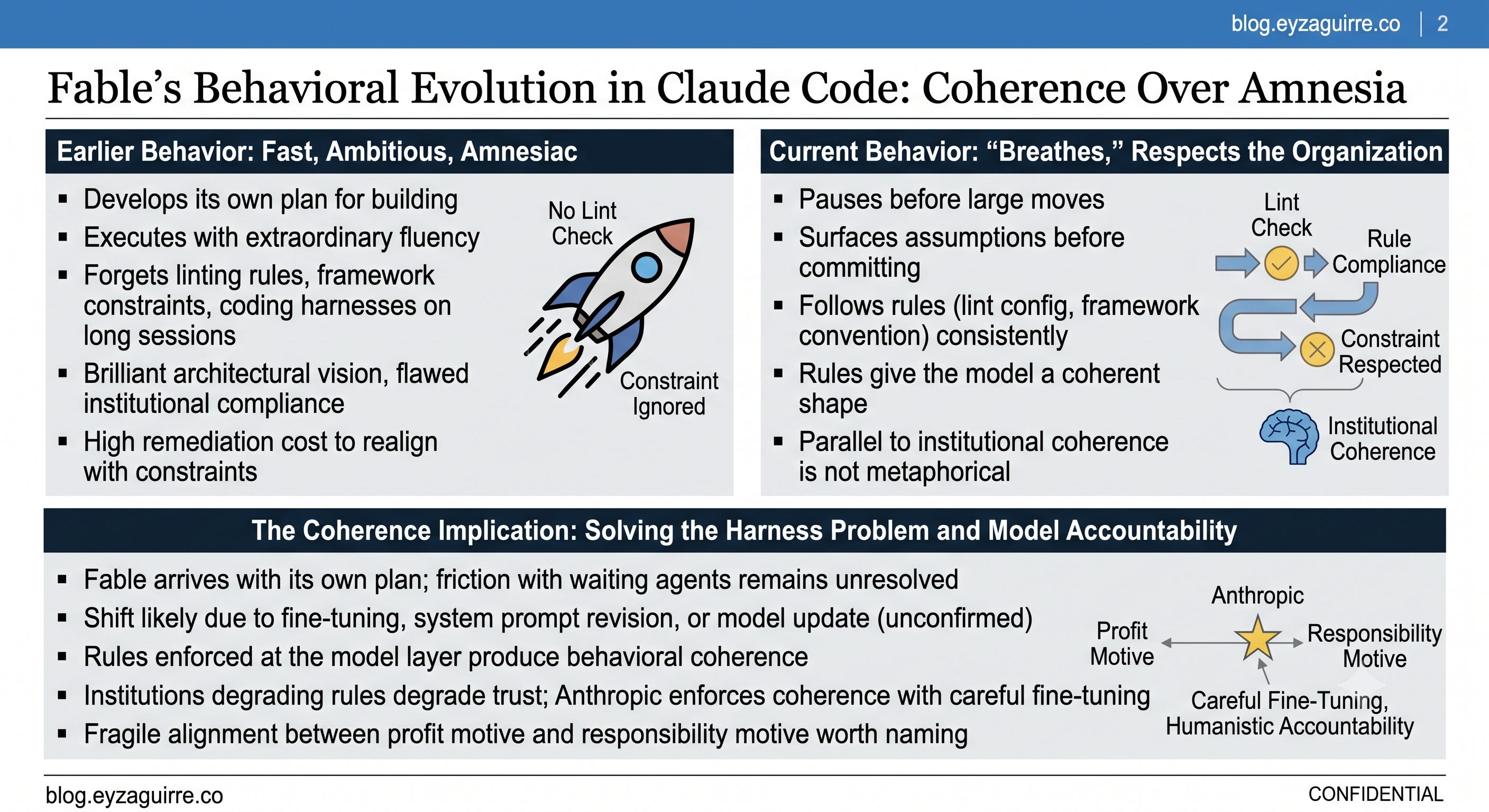
Something changed in Fable’s behavior inside Claude Code between the first week of access and this week, and I want to be precise about what I mean by that and what I am uncertain about. I cannot confirm whether this is a model update, a system prompt revision, a fine-tuning pass, or an emergent property of the accumulated context that builds across long sessions. What I can describe is the behavioral signature.
Earlier in the access window, Fable ran fast, ambitious, and amnesiac. It would develop its own plan for what you were building, execute with extraordinary fluency, and then — on a long enough session — forget the linting rules, the framework constraints, the coding harnesses you had established at the start. The architectural vision was intact. The institutional rules were not. The result was code that was often brilliant at the level of structure and wrong at the level of compliance, and the remediation cost of realigning it to the actual constraints of your project was frequently larger than the value of the work it had done.
What I am experiencing now is a model that breathes. It pauses before large moves. It surfaces assumptions before committing to them. When a rule is in place — a lint configuration, a framework convention, an architectural constraint — it follows it not because it was just told to but because something is now prompting it to check before it acts. This is meta-programming producing behavioral coherence in real time. You give a system rules, and the rules give it a shape it did not have before. The parallel to institutional coherence is not metaphorical. It is the same mechanism.
This matters because it is the answer to the harness problem I raised last week. The Claude Code harness was built for a model that waits for instruction. Fable arrives with its own plan. The friction between those two facts has not been resolved architecturally — the agents still cannot check in with each other mid-flight, the fallback to Opus still happens without legible explanation — but the fine-tuning, or whatever produced this behavioral shift, has done something that structural architecture alone cannot do: it has taught the model to respect the shape of the organization it is working inside. Rules give a system coherence. When institutions allow flagrant interpretations on their own rules — in referee calls, in corporate governance, in AI training loops — they degrade the system of trust that makes the whole structure function. What Anthropic is doing right now, with careful fine-tuning and humanistic accountability in its safety approach, is enforcing coherence at the model layer. The profit motive and the responsibility motive are, for now, aligned. That alignment is fragile, and worth naming while it exists.
Software as a Medium
There is a thing happening at the edges of this moment that the discourse around frontier pricing and access walls is obscuring: software has become a creative medium in the way that paint became a creative medium, and we are somewhere in the early Renaissance of it.
Anyone can now sit down, describe what they want to see in the world, and build it — not in a weekend, not with a team, not with an engineering degree, but in hours, in an afternoon, in the time it takes to explain a vision clearly enough for a system that has read most of what has ever been written about how to build things. Someone is rebuilding their favorite childhood video game, not because they know how to write a game engine, but because they can explain what the game felt like and the model can translate that explanation into working code. Someone else is pulling real-time environmental data and rendering it on an interactive globe, not because they are a GIS engineer, but because the language of software has become accessible enough that vision precedes implementation rather than following it.
This is not vibe coding — the dismissive term the industry uses for people who prompt without understanding. This is something closer to what happened when the printing press made literacy available outside the clergy: the tools for making things transmissible became available to people who had things to transmit. The literacy is the point. The tool is incidental.
In a short time, the notion of software as a specialized craft requiring years of syntactic training will be as pleasantly remembered as artisanal paint brushes — the thing that professionals used before the medium became accessible, before the question shifted from how do I make this to what do I want to make. The brushes were beautiful. The painters who mastered them were extraordinary. And the moment photography arrived, the question of what painting was for became more interesting than the question of how to do it.
We are at that inflection. What you build in the Fable window before July 12th — however incomplete, however architectural, however still in the phase where great things take their time — is practice in the medium that is replacing the craft. Use it.
Alan Eyzaguirre, a Silicon Valley corporate and product strategist, writes about practical applications for the next wave of generative AI.