
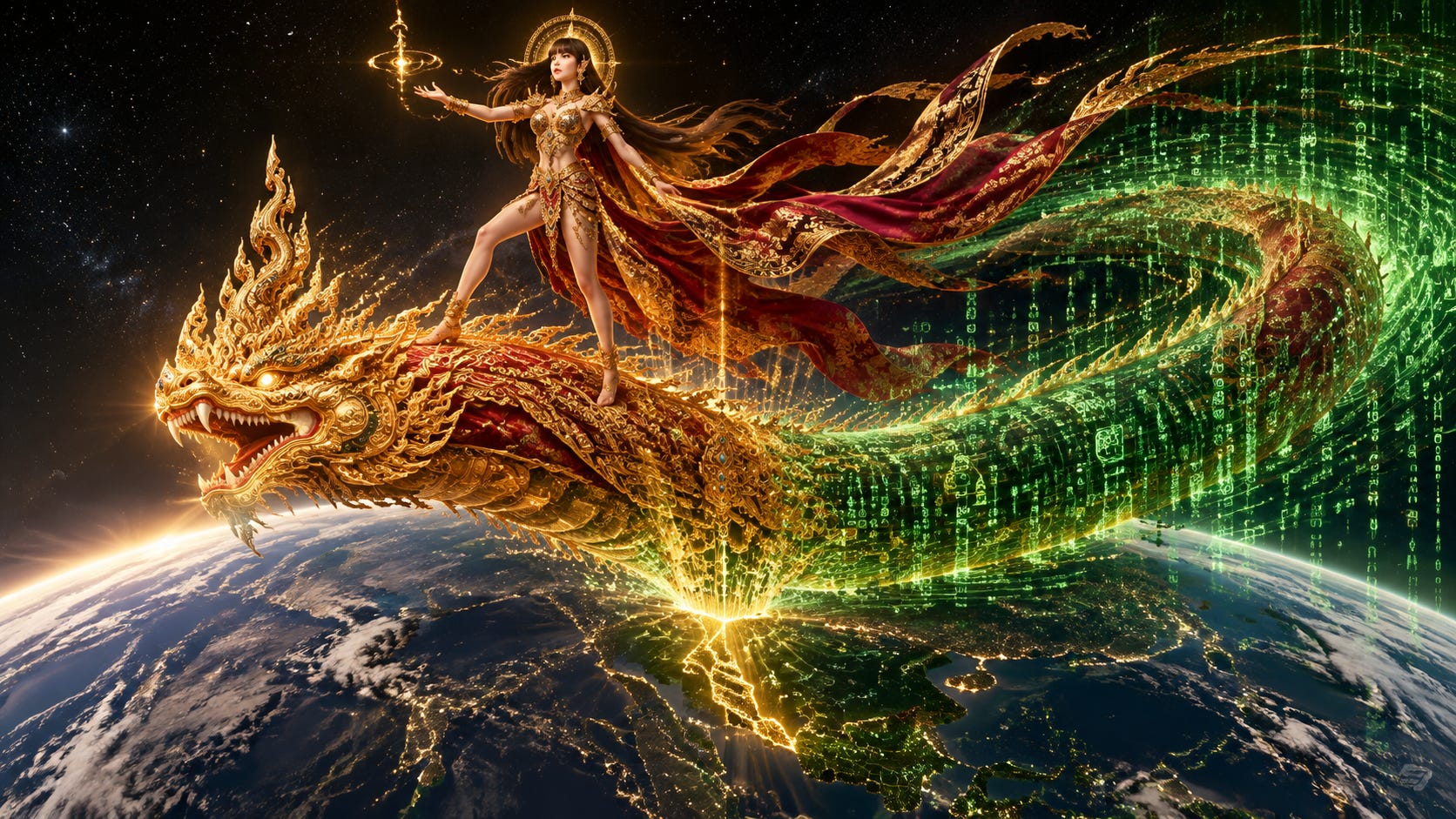
In January 2026, this publication ran “Tung Tung Tung Sahur: The Continuum of Inevitability,” identifying that AI-generated music was not an aberration of digital culture but the visible edge of a much older pattern — an impulse, in the author’s words, “older than language” that “is learning to sing through machines.” The essay predicted that the machines would indeed learn to sing.
The eleven months since have answered that question with unusual precision. In September 2026, LISA — the Thai rapper, singer, and BLACKPINK member — released “SaWaDiKa,” whose first-day audience of 70.8 million viewers constituted the largest single-day debut of the year. In November, she opened the first K-pop residency in the history of Las Vegas. A pattern of Eastern cultural production, coordinated through algorithmic distribution and arriving unbidden at the center of Western spectacle, completed the arc the original essay had traced in miniature through a wooden log character from an Indonesian TikTok feed.
What follows is a study of the same musical continuum, observed from its opposite end. Where the original essay examined meaning dissolving into pattern, this one examines pattern re-emerging as meaning: a manufactured blessing, engineered from Sanskrit in the 1930s and mandated by decree in 1943, now functioning as the load-bearing hook of a global pop single. The method is unchanged. The subject has simply grown louder.
The arguments below assume the framework established in January; the conclusions, we believe, were audible then as they are undeniable now.
— Eyzaguirre.co Culture Metrics, November 2026
There is a word at the center of this story that most people assume is ancient. Sawasdee — the Thai greeting, the first word every visitor learns, the sonic signature of an entire nation — was invented. A linguist named Phraya Upakit Silpasan at Chulalongkorn University coined it in the 1930s from the Sanskrit svasti, “well-being, good fortune”, and a nationalist government mandated its use on January 22, 1943, as part of a modernization campaign. Before that, Thais greeted each other with questions — Have you eaten yet? Where have you been?

Image: LISA: SaWaDiKa video (Youtube.com)
Hold that fact. A manufactured blessing, engineered from an older sacred language, promoted by decree, that within a single generation became so authentically Thai that almost no one remembers it was ever anything else. A pattern that migrated from Sanskrit into Thai, from Thailand into the world’s airports, and — in September 2026 — onto a stage at Hua Lamphong railway station in Bangkok, where a woman born Lalisa Manobal said hello to seventy million people in a single day.
In November 2026, I sat with “SaWaDiKa” the way I once sat with “Tung Tung Tung Sahur.” The same dissolution happened — but pointed in the opposite direction. Where the brainrot meme dissolved meaning into pure phonetic pattern, this track did something stranger: it took a greeting, a blessing, a word whose entire function is the coordination of goodwill between strangers, and compressed eighty years of cultural engineering into three minutes of bass-heavy hip-hop produced by Thom Bridges and Ojivolta. It was a continuum.
The Pattern That Migrates
The wai — the palms-together bow that accompanies the greeting — originates in the Indian Añjali Mudrā, cousin to the namaste. The word comes from Sanskrit. The politeness particle ka that closes it marks the speaker as female, a grammatical act of courtesy encoded into the language itself . Layer on layer of migrated pattern, each one adopted, adapted, naturalized.
This is what cultural patterns do. They do not stay where they were born. They travel along whatever infrastructure exists — trade routes, empires, radio, and now, recommendation algorithms.
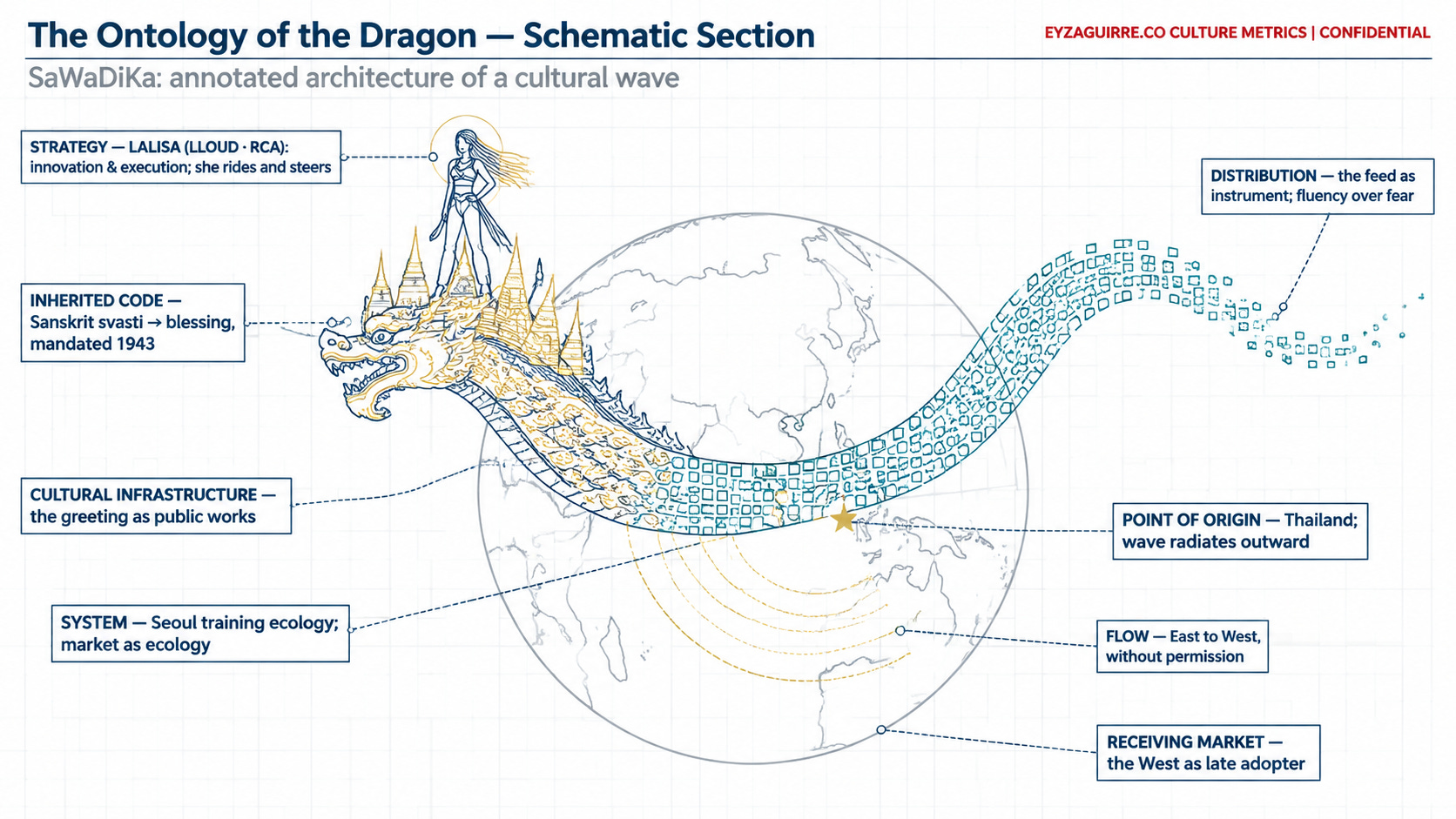
The infrastructure in 2026 is the feed. When Lisa released “SaWaDiKa” through her own label Lloud and RCA Records on September 3, 2026, as the lead single of her EP Press Play , the music video hit 70.8 million views in its first 24 hours— the highest first-day count of any release on the platform worldwide that year, second in her catalog only to “LALISA” itself, and crossing 100 million views within two days. No Western label apparatus coordinated this. A Thai artist, trained in Seoul’s K-pop system, singing a Thai greeting over Thai imagery, coordinated by an algorithm that had learned what the world’s bodies wanted before the world’s mouths could ask for it.
The pattern migrated again. This time the trade route was machine-made.
Provincializing the Machine
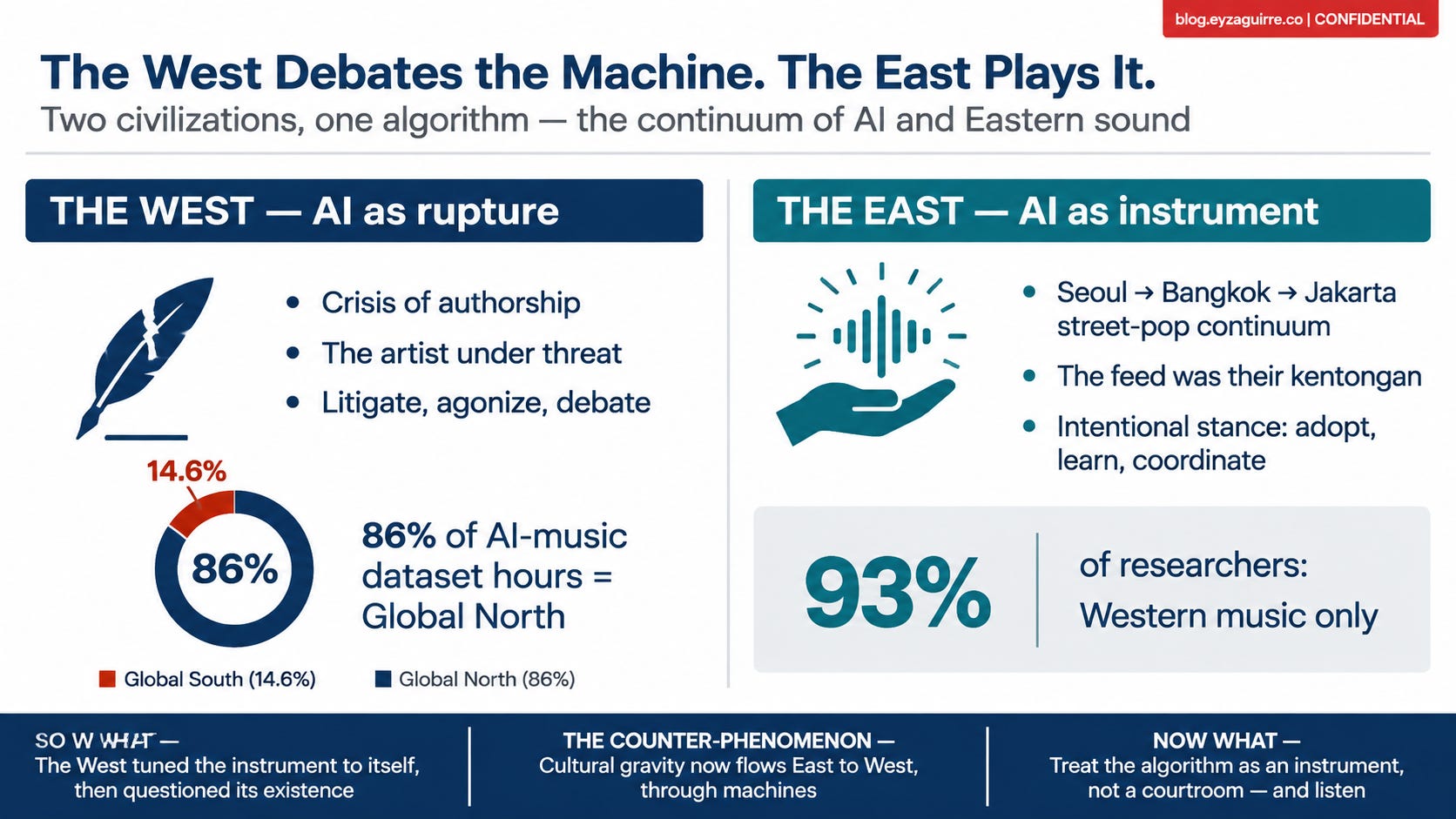
Here is where the Western story about AI and the Eastern story diverge — and where the continuum becomes visible.
The dominant Western narrative treats artificial intelligence as a rupture: a crisis of authorship, a threat to the artist, a question to be litigated and agonized over. Meanwhile, the research literature quietly documents something else: the machinery of AI music generation is overwhelmingly trained on Global North repertoires — roughly 86% of dataset hours and over 93% of researchers concentrate on Western music, while genres from the Global South account for only 14.6% of the data . The West built the instrument, tuned it to itself, and then debated whether the instrument should exist.
The East — broadly, the non-West, the street-pop continuum running from Seoul through Bangkok through Jakarta — never had the luxury of that debate. K-pop’s production culture was always a hybrid organism: industrial precision training, algorithmic choreography, feedback loops between fan armies and streaming platforms. When I wrote about “Tung Tung Tung Sahur,” I argued that Generation Alpha had internalized multi-agent coordination at the level of reflex — treating AI generators, memes, and human intention as co-equal instruments in a single flow. Lisa’s generation of Thai and Korean pop architects internalized the same move a decade earlier. The feed was their kentongan. They did not ask whether the algorithm was a real agent. They adopted the intentional stance toward it, learned its language, respected its constraints, and watched how richly they could think together.
The results are not marginal. “Rockstar,” her 2024 single, was produced in Bangkok and shot on Yaowarat Road with nearly a hundred Thai dancers and early-morning road closures so total that Thailand’s Tourism Authority later built a walking route around the video’s locations. It debuted at number one on the Billboard Global Excl. U.S. with 94.2 million streams, the most weekly streams for a non-American artist that year. Alter Ego landed at number seven on the Billboard 200. And in November 2026 she opened the Viva La Lisa residency at Caesars Palace in Las Vegas — the first residency by a K-pop artist in the history of the city that defines Western spectacle.
The pattern is not flowing West to East. It is flowing East to West, through machines, and the West is only now noticing that Las Vegas learned to say sawasdee ka.
What “SaWaDiKa” Actually Is
“SaWaDiKa” is the expression of a single pattern unfolding across different media.
The Sanskrit blessing migrated into Thai. The wai migrated into the greeting. The greeting migrated into a title — a gendered, courtesy-encoded word placed at the front of a global rap single, untranslatable in full to Western ears and entirely legible to anyone who has ever been greeted by a Thai woman. Red billboards reading “HELLO สวัสดีค่ะ” appeared in Bangkok, New York, Los Angeles, and Mexico City before anyone knew what they were for. The Tourism Authority of Thailand had already signed her as its Amazing Thailand Ambassador, and CNN now openly describes a Thai “T-wave” modeled on Korea’s K-wave, with Lisa as its carrier.
What emerges is:
Phonetically Thai (a greeting that is the culture, not a decoration of it)
Structurally Western-facing (hip-hop maximalism, braggadocio, Thom Bridges and Ojivolta’s hard-edged production honoring her origins without reducing them to aesthetic garnish)
Visually rooted (Hua Lamphong station, Muay Thai rings, tuk-tuks, Thai-patterned fabrics, Chula kites)
True (it works, it lands, in Bangkok and Las Vegas simultaneously)
In Thai, sawasdee means both hello and goodbye. That double meaning is the entire thesis. An artist who has spent years arriving somewhere new without ever quite leaving where she started — and a pattern older than nations, saying farewell to Western gatekeeping while saying hello to the algorithm.
The Flash of Instinct: The Counter-Phenomenon
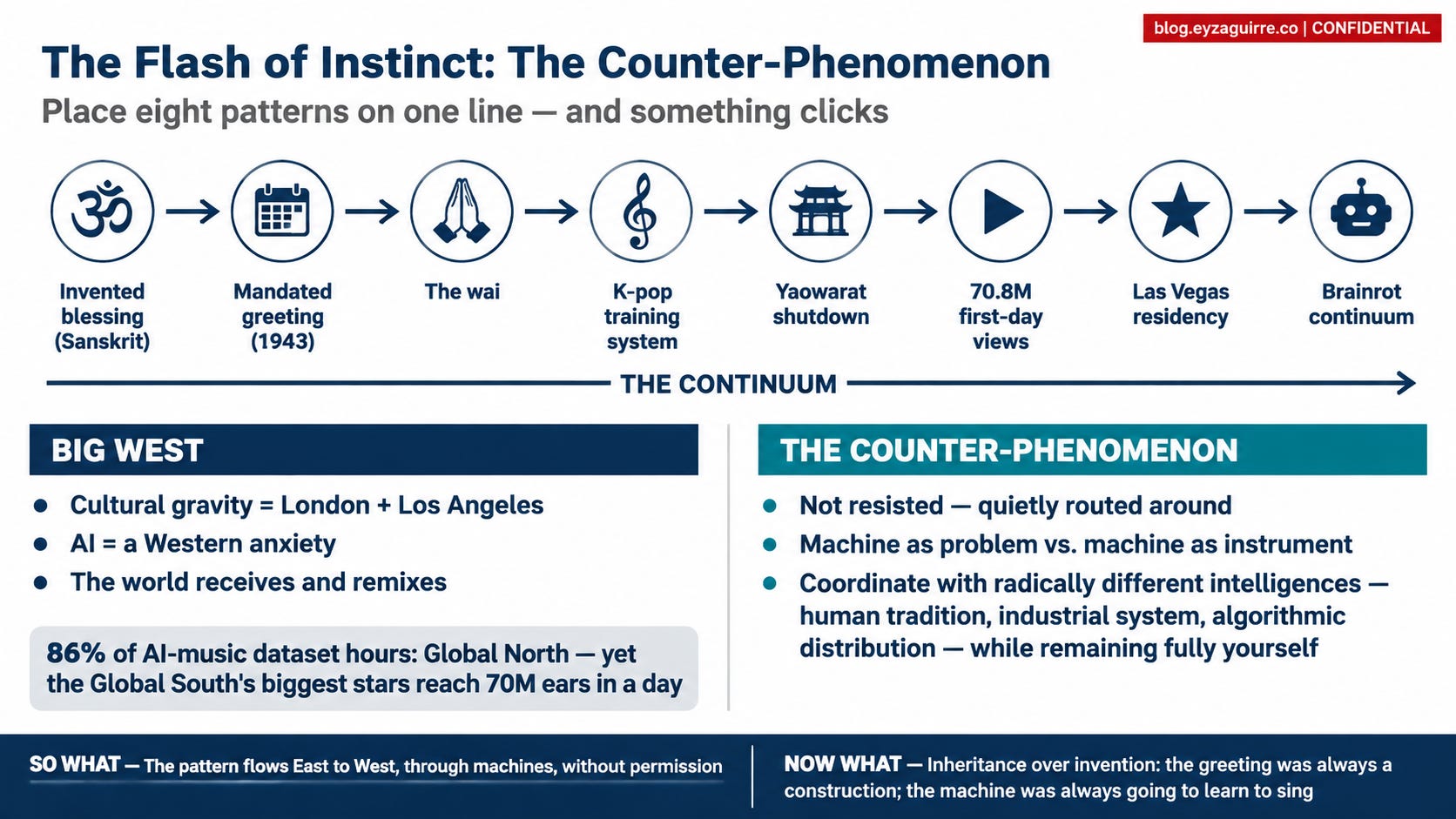
The moment you place the invented blessing, the mandated greeting, the wai, the K-pop training system, the Yaowarat shutdown, the 70.8 million first-day views, the Las Vegas residency, and the brainrot continuum on the same line, something clicks.
The “Big West” phenomenon — the assumption that cultural gravity originates in London and Los Angeles, that AI is a Western anxiety, that the rest of the world receives and remixes — is not being resisted. It is being quietly routed around. Where the West treats the machine as a problem of authorship, Bangkok treats it as an instrument. Where the West’s AI music corpus cannot hear the Global South, the Global South’s biggest stars sing directly into 70 million ears in a daywithout asking the corpus for permission. This is not domination in reverse. It is the same ancient wisdom the brainrot generation practices: coordinate with radically different intelligences — human tradition, industrial system, algorithmic distribution — while remaining fully yourself.
Lisa did not invent this. She inherited it — from a linguist who built a blessing out of Sanskrit, from a government that understood a greeting could be infrastructure, from a Seoul training system that treated the market as an ecology, from a generation that treats the feed as a songline.
The greeting was always a construction. The nation was always a remix. The machine was always going to learn to sing.
The only question was which throat it would sing through first.
In September 2026, seventy million people in one day heard the answer, and it arrived as a wish: may goodness be with you.
The continuum says hello. The continuum says goodbye.
It is the same word.
Alan Eyzaguirre, a Silicon Valley corporate strategist, product manager, and AI engineer, writes about AI’s impact on society and culture.