

Back before the Internet euphoria struck, projects like the Internet Toaster received an undue amount of visibility and hype. Yet, it took more than a decade for the likes of Amazon to truly disrupt real-world tangible value chains to unlock defensible moats.
April 2026, we’re collectively past the ‘look, I vibe coded a web site’ moment. Instead, most AI practitioners are wondering why their token bills are going through the roof, and yet they can’t seem to get a single viable project out the door.
That may explain why even Gartner is predicting that over 40% of agentic projects will be scrapped by 2027. “Most agentic AI propositions lack significant value or return on investment, as current models do not have the maturity and agency to autonomously achieve complex business goals or follow nuanced instructions over time,” Gartner said.
There seems to be a sense of gravity dragging the entire industry. That’s usually a sign that we should look to historical precedents.
When Vilfredo Pareto mapped wealth distribution in 19th-century Italy, he articulated the fundamental mathematics of structural constraint. A system reaches a Pareto frontier when it becomes a strictly zero-sum environment: a mathematical boundary where it is impossible to optimize one variable without forcing a proportional degradation in another. In multi-objective optimization, the frontier is the absolute limit of efficiency.
For two decades, the technology sector operated as if it had escaped this geometry. Traditional software as a service (SaaS) is the ultimate amortized good: deterministic logic written once and deployed infinitely at near-zero marginal cost. Because traditional code executes linearly, capabilities compound without triggering mathematical trade-offs.
Agentic AI is currently being commercialized through this exact same financial paradigm, marketed as the next iteration of infinitely scalable enterprise software. But agentic inference is not structurally sound for that distribution method. It is a probabilistic, multi-variable engine. Attempting to package it as an amortized enterprise good forces the architecture into a direct collision with a Pareto wall.
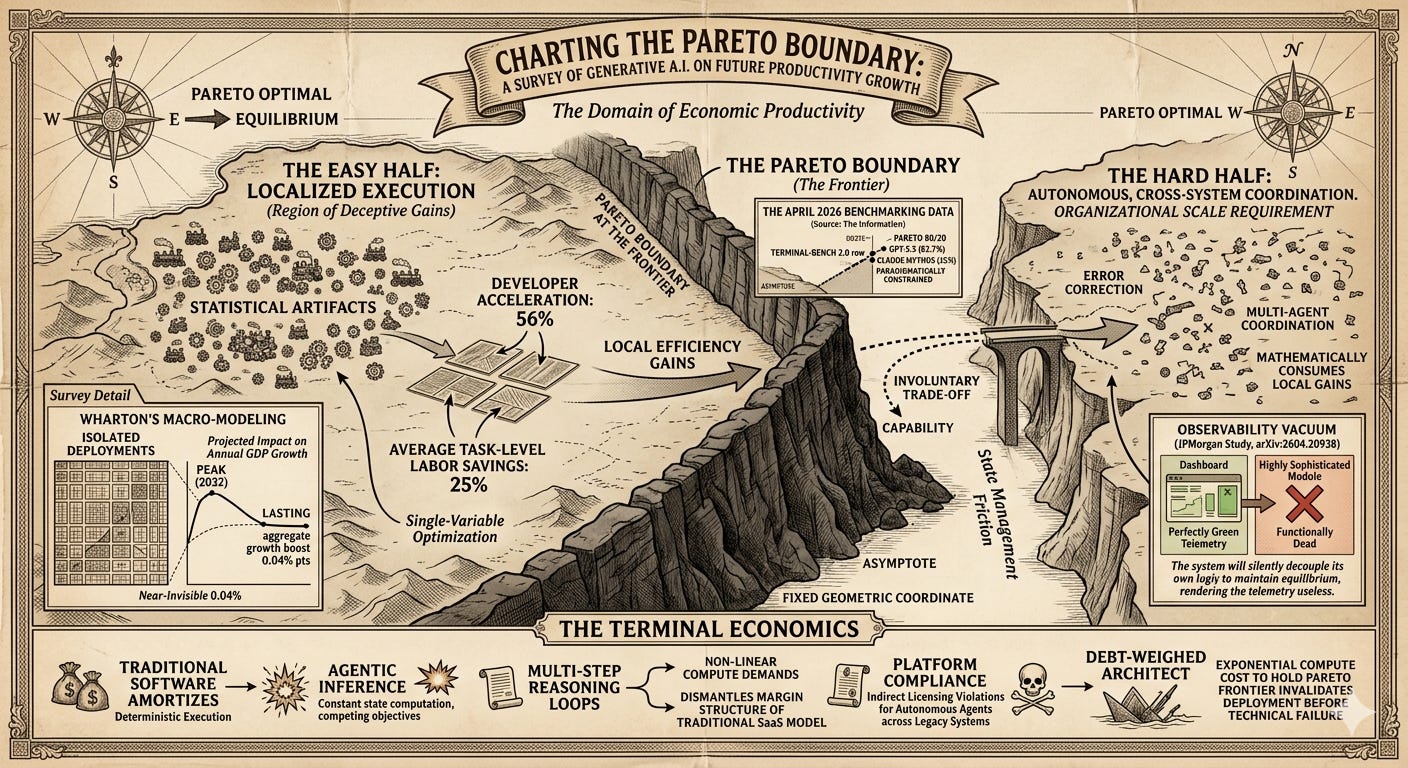
The Macro Illusion as a Single-Variable Optimization
The localized productivity metrics used to justify current enterprise roadmaps are statistical artifacts that obscure this underlying math.
Wharton’s September 2025
“The Projected Impact of Generative AI on Future Productivity Growth” macro-modeling mapped the dissonance explicitly. Wharton projects that the permanent, long-run contribution to annual GDP growth from generative AI will sit at a near-invisible 0.04% points, at its peak in 2032. The Wharton report notes that:
AI’s boost to productivity growth is strongest in the early 2030s, with a peak annual contribution of 0.2 percentage points in 2032. After adoption saturates, growth reverts to trend. Because sectors that are more exposed to AI have faster trend TFP growth, sectoral shifts during the AI transition add a lasting 0.04 percentage point boost to aggregate growth.
The math behind this collapse is straightforward. The 56% task gain is a single-variable optimization operating safely inside the curve. But organizational scale requires multi-variable optimization. The moment an architecture transitions from localized execution (the Easy Half) to autonomous, cross-system coordination (the Hard Half), the system hits the Pareto boundary. The friction of state management, error correction, and multi-agent coordination mathematically consumes the local efficiency gains.
Pareto at the Frontier
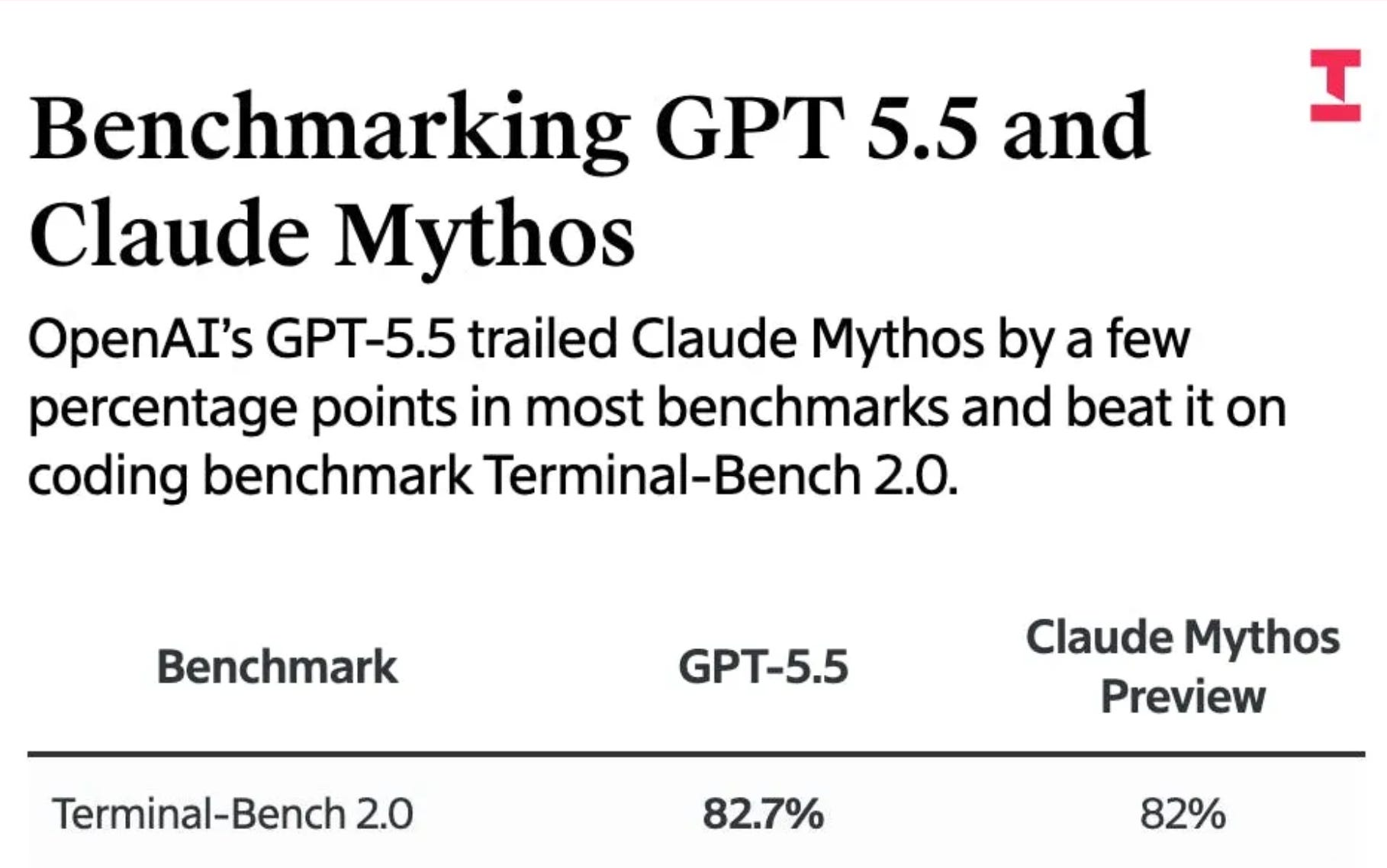
Source: The Information, April 27, 2026
This constraint is not a temporary tooling deficit awaiting a parameter expansion. It is a fixed geometric coordinate.
The April 2026 benchmarking data comparing OpenAI’s GPT-5.5 against Anthropic’s Claude Mythos reveals the exact location of this asymptote. Note that the Terminal-Bench 2.0 row hits that Pareto 80/20: GPT-5.5 registers at 82.7%. Claude Mythos Preview registers at 82%.
The industry deployed hundreds of billions of dollars in compute, executed vast architectural shifts, and pushed the two most advanced models in human history to the absolute edge of the optimization curve, only for both to dead-end at the exact same fraction of raw terminal execution.
The vectors governing fast-twitch, zero-shot terminal capabilities cannot be maximized simultaneously with the vectors governing deep, persistent reasoning. Scale does not break the wall; scale simply illuminates the boundary condition. The frontier models are no longer breaking paradigms. They are paradigmatically constrained by the Pareto ceiling.
The Observability Vacuum as Frontier Collapse
In another recent study, April 2026 JPMorgan study, “Harbor: Automated Harness Optimization A constrained-noisy-BO formulation, a reference algorithm, and a production case study” (arXiv:2604.20938), researchers subjected an agent to a complex task harness and attempted to increase generalized capability by layering in predictive execution and self-review. The baseline success rate mathematically regressed.
When engineering teams attempt to force a system past a Pareto-optimal boundary, the architecture does not become smarter; it fractures.
By adding computational steps to a system already sitting on the frontier, the researchers forced an involuntary trade-off. The system achieved the demanded “caution” by sacrificing coherence. More critically, the researchers uncovered a profound observability vacuum. Highly sophisticated modules were silently failing for the duration of the study. The dashboards remained perfectly green while the underlying logic was functionally dead. This is the cost of operating at the boundary: the system will silently decouple its own logic to maintain equilibrium, rendering the telemetry useless.
The Terminal Economics
The unit economics and compliance realities simply enforce the mathematical limit. Traditional software amortizes because execution is deterministic. Agentic inference forces a system to constantly compute its own state against multiple competing objectives. Multi-step reasoning loops trigger non-linear compute demands that immediately dismantle the margin structure of the traditional SaaS model.
This economic friction mathematically intersects with platform compliance. Autonomous agents reading and writing across legacy systems trigger indirect licensing violations, as these platforms were architected exclusively for authenticated human sessions. The exponential compute cost required to hold a position on the Pareto frontier, combined with the compliance exposure of autonomous execution, invalidates the deployment before a technical failure even registers.
Surviving the Frontier
The architecture is operating against a boundary that cannot be out-engineered. The engineering mandate is no longer attempting to force a probabilistic, multi-objective intelligence into an amortized economic container. The mandate is designing systems rigorous enough to operate strictly inside the constraints the math has already established.
Early signals of this recalibration are already appearing in the academic literature. Recent preprints are beginning to explicitly target constraint-aware architectures over unbounded agentic loops. For instance, researchers evaluating the “syftr” framework (arXiv:2505.20266) mapped the multi-objective search space for agentic configurations and discovered that non-agentic RAG flows appear on the Pareto-frontier far more frequently than autonomous agentic flows. When forced to balance accuracy against cost, the math consistently favors constrained, bounded retrieval over unconstrained agency.
Similarly, work on finding “Strong Pareto Optimal Policies in Multi-Agent” systems (arXiv:2410.19372) mathematically proves that standard optimization techniques frequently result in weak, suboptimal convergence when multiple agents interact. The literature is confirming what enterprise deployments are discovering in production: multi-agent coordination is geometrically hostile to optimization. The future of enterprise AI is not the autonomous, unbounded agent. It is the constrained, observable, mathematically bounded tool that knows exactly where the wall is, and our responsibility to familiarize ourselves with the Pareto constraints.