
Abstract
The following examines Christo and Jeanne-Claude's *Surrounded Islands* (1983) through a critical examination of their radical deployment of pink as an ontological statement. Moving beyond simplistic interpretations of their work as merely aesthetic spectacle, this analysis positions their deliberate choice of artificial pink fabric as a sophisticated dialectical intervention that challenges fundamental dichotomies in Western philosophical tradition: nature/culture, permanence/transience, and art/life. *Surrounded Islands* represents a profound philosophical proposition about the nature of human perception and environmental engagement. The pink intervention—deliberately non-natural and stimulating—functions as a form of material philosophy that disrupts habitual modes of perception, creating a "temporal excavations of attention" that reveal otherwise invisible relationships between people, place, and constructed environments.
Keywords
Environmental art, chromatic ontology, Christo and Jeanne-Claude, Surrounded Islands, temporality, phenomenology, material philosophy
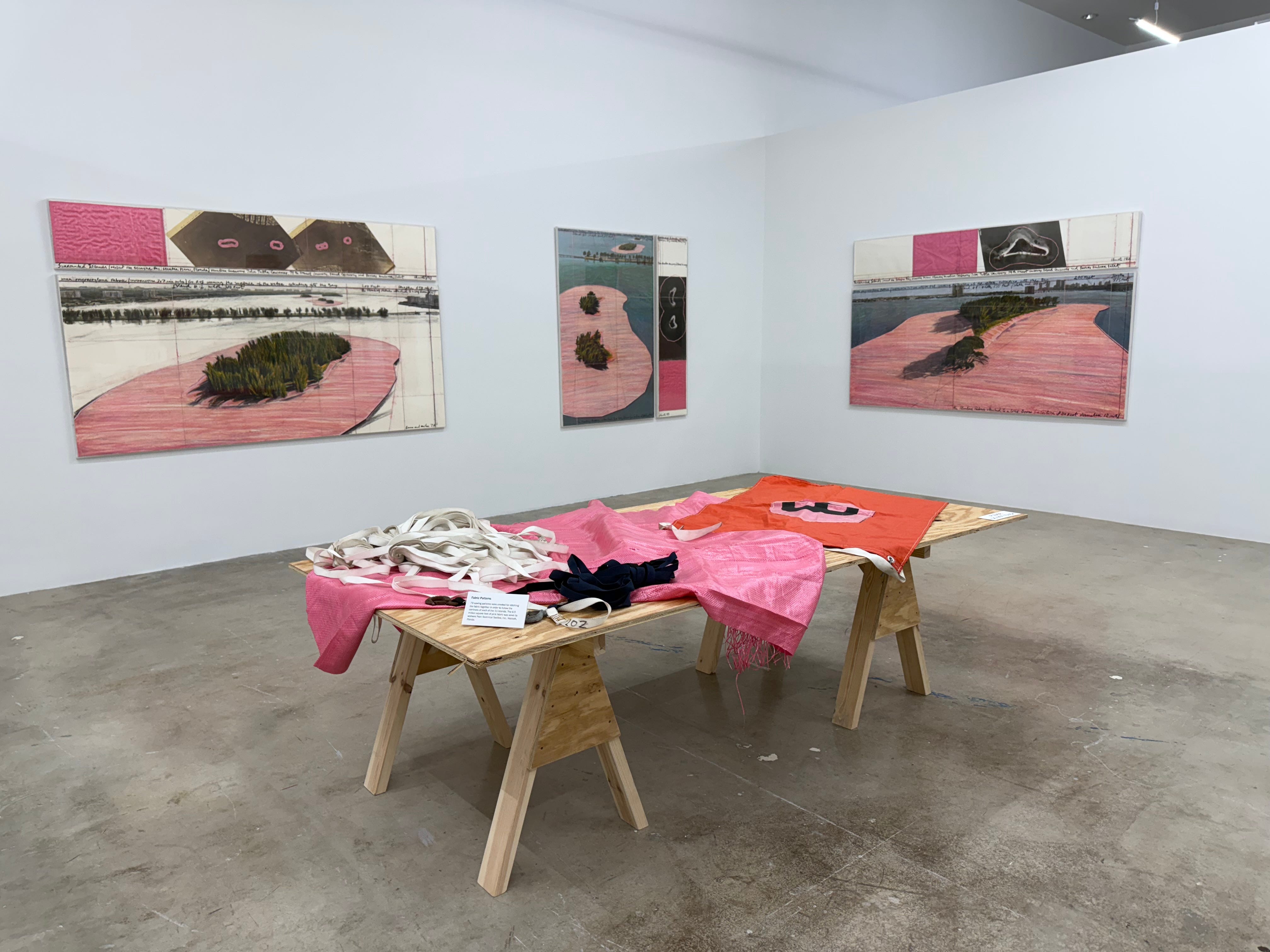
NSU Museum, April 2025
Introduction: Beyond the Spectacular
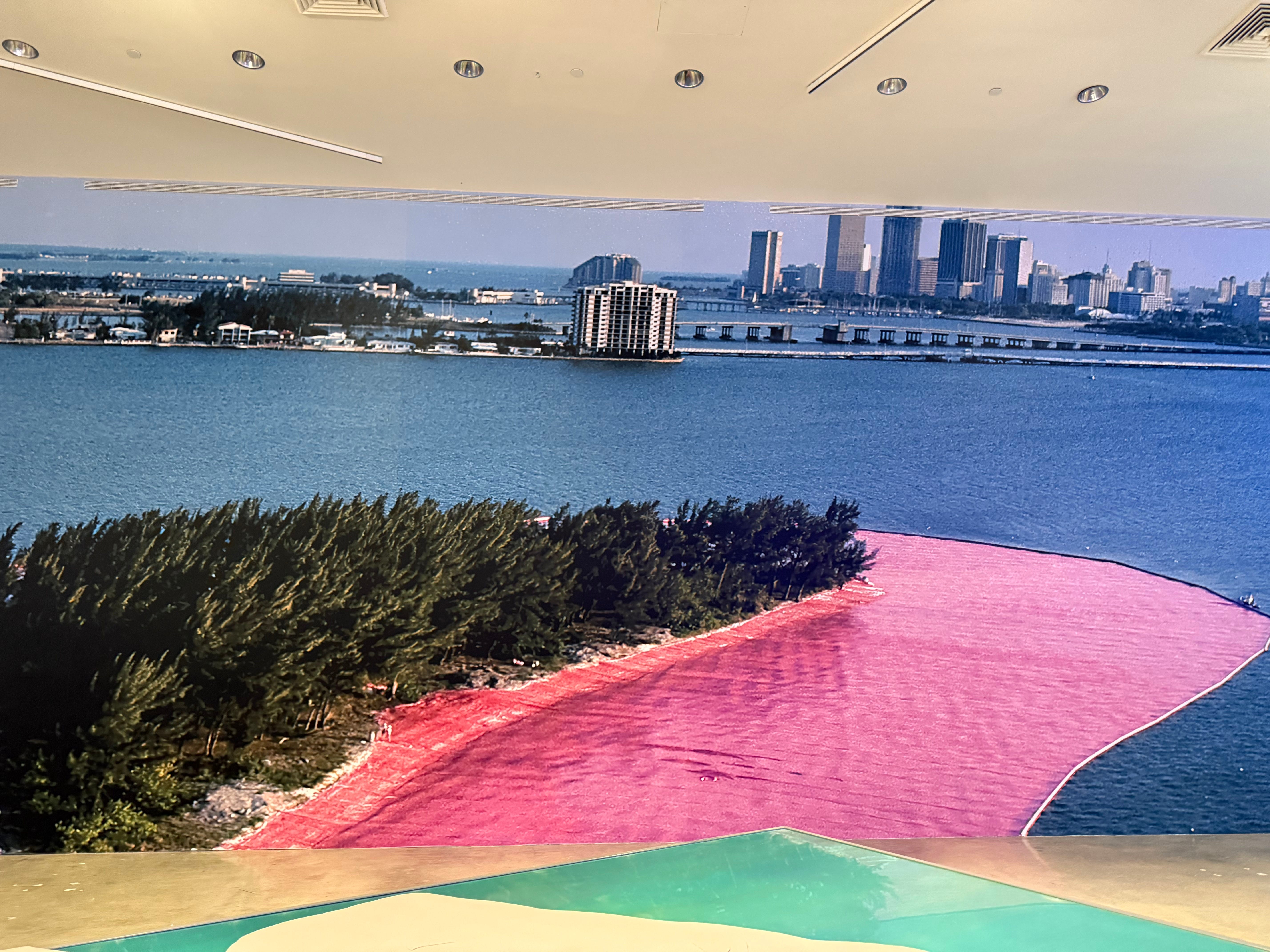
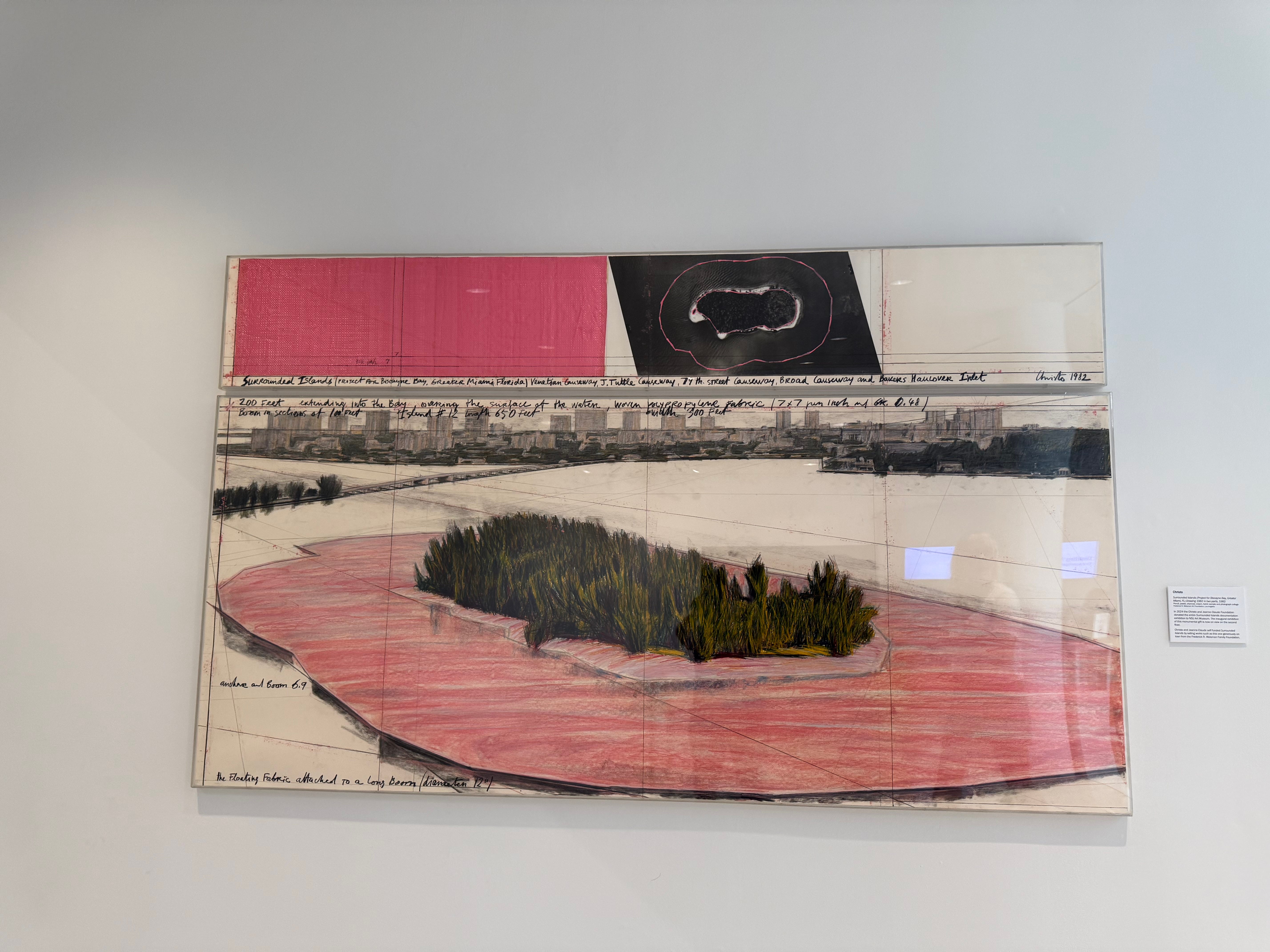
"Nobody needs a running fence or surrounded islands. They are created because Jeanne-Claude and I have this unstoppable urge to create." This declaration by Christo articulates a fundamental philosophical tension at the heart of *Surrounded Islands*—the work exists not to fill a need or solve a problem, but as a pure expression of creative imperative, divorcing art from utility and inserting it instead into the realm of ontological questioning. The resulting intervention—6.5 million square feet of floating bright pink fabric surrounding eleven islands in Biscayne Bay for fourteen days in May 1983—represents far more than a spectacular visual transformation. It constitutes a "chromatic ontology": a philosophical statement made through color that questions the very nature of being, time, and human perception.
The work's philosophical significance lies precisely in its use of pink as a deliberately artificial, non-natural chromatic intervention. "Pink is not natural and thus stimulant," Christo stated, revealing a sophisticated understanding of color as philosophical provocation rather than mere decorative element. This "unnatural" pink constitutes a multilayered philosophical statement that challenges fundamental Western dichotomies and opens new possibilities for understanding the relationship between art, environment, and human experience.
Chromatic Ontology: Pink as Philosophical Proposition
The notion of "chromatic ontology" offers a framework for understanding how Christo and Jeanne-Claude deployed color not merely as visual element but as philosophical proposition. Their selection of pink—a color rarely found in nature at such scale—constitutes what philosopher Graham Harman might term an "object-oriented ontology" that allows the material world to speak independently of human utility or meaning-making. The pink fabric becomes an autonomous actor in dialogue with its environment rather than a passive representation.
This approach reverses traditional aesthetic hierarchies that subordinate color to form. In *Surrounded Islands*, color becomes primary—the pink does not represent anything beyond itself but stands as a pure chromatic presence that forces engagement on its own terms. This aligns with Gilles Deleuze's concept of "affect" as a pre-cognitive, bodily response that precedes intellectual interpretation. The immediate visual impact of the vivid pink against blue water creates what Deleuze would term an "intensity" that disrupts habitual modes of perception.
Christo and Jeanne-Claude's insistence that their work has "absolutely no purpose whatsoever" further reinforces this philosophical positioning. By creating a massive intervention that serves no utilitarian function, they challenge the instrumental rationality that dominates contemporary relationships with environment. The pink fabric exists outside economic logic—it produces nothing, serves no function, and disappears after two weeks, leaving only transformed perception in its wake.
The Dialectics of Artificiality and Nature
The deliberate artificiality of the pink fabric creates a dialectical tension with the natural elements of Biscayne Bay that reveals, rather than conceals, the already constructed nature of the environment. The islands themselves were man-made, created through dredging operations in the 1920s. By highlighting rather than disguising human intervention, *Surrounded Islands* collapses the nature/culture binary that structures much environmental discourse.
This strategy represents a sophisticated philosophical response to environmental ethics that moves beyond simplistic preservation narratives. Rather than fetishizing an imagined "pristine" nature, Christo and Jeanne-Claude acknowledge the already-hybrid character of contemporary environments. The pink fabric makes visible the invisible human shaping of "natural" landscapes that is often ideologically obscured. As Bruno Latour might observe, their work reveals the impossibility of separating nature from culture in the Anthropocene era.
The artists' extensive environmental preparations—removing 40 tons of garbage from the islands, conducting impact studies, monitoring wildlife—further complicates simplistic readings of their work as anti-environmental. Instead, their approach models a nuanced engagement with environmental ethics that acknowledges human presence while taking responsibility for its impacts. The pink fabric thus becomes a material articulation of what philosopher Timothy Morton terms "dark ecology"—an ecological awareness that includes human intervention rather than imagining its absence.
Temporal Excavations of Attention
The ephemeral nature of *Surrounded Islands*—lasting only fourteen days—constitutes what I term a "temporal excavation of attention" that disrupts conventional relationships with time in art and environment. Traditional Western art has privileged permanence and durability, with monuments and museums designed to preserve works beyond human lifespans. Christo and Jeanne-Claude's deliberate embrace of impermanence represents a radical philosophical challenge to this tradition.
Their statement that "freedom is the enemy of possession and possession is permanence" reveals a sophisticated understanding of the relationship between temporality, ownership, and perception. By creating a work that cannot be owned, collected, or preserved, they disrupt art market logics and instead create what philosopher Henri Bergson might recognize as "pure duration"—a lived experience of time that exists outside spatial metaphors of time as linear progression.
The pink intervention creates what German philosopher Martin Heidegger would term a "clearing" (Lichtung)—a temporary opening in habitual perception that allows for fresh engagement with the environment. The striking color forces a phenomenological reset, making familiar landscapes strange and thus newly available to consciousness. This aligns with Heidegger's concept of "unconcealment" (aletheia), where truth emerges not through representation but through revealing what has been hidden by familiarity.
The work's temporary nature generates the "preciousness and urgency" the artists described, creating an intensity of engagement impossible with permanent installations. This philosophy of temporality challenges not only art traditions but also contemporary relationships with time characterized by distraction and fragmentation. *Surrounded Islands* demanded sustained attention—a rare commodity in modern experience—creating what philosopher Bernard Stiegler might term a "pharmakon" that heals attention from its technological dispersion.
The Dialectics of Scale: Intimate Monumentality
*Surrounded Islands* navigates a complex dialectic between monumental scale and intimate experience. The work's massive size—visible from aircraft and extending across 11 islands—placed it in dialogue with earlier monumental art traditions from Egyptian pyramids to American land art. Yet unlike many monumental works that overwhelm through sheer size, the pink fabric created what might be termed an "intimate monumentality" that invited personal engagement rather than awe-struck distance.
This approach redefines monumentality away from permanence and domination toward temporary transformation and dialogue. The fabric's response to wind, water, and light created a constantly changing experience that required engaged observation rather than passive consumption. This represents what philosopher Maurice Merleau-Ponty would recognize as a shift from "geometric" to "lived" space—from abstract measurement to embodied experience.
The scale of public involvement—430 workers during installation, millions of visitors, years of community engagement—further complicates traditional artistic hierarchies between creator and audience. Though Christo and Jeanne-Claude maintained artistic control, the work's realization depended on collective effort that blurred boundaries between artist and participant. This represents a philosophical challenge to Romantic notions of artistic genius and individualism, suggesting instead a relational aesthetic that acknowledges interdependence.
Pink as Transgressive Marker
The choice of pink carried specific cultural and historical connotations that added further philosophical complexity to *Surrounded Islands*. In Western color symbolism, pink has traditionally been associated with femininity, frivolity, and the decorative—categories historically marginalized in "serious" art discourse. By deploying this color at monumental scale in a public art context, Christo and Jeanne-Claude engaged in what philosopher Jacques Rancière would term a "redistribution of the sensible"—a rearrangement of what is visible and valued in public space.
This color choice was particularly significant given the contemporary context of early 1980s Miami, struggling with negative media portrayals focusing on crime, drug trafficking, and racial tensions. Against this backdrop, the dramatic transformation of Biscayne Bay with pink fabric constituted a powerful countervailing image that challenged dominant narratives about the city. The Orlando Sentinel's observation that "Pink used to mean flamingos, sunsets and art deco hotels. Now it means Christo" captures this semiotic transformation.
The pink fabric's association with traditional "feminine" qualities also complicated gender dynamics in a field historically dominated by male artists creating "heroic" interventions in landscape. Though Jeanne-Claude was not officially credited as co-artist until 1994, the concept for surrounding the islands originated with her. The vibrant pink can be read as a subtle subversion of gendered art hierarchies, inserting traditionally feminized color into monumental public art discourse.
The Politics of Perception
While Christo and Jeanne-Claude resisted explicit political interpretations of their work, insisting it had "no purpose whatsoever," *Surrounded Islands* nevertheless engaged profound political questions about public space, environmental governance, and collective decision-making. The complex process of obtaining permissions from multiple government agencies—involving public hearings, environmental studies, and community engagement—constituted what political philosopher Hannah Arendt might recognize as a form of "action" that created new public spaces for debate and deliberation.
The project's capacity to transform perception has implications that extend beyond aesthetics into what philosopher Jacques Rancière terms "the politics of aesthetics." By altering how people saw Biscayne Bay—making visible what had been ignored, highlighting relationships between land and water, exposing the constructed nature of "natural" landscapes—*Surrounded Islands* engaged in what Rancière calls "dissensus," disrupting established ways of seeing and opening possibilities for new perceptions.
The artists' insistence on self-funding their projects—"No commissions, no sponsors, ever," as Christo stated—further positioned their work outside conventional systems of patronage and power. By financing *Surrounded Islands* entirely through sale of preparatory drawings and other works, they maintained artistic autonomy while demonstrating alternatives to dominant funding models that often constrain creative possibilities.
Dialectics of Legacy: Presence in Absence
Forty years after its brief physical existence, *Surrounded Islands* continues to influence Miami's cultural identity and broader conversations about environmental art. This ongoing impact represents what I term the "dialectics of legacy"—the paradoxical way in which the work's deliberate impermanence has created lasting transformation. Though the pink fabric was removed after fourteen days, the perception it enabled remains, demonstrating what philosopher Henri Bergson might recognize as the capacity for temporary experiences to create permanent changes in consciousness.
The current transfer of the complete documentation exhibition to NSU Art Museum Fort Lauderdale further complicates this temporal dialectic. The comprehensive archive—including drawings, photographs, permits, and fabric samples—preserves traces of the temporary installation, creating what Jacques Derrida would term a "supplement" that both adds to and substitutes for the original work. This institutional preservation of a deliberately impermanent work creates productive tension between the artists' philosophy of temporality and the museum's mission of permanence.
The lasting impact on Miami's cultural evolution—from the establishment of Art Basel Miami Beach to the city's emergence as a global art destination—demonstrates how temporary interventions can catalyze permanent transformations. Nina Johnson's observation that "Whatever you think of Miami I think is in some way influenced by Christo" captures this paradoxical legacy—a two-week installation that permanently altered a city's relationship with art, environment, and self-perception.
Conclusion: Pink as Philosophical Wake-Up Call
The deliberate artificiality of pink in *Surrounded Islands* functioned as what Wittgenstein might term a "form of life"—not merely a color choice but a way of engaging with the world that reveals philosophical truths otherwise invisible. By creating what Christo called a "gentle disturbance," the pink fabric disrupted habitual perception, opening temporary spaces for fresh engagement with environment and experience.
This approach constitutes what I propose to call "material philosophy"—theoretical propositions made not through text but through physical interventions that engage bodily experience and perception. The pink fabric made visible philosophical concepts of temporality, artificiality, attention, and environmental relationship not as abstract ideas but as lived experiences accessible to all viewers regardless of philosophical training.
Four decades later, *Surrounded Islands* continues to challenge conventional dichotomies between permanent/temporary, natural/artificial, and public/private. Its sophisticated deployment of pink as philosophical provocation offers contemporary artists, thinkers, and publics a model for engaging complex questions through material interventions rather than theoretical distance. In an era of accelerating environmental change and perceptual fragmentation, Christo and Jeanne-Claude's deliberate use of "unnatural" pink as environmental intervention provides a powerful philosophical framework for reconsidering relationships between humans, environment, and the constructed world.
(Co-written with Claude 3.7 thinking).