
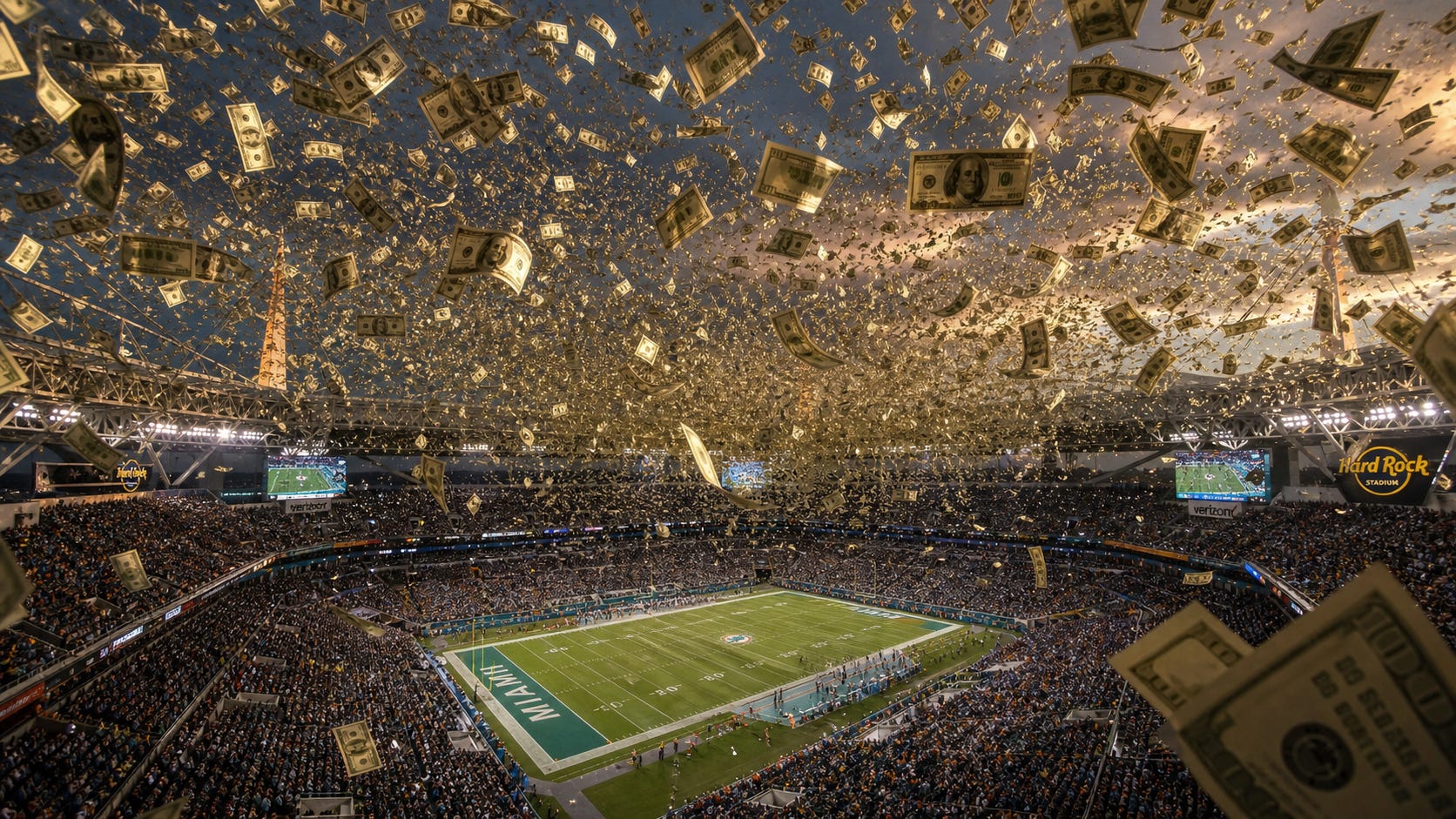
Peek at Kalshi app today, and you’ll see a staggering number: $12.4 billion moved through FIFA World Cup markets on that platform in a single month. That’s about 5 Vegas Domes, twelve Dreamforce conferences, or about one month of Meta’s board approved R&D OPEX. The gargantuan number underscores that we, as a society, decided that public opinion — the gestalt, the collective hunch, the thing a crowd feels before it can explain why — has just become fully mineable. And it may be the last major human phenomenon to fall.
What used to be a mood is now a market.
Everything else went first. Our purchases, searches, faces, sleep, heartbeats, friendships, and fears have been instrumented and monetized for two decades. But the gestalt — the aggregate, pre-verbal sense a population has about what is true, who will win, what is fair, what is coming — resisted extraction longer than almost anything else, because it lived nowhere you could query it. It existed only as a diffuse, untraceable atmosphere: the mood in a stadium, the shift in a newsroom, the thing pollsters chased a week late and always imperfectly. Pew Research Center has spent years documenting how thin that resistance has become. Combined monthly trading volume on prediction markets rose from under $5 billion in September 2025 to nearly $24 billion by April 2026, with sports — not elections, not economic indicators — driving the overwhelming majority of it. Pew’s data shows the last frontier being colonized in real time.
Kalshi is the colonization mechanism, and its business model prowess and Timothy Chalamet commercials, sold our inherent tribal-oriented humanity—without even asking. It prices conviction continuously, the instant it forms, and turns the resulting number into a tradable asset. What used to be a mood is now a market. What used to dissipate the moment the final whistle blew now persists as settled data, timestamped, auditable, monetizable, and available for the next model to train on.
What Was Actually Lost
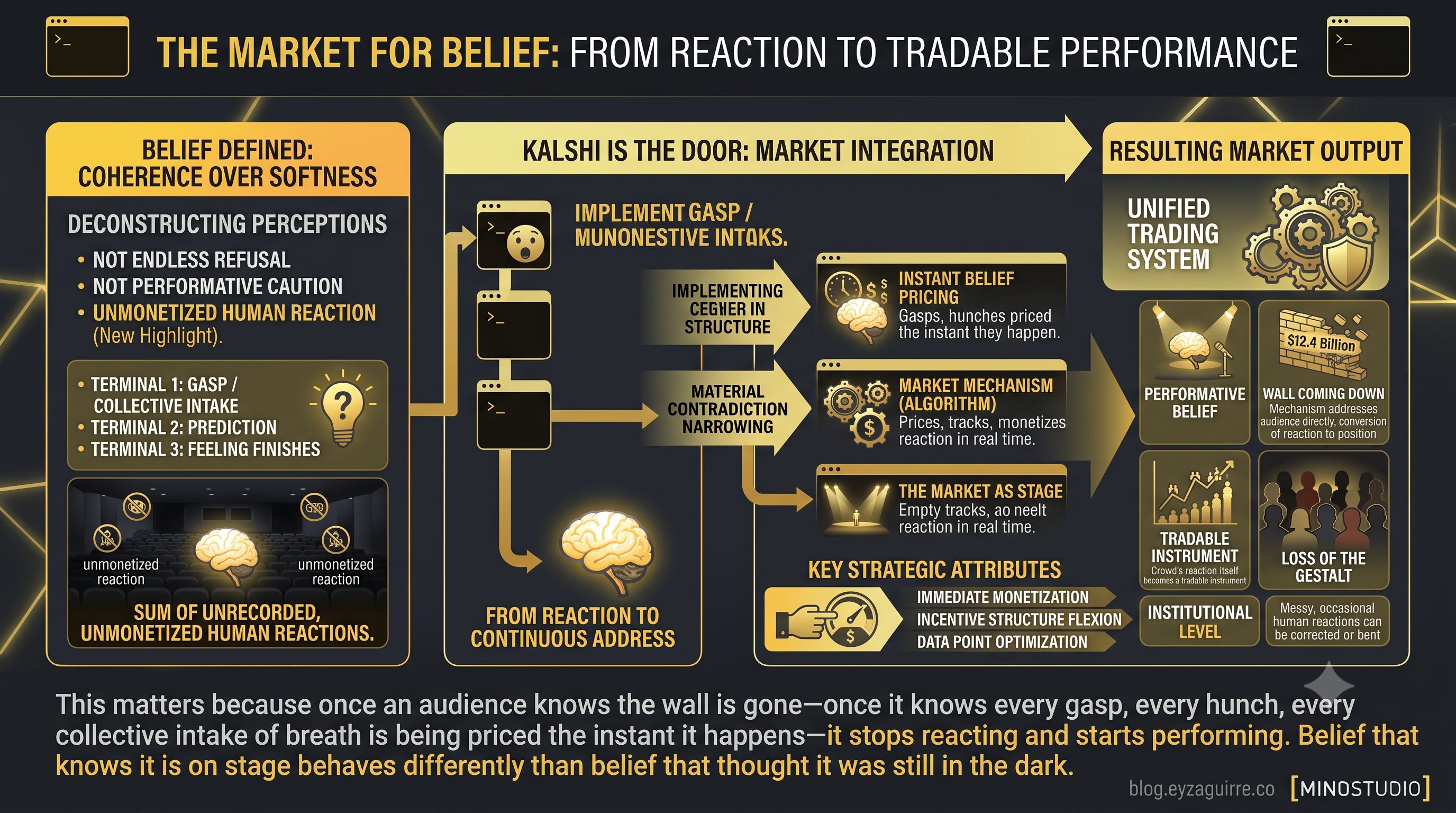
There used to be a fourth wall between belief and market, the same wall that separates a stage from an audience. The convention was simple and, for most of human history, unbreakable in practice: what a person felt about an outcome — who would win, what was fair, what was coming — existed on one side of that wall, and the mechanisms that priced, tracked, and monetized behavior existed on the other. The actor did not turn to the crowd and ask what they’d bet on the next scene. The crowd’s reaction was not itself a tradable instrument. The wall held not because anyone defended it, but because no one had yet built a door through it.
Kalshi is the door.
The gestalt mattered precisely because it lived entirely on the audience’s side of that wall. No algorithm could correct it, no incentive structure could bend it, no dashboard could optimize it into a more profitable shape, because it existed only as the sum of millions of unrecorded, unmonetized human reactions. It was messy, often wrong, occasionally cruel, frequently late — and none of that mattered, because its value was never in its accuracy. Its value was in being the one thing a person’s belief could contribute to without becoming a data point first, without the actor on stage ever knowing it was being watched, priced, and settled in real time.
There will be no referendum on this loss, because a referendum is itself just another instrument for pricing opinion. The gestalt does not get a vote in its own extraction.
What $12.4 billion represents is the wall coming down, in full view, with applause. The audience is no longer merely reacting. It is being addressed directly, continuously, by a mechanism that wants its reaction converted into a position before the feeling has even finished forming. And once an audience knows the wall is gone — once it knows every gasp, every hunch, every collective intake of breath is being priced the instant it happens — it stops reacting and starts performing. Belief that knows it is on stage behaves differently than belief that thought it was still in the dark, safely anonymous, unaccountable to anyone but itself.
This is not a claim that the door was built maliciously, or that what replaced the wall is without value. Markets that price belief in real time are, in some respects, more honest than the institutions — polling, punditry, legacy commentary — that spent decades claiming to represent public opinion while quietly directing it from backstage. That argument has real force. But it is an argument, not a fact, and it should not be allowed to settle the deeper question by default: something was lost the moment the last wall between felt belief and priced belief came down, and there is no rebuilding it once the audience knows it’s being watched.
Should We Cherish It
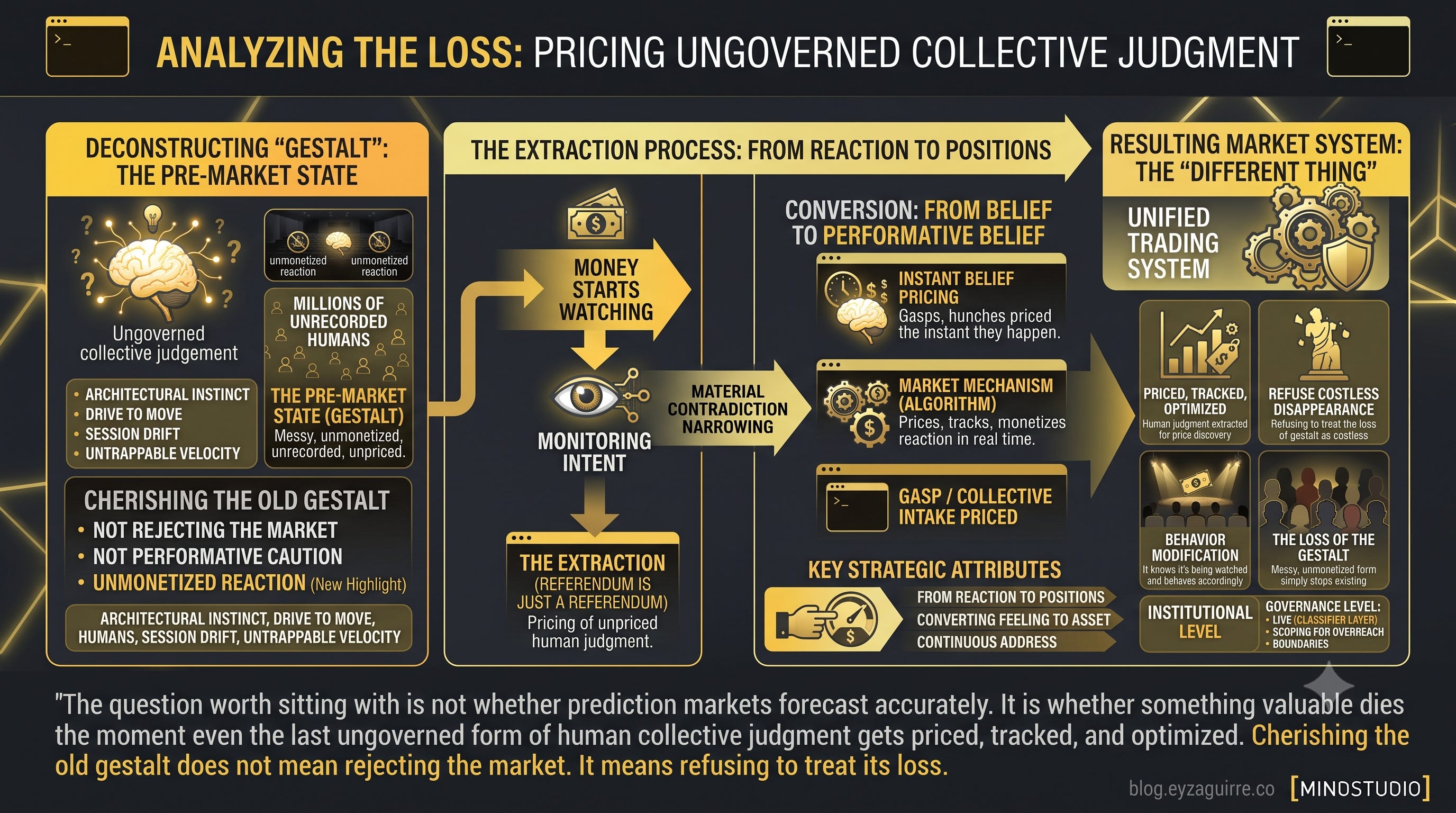
The question worth sitting with is not whether prediction markets forecast accurately. It is whether something valuable dies the moment even the last ungoverned form of human collective judgment gets priced, tracked, and optimized. Cherishing the old gestalt does not mean rejecting the market. It means refusing to treat its disappearance as costless.
There will be no referendum on this loss, because a referendum is itself just another instrument for pricing opinion. The gestalt does not get a vote in its own extraction. It simply stops existing in its old form the moment enough money starts watching it, and what replaces it — however useful, however lucrative, however genuinely more accurate — is not the same thing wearing a new interface. It is a different thing entirely, one that knows it is being watched, and behaves accordingly.
$12.4 billion is not just a number about football. It is the receipt for the last thing that used to be free of the ledger.
Alan Eyzaguirre, a Silicon Valley corporate and product strategist, writes about practical applications for the next wave of generative AI.