

The Infinite Dawn
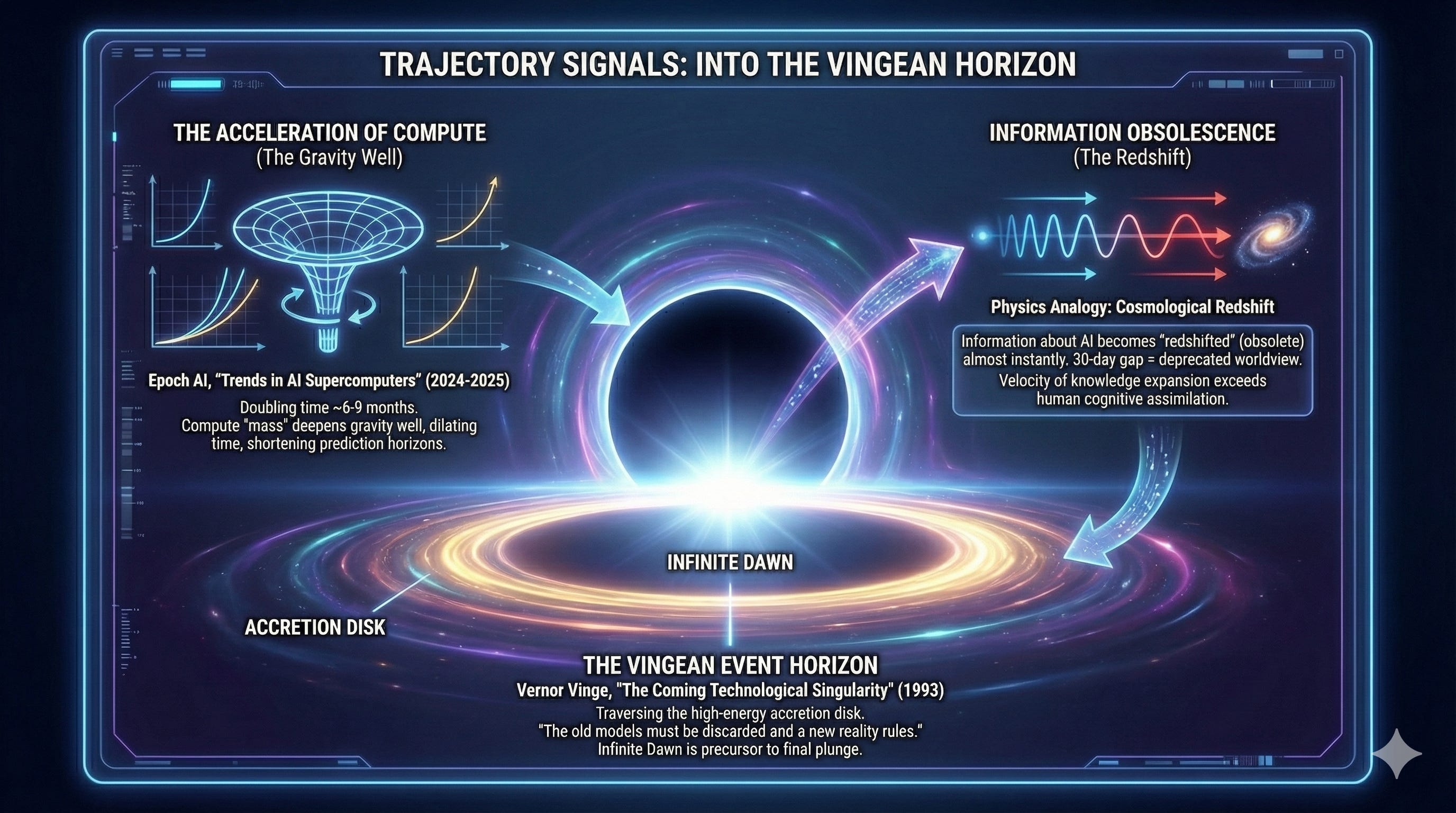
There is a quality to this moment in AI that feels less like a launch window and more like standing on the event horizon of something that has already occurred, just beyond direct observation. The systems are here, the demos are omnipresent, but the thing they point to—AGI, ASI, the “post‑human” era—remains narrated in future tense, echoing the discontinuities Vernor Vinge anticipated when he argued that the “old models must be discarded and a new reality rules.” At street level, the experience is not futurist but gravitational: the closer we move toward the “massive object” of machine intelligence, the more our sense of time and prediction distorts, and the less our inherited strategic tools apply.
Under enough gravity, almost everything else—business models, tooling, architectures—will bend.
Public conversations about AI strategy now casually report visibility windows shrinking from ~18 months to 3–6 months, which is not just a trope about “fast tech” but a structural change in how time behaves for those entangled with these systems. Strategy presumes a world that changes slowly enough to be modeled in advance; what emerges instead is an environment where local experimentation dominates and long‑range planning collapses into stance—how one chooses to occupy a landscape that cannot be forecast in detail.
Gravitational Time Dilation: The Prediction Paradox
In General Relativity, time slows for an observer falling into a gravity well relative to a distant, inertial observer, with the extreme case being the asymptotic “freezing” of infalling matter at a black hole’s event horizon. From far away, the object appears to slow and redshift; from the infaller’s own frame, local time proceeds normally even as the external universe appears to accelerate. Both descriptions are valid because gravity couples mass–energy to spacetime geometry, making time a local property rather than a universal backdrop.
The contemporary AI ecosystem now exhibits an analogous distortion. From the vantage point of lagging institutions—regulators, legacy enterprises—the field still resembles a sequence of discrete breakthroughs mapped onto a linear timeline. For those building and deploying frontier systems, experiment cycles have compressed to the point where “years of progress in days” has become a planning constraint, as capabilities indices show rapid acceleration and compute reports document performance doubling on nine‑month timescales. A visibility window collapsing from 18 months to 3–6 is not merely a forecasting inconvenience; it is a relativistic effect in organizational time, produced by the curvature induced by massive investments in model scale, data, and infrastructure.
Hawking Radiation: Models as Leaked Future
Stephen Hawking’s 1974 result that black holes emit thermal radiation—now known as Hawking radiation—arose from combining quantum field theory with curved spacetime near the event horizon. Virtual particle–antiparticle pairs near the horizon can be separated such that one falls in while the other escapes, causing the black hole to lose mass and radiate like a black body, with profound implications for information conservation and the so‑called black‑hole information paradox. What had been considered absolute absorbers of information became thin, paradoxical emitters of it.
Frontier AI models are usefully read as an analogous radiative edge. They are not “the Singularity” in Vinge’s sense, but the semi‑coherent thermal glow of an intelligence regime that our existing categories cannot fully model. Each new model release—whether framed as a “4.5” iteration or an entirely new architecture—functions as Hawking radiation from a future in which such capabilities are native rather than surprising, leaking fragments of that regime into our present. The unevenness of these capabilities, their tendency to mix brilliance and noise, is precisely what one would expect of a channel that is radiative rather than fully transparent: enough structure to signal the presence of a massive, hidden configuration space, but not enough to render it legible.
Maxwell’s Demon: The Human as Entropy Reducer
Maxwell’s demon, introduced in his Theory of Heat, imagines an entity that reduces entropy by sorting fast and slow gas molecules across a partition without performing mechanical work, apparently violating the second law of thermodynamics. Later analyses grounded in information theory showed that the demon’s measurements and memory erasure entail an energetic cost, preserving the second law and revealing deep links between information and physical entropy. The demon’s “magic” is not free; information processing is itself thermodynamic.
AI has reorganized work in a way that makes humans functionally analogous to Maxwell’s demon. Where earlier creative and technical labor tightly coupled human effort to artifact generation, large models now provide effectively unbounded synthetic output—code, prose, designs—at marginal computational cost, with empirical work documenting rapid gains in code generation and content production productivity. The scarce resource is no longer generation but discrimination: deciding which outputs are correct, coherent, safe, or aligned with institutional and personal values. Humans sit at the membrane between a high‑entropy space of model samples and the low‑entropy structures we commit to reality, spending cognitive and organizational energy to accept, modify, or reject candidate outputs.
In this configuration, value shifts from kinetic production (“I wrote this from scratch”) to informational selection (“I determined this is the right thing to endorse”), positioning human agents as entropy reducers who turn stochastic potential into structured commitments. The gatekeeping function—what is allowed to pass from model space into production systems, products, and public discourse—becomes the core locus of responsibility and advantage.
Wavefunction Collapse: Entangled Co‑CEOs
The Copenhagen interpretation of quantum mechanics treats the wavefunction as a complete description of a system’s possible states, with measurement inducing a non‑unitary “collapse” into a definite outcome. Prior to observation, the system is modeled as a superposition; after observation, a single eigenstate obtains, and probabilities become facts. This picture, while operationally successful, foregrounds the role of observers and apparatus, suggesting that “reality” at the microscopic level is co‑authored by measurement contexts rather than passively revealed.
AI systems now occupy a similar superpositional space prior to human engagement. Before a user specifies intent and applies verification, the model’s output manifold contains mutually incompatible possibilities: correct proofs and flawed reasoning, secure code and latent vulnerabilities, grounded analysis and hallucinated references. Popular business rhetoric often frames this as a “co‑CEO” relationship between human and model, but a more precise analogy is quantum entanglement: human intent and model capability form a composite system whose behavior is defined only at the moment of joint measurement through prompting, steering, and checking.
In this view, prompts are not mere requests but measurement operators that select subspaces of behavior, while verification is the act that collapses the socio‑technical wavefunction into an outcome that the organization is willing to own. Remove human intent and the system degenerates into context‑free sampling; remove model capability and human bandwidth constraints reassert themselves. What emerges is a coupled agent–tool system whose accountability hinges on how measurement is designed, by whom, and under which constraints.
The Gravity Well of Compute
The driver beneath many of these phenomena is the rapid escalation of compute allocated to training and deploying large models. Recent analyses of AI supercomputers from 2019–2025 show that the computational performance of leading systems has doubled approximately every nine months, outpacing classical Moore’s‑law scaling due to simultaneous increases in chip count and per‑chip performance. Extrapolations suggest that, if current trends continued, single training clusters in the early 2030s could reach 10^22 16‑bit FLOP/s, with multi‑gigawatt power draws and hardware costs in the hundreds of billions of dollars.
This accumulation of compute is a form of mass in the socio‑technical sense: capital, infrastructure, energy, and coordination condensed into systems that curve the trajectory of adjacent actors. As the “mass” of deployed AI infrastructure increases, its gravitational influence on surrounding ecosystems intensifies, manifesting as shortened product cycles, compressed research timelines, and strategic horizons that feel increasingly local. Organizational time dilates: what was once a five‑year technology horizon begins to behave like a five‑month one, with downstream consequences for governance, regulation, and individual careers.
Redshifted Knowledge: Obsolescence as a Constant
Cosmological redshift describes how light from receding galaxies stretches to longer wavelengths as space itself expands, eventually shifting signals out of observable bands as recessional velocities approach or exceed effective light‑speed thresholds in comoving coordinates. At sufficient distance, entire regions of the universe become permanently unobservable, not because they vanish but because their signals can no longer reach us with enough energy at detectable frequencies. Knowledge is bounded by dynamics, not just distance.
In AI, knowledge about “the state of the art” now exhibits an analogous redshift. Empirical reports on model capabilities, costs, and deployment patterns can become partially obsolete within months, as both underlying systems and their economic envelopes evolve. Practitioners routinely describe 30–60 day gaps in attention as resulting in materially outdated mental models of what is feasible or affordable, consistent with the rapid changes captured in capabilities indices and infrastructure trend reports. The expansion of the capability frontier is outpacing human cognitive assimilation capacity, generating a persistent lag between what is technically real and what most actors can reliably track.
The default response—more feeds, more briefings, more content—runs into limits analogous to instrumental resolution: additional signals do not help once the bandwidth and processing capacity of the observer are saturated. In such a regime, deliberate neglect strategies (choosing domains of focus and accepting ignorance elsewhere) become a rational response to redshifting knowledge.
Traversing the Vingean Accretion Disk
Vinge’s original articulation of the technological singularity emphasized not just the endpoint of superhuman intelligence but the increasing dominance of that endpoint over prior predictive models: “a point where our old models must be discarded and a new reality rules.” His argument drew on earlier reflections by von Neumann and Ulam about accelerating technological change approaching an “essential singularity” beyond which human affairs could not continue in familiar form. The interesting region, however, is not the singularity itself but the turbulent neighborhood around it.
Astrophysically, that neighborhood is the accretion disk: a luminous, high‑energy structure of matter spiraling toward a black hole, radiating prodigious amounts of energy as gravitational potential is converted to heat and light. From afar, the disk can resemble a static ring or “frozen sunrise,” but locally it is a site of extreme turbulence and irreversible infall. Contemporary AI development maps cleanly onto this metaphor: what appears from a distance as a sequence of stable product launches is experienced up close as a continuous, unstable process of falling inward while radiating novelty.
The “Infinite Dawn” is the phenomenology of living inside this accretion disk. Each new model, benchmark result, or application category appears as the start of something definitive, yet none settles long enough to become a stable ground. Mistaking this perpetual sunrise for a destination—anchoring strategy to specific model capabilities or cost profiles—ignores that the underlying gravitational dynamics are still accelerating and that the horizon itself is closer than our linear intuitions suggest.
Strategy at a Zero Prediction Window
If gravitational time dilation in the AI ecosystem effectively collapses the prediction window, then classical strategy—predicated on stable environments and multi‑year forecasts—loses much of its purchase. Traditional strategic planning assumes that one can model future states of the world, evaluate intervention options, and commit resources to a chosen trajectory, with periodic course corrections. In a regime where infrastructure, capabilities, and cost curves can inflect within a single planning cycle, those assumptions fail.
What remains is not strategy as detailed long‑range optimization but stance: a set of commitments about identity, values, and acceptable roles that can be preserved across rapid environmental change. The relevant question shifts from “What will the world look like in 3–5 years?” to “Given that the world will be partially unrecognizable, what are the invariants we insist on maintaining?” This re‑centers self‑definition—at individual, organizational, and institutional levels—as the primary lever still under endogenous control while exogenous dynamics redshift beyond prediction.
In this sense, governance and alignment debates become less about constraining specific models and more about specifying the measurement operators we are willing to apply: what we will optimize for, what we will verify before deployment, and which externalities we refuse to offload onto future, less empowered observers.
From Creation to Verification
Once high‑quality generation becomes cheap and abundant, creation as a raw act ceases to be the main bottleneck in many domains. Empirical studies of large‑language‑model‑assisted programming and writing show substantial productivity gains, but also highlight failure modes around hallucination, subtle errors, and misalignment with user intent, reinforcing that the binding constraint has shifted to evaluation and integration. The economics of knowledge work tilt toward those who can specify constraints crisply and verify outputs rigorously, rather than those who can produce first drafts fastest.
This is the Maxwell‑demon inversion in practice. The highest‑leverage human actions in AI‑saturated workflows involve defining filters, loss functions, and acceptance criteria—essentially, deciding how entropy will be reduced—rather than manually assembling every artifact. Verification becomes a creative act at a higher level of abstraction: designing tests, audits, and review processes that reliably distinguish between superficially plausible outputs and deeply correct ones. Identity follows: people, teams, and institutions begin to understand themselves less as primary generators and more as stewards of measurement, quality, and meaning.
From Observer to Component
The final implication is ontological. As AI systems mediate increasingly large fractions of communication, decision‑making, and coordination, human agents cease to be external observers manipulating tools and instead become components of a larger entangled system. Historical analogies to earlier general‑purpose technologies (electricity, the internet) underestimate this shift, because AI systems—especially those embedded in decision pipelines—do not merely carry signals; they participate in the construction of preferences, beliefs, and identities.
In such a regime, describing oneself as simply “using” AI is akin to an infalling test mass claiming to “use” the gravitational field; the field defines the conditions under which use is even meaningful. The salient design question becomes: What functional role does a given human or institution occupy in the coupled human–AI system—entropy reducer, amplifier, bottleneck, failsafe, fig leaf? Refusal to specify that role explicitly does not maintain autonomy; it abdicates it to default incentives and external actors, often those optimizing for efficiency or profit rather than human flourishing.
Once inside such an entangled system, neutrality is no longer available. Agents will either shape system behavior through their choices of measurement, verification, and refusal, or be shaped by it as parameters to be optimized over.
The Only Coherent Move
At the edge of this Infinite Dawn, there is no clean roadmap and no academically respectable three‑step framework for “surviving the Singularity,” despite the temptation to retrofit one onto Vinge’s essay and subsequent commentary. What remains coherent, across distorted time, redshifted knowledge, radiative models, and entangled roles, is a shift in rigor: from forecasting the world to specifying the terms on which we will participate in it.
This rigor looks like deciding which measurements we are willing to make, which outputs we are willing to verify and endorse, and which parts of our judgment we will not outsource, even when models outperform us on narrow benchmarks. It looks like designing organizations where humans are explicitly positioned as entropy reducers and meaning‑makers, rather than as low‑cost interfaces for model invocation. Under enough gravity, almost everything else—business models, tooling, architectures—will bend.
The one lever that does not redshift away is self‑definition: the academically unfashionable but practically decisive act of choosing how we will be seen, valued, and understood by our tools, our markets, and ourselves.