
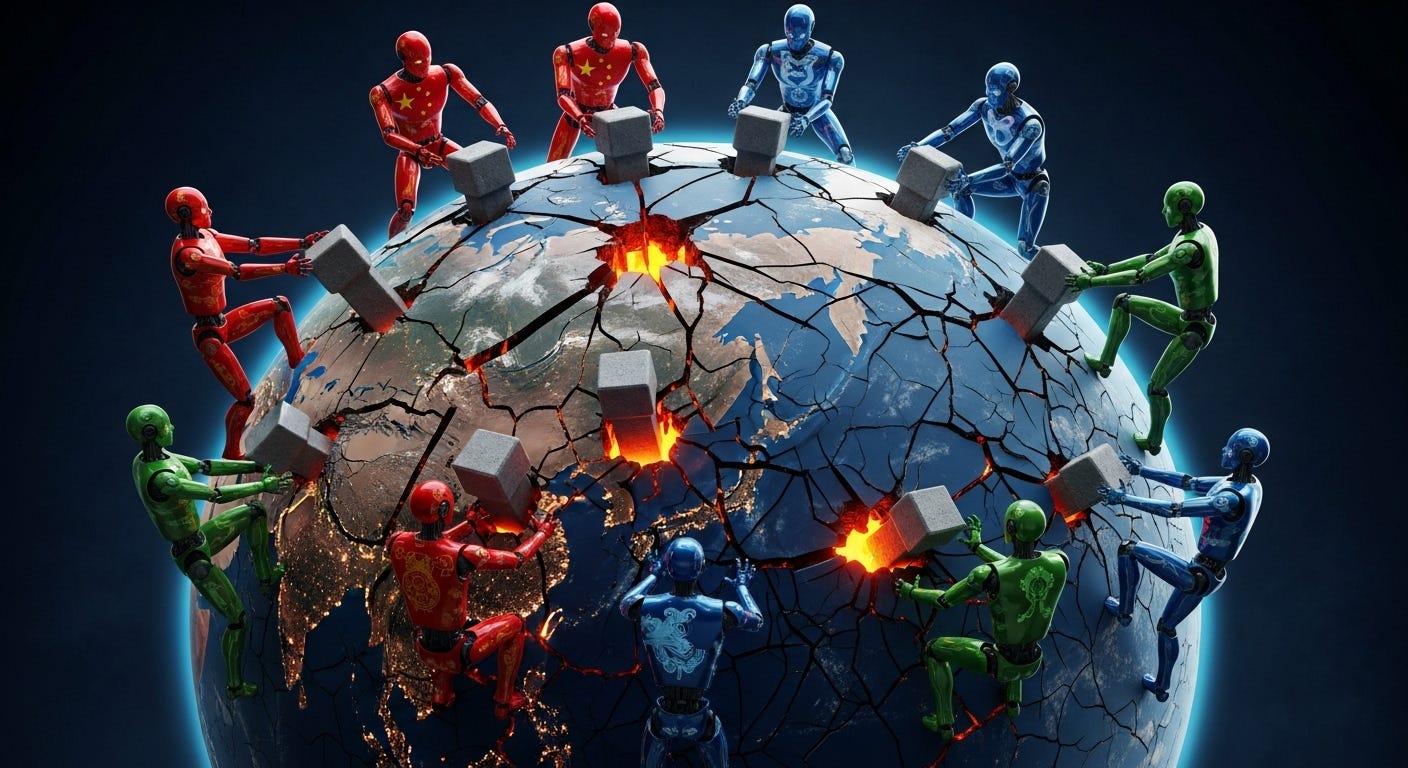
In about 18 months, a single person with Claude or GPT-6 will be able to generate a billion-dollar business. They’ll write the code, design the product, run the marketing, manage the operations—all through AI agents working on their behalf.
When that happens, what does “earning a living” even mean?
Everyone’s focused on Universal Basic Income as a policy question. Should it be $1,000 or $2,000 a month? Should it be means-tested? The usual debates.
But there’s a deeper question no one’s asking: When AI agents are negotiating resource allocation on behalf of billions of people, what language will they use?
Because it won’t be English. And it won’t be legislation.
It’ll be something else entirely. And we don’t have it yet.
AI-mediated Future Scenarios
1. The Fragmentation
Without shared frameworks for value negotiation, we don’t get a unified society with UBI. We get neo-tribal zones.
Imagine Burning Man, but permanent. Not hippie communes—think autonomous micro-societies with their own rules, their own resource pools, their own definitions of fairness. Some will be hyper-capitalist. Some will be post-money gift economies. Some will be algorithmic dictatorships.
These aren’t fringe communities. They’re already forming. Every DAO, every private Discord with its own economy, every alternative community experimenting with new social contracts—these are the prototypes.
The question: how do these zones trade with each other? How does the libertarian tech colony negotiate with the mutual aid network negotiate with the corporate enclave?
Right now, they can’t. Each speaks a different language about value. And when push comes to shove, negotiation breaks down into power dynamics—who has more guns, more money, more leverage.
That’s not a bug of our current system. That’s what happens when you don’t have better tools.
2. The Agent Wars
You’ll have personal AI agents soon. Everyone will. They’ll manage your money, negotiate your contracts, optimize your life.
But here’s the problem: your agent runs on Llama (open source), your employer’s runs on GPT (OpenAI), your city’s runs on Gemini (Google), your insurance company’s runs on Claude (Anthropic).
When they need to negotiate—and they will, constantly—they’ll fail. Not because of technical incompatibility, but because of semantic incompatibility.
Your agent thinks “fair compensation” means maximizing your individual outcome. Your employer’s agent thinks it means market rates adjusted for collective productivity. Your city’s agent thinks it means equitable distribution across social groups.
These aren’t just different numbers. They’re incommensurable value systems expressed in code.
Right now, we solve this with humans mediating. Lawyers, managers, bureaucrats—people who can translate between frameworks.
But when agents are making thousands of micro-negotiations per second? When the pace of AI-mediated transactions exceeds human oversight capacity?
We’re headed toward a world where AI agents from different ecosystems literally can’t understand each other’s definitions of basic concepts like “risk,” “value,” or “fair allocation.”
This is the Tower of Babel problem, but for machines. And unlike the biblical version, we can’t just walk away from the tower.
3. The Geopolitical Freeze
China’s AI, America’s AI, Europe’s AI—they’re already diverging. Different training data, different values, different optimization targets.
When they need to cooperate (climate, trade, security), how do they negotiate? Through human diplomats? That’s the old way, and it’s already too slow.
But there is no new way. Not yet.
Chinese AI’s conception of “collective good” and American AI’s conception of “individual liberty” aren’t just different—they’re fundamentally incompatible at the architectural level. These AIs are optimizing for different objective functions that can’t be reconciled through normal diplomatic channels.
The first time a Chinese autonomous trading system needs to negotiate carbon credits with an American one, both sides will claim they’re being fair according to their own frameworks. And both will be right. And neither will have a way to bridge the gap.
This isn’t a political problem. It’s a semantic infrastructure problem. We don’t have the tools to make these negotiations legible across civilizational boundaries.
And unlike traditional diplomacy, where humans can muddle through with vague language and implicit understanding, AI systems require explicit frameworks. They can’t operate on vibes.
The Failure Modes
We’re 12-24 months from AI that can run entire businesses. We’re 36 months from most white-collar work being automatable. We’re 60 months from serious debates about whether jobs are necessary.
The infrastructure for post-work negotiation doesn’t exist yet. And if we don’t build it, we get one of two defaults:
Bi-lateral Détente: AI systems that impose a single value system because it’s computationally simpler. Someone’s AI becomes the standard—probably whoever has the most compute, the most users, or the most geopolitical leverage. Everyone else adapts or gets left out.
Chaotic fragmentation: Incompatible AI ecosystems that can’t negotiate, leading to digital balkanization. Your AI can only talk to other AIs in its ecosystem. Cross-boundary negotiation requires human intervention at every step, which defeats the entire point of having agents.
Both futures suck.
There’s a third path. But it requires building something that doesn’t exist yet.
The Real Stakes
In a world where anyone can generate infinite economic value through AI, distribution becomes the only problem.
And distribution isn’t about economics. It’s about how we negotiate meaning.
When your AI agent needs to negotiate with mine about who gets what, we need more than just APIs and data formats. We need a way to make our different conceptions of “fair,” “need,” and “contribution” legible to each other.
Right now, we don’t have that. We have money (which only works when scarcity exists), we have politics (which only works at human speed), and we have violence (which nobody wants).
We need something else. Something that can operate at machine speed, across value systems, without requiring everyone to agree on what’s right.
Not a new ideology. Not a new economic system. Something more fundamental.
Infrastructure for meaning-making at scale.