
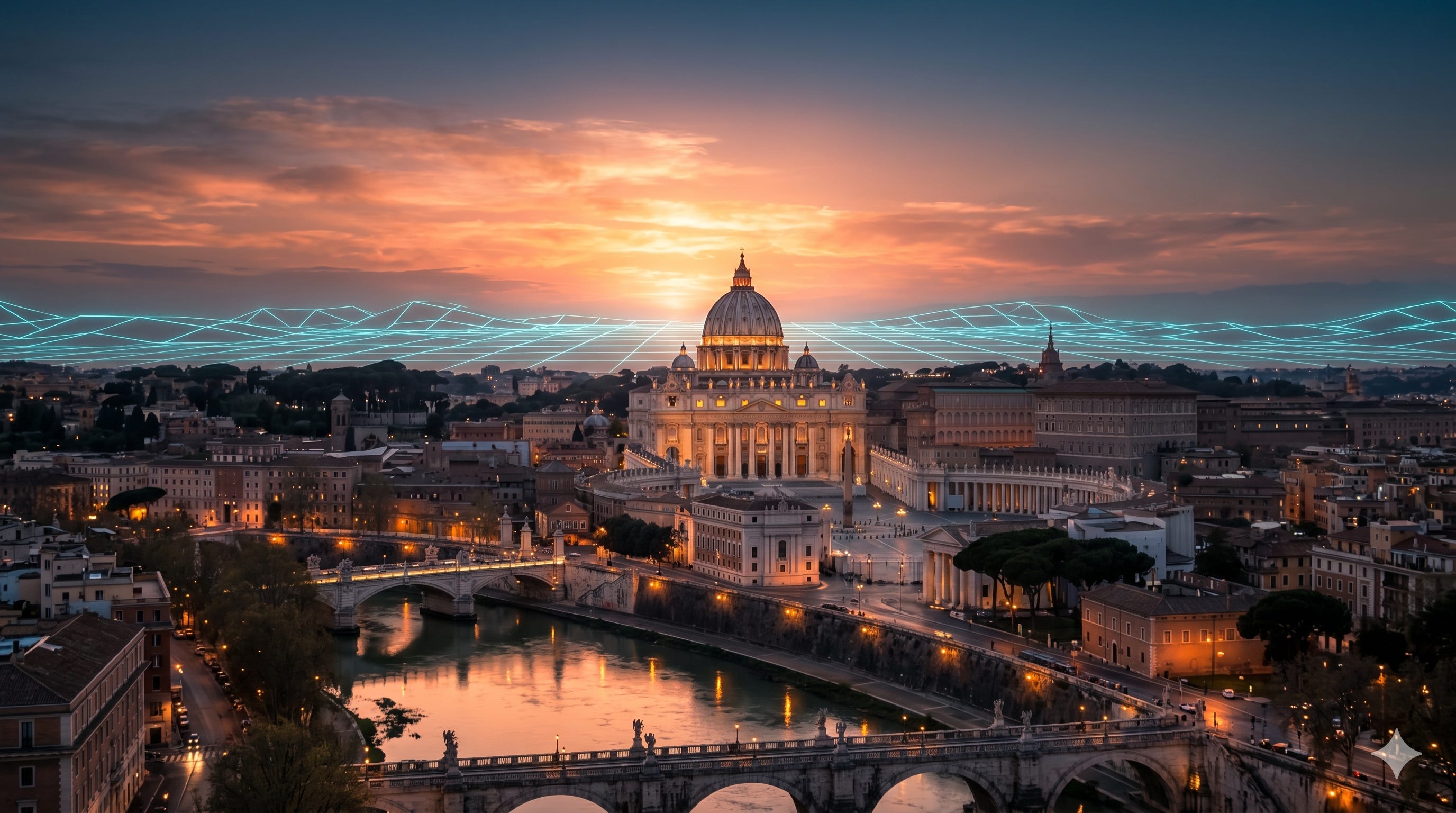
On May 25, 2026, the Roman Catholic Church published its first encyclical on artificial intelligence. The document, Magnifica Humanitas — Magnificent Humanity — was signed on the 135th anniversary of Rerum Novarum, the Church’s foundational teaching on labor and capital. The timing was not accidental. Pope Leo XIV wanted the lineage visible.
“Every person is unique and irreplaceable,” he wrote, “a free and intelligent subject with a conscience, capable of seeking God, serving one another, caring for our common home.”
That sentence was delivered from inside one of the world’s oldest surviving institutions. That is worth pausing on.
What the Architecture Already Said
The Vatican is a place where time accumulates in stone. The Apostolic Palace, the Sistine Chapel, the colonnades of St. Peter’s Square — these are not decorations. They are the physical record of an institution that has had to survive its own failures. The Church has endured councils, schisms, reforms, and the kind of moral reckoning that most organizations do not survive. It has outlived emperors, ideologies, and several previous technological revolutions.
When Pope Leo chose to speak about artificial intelligence from that setting, he was not simply adding a papal seal to a technology ethics document. He was invoking an institutional argument: that the systems which last are the ones willing to confront their own contradictions, return to first principles, and rebuild around the human person.
He made that self-critique explicit. Magnifica Humanitas acknowledges the Church’s own delayed reckonings — including its historical complicity in slavery — and places that admission alongside its call for AI accountability. The encyclical renews the Church’s “firm condemnation of every form of slavery, trafficking, and commodification of persons,” in the same breath that it warns against AI systems that concentrate power, replace human judgment, and reduce workers to inputs.
The architecture supported the speech. The speech acknowledged the cracks in the architecture.
That is what institutional durability looks like. Not the absence of contradiction. The willingness to outlive it.
Human Dignity as the Central Argument
Leo’s argument runs deeper than most of the coverage suggested. The encyclical condemns the use of AI in autonomous weaponry, calls for legal frameworks to prevent the concentration of data and economic power, and demands safeguards for workers facing displacement. But the core claim is more fundamental.
“A person’s dignity,” as America Magazine distilled it, “does not depend on what they can achieve or produce.”
That is a direct challenge to the operating assumption of most AI development: that value is measured in throughput, output, and scale. Leo’s answer is that a technology designed to maximize those things at the expense of human dignity is not progress. He also issued a challenge to democratic institutions, urging them to move from aspiration to action: “Let us establish standards for discernment — the dignity of the human person, the universal destination of goods, the preferential option for the poor, care for our common home and peace — and let us translate these standards into practices.”
That phrase — translate these standards into practices — is where the real work lives. It is the work of policy. And it lands harder when you look at what the technical record of the past twelve months actually shows.
What the Infrastructure Revealed While Everyone Was Watching the Models
In March 2025, a widely used component in automated software pipelines was compromised. More than 23,000 repositories were affected in a single campaign. Secrets were extracted. Production pipelines were implicated. The organizations involved were not negligent — they were operating exactly as the ecosystem had been designed to operate, extending trust to shared components because the alternative, reviewing every dependency at every update, was not how the industry had structured its incentives.
That incident was not exceptional. Supply-chain-related breaches rose 40 percent year over year in 2025. The attack surface expanded because the software production stack — the pipelines, the shared actions, the inherited credentials — scaled faster than the trust model underneath it was designed to handle.
The platforms at the center of that stack know it. A major platform provider’s 2026 security roadmap includes native egress controls, scoped secrets, dependency locking, and execution telemetry — capabilities enterprise security teams have been requesting since the platform launched broadly in 2019. The gap between when the risk was understood and when the structural fix ships is not a gap of engineering capacity. It is a gap produced by incumbent gravity: the defaults that drove adoption are now load-bearing, and changing them costs the platform more than it costs any individual attacker.
That is the same bargain the early internet made with email. By the mid-2000s, unwanted bulk traffic accounted for somewhere between 45 and 85 percent of all email volume. The protocol was never fixed. A remediation industry grew up around the flaw. The cost was distributed across every IT budget on earth and declared the price of doing business.
The AI era is acquiring the same shape. Except the degraded layer is no longer just communication. It is production. A compromised pipeline can alter the artifact that 40,000 downstream developers pull into production on Monday morning. That is a different category of problem.
And the frontier has already moved again. Research presented at NeurIPS 2025 found that AI systems with near-zero vulnerability in text-only settings experienced attack success rates above 75 percent when semantically equivalent inputs arrived through modified audio or image channels.
Separate 2025 research showed that adversarial audio — engineered to carry an instruction the model processes while remaining indistinguishable from ambient sound to a human listener — materially elevated jailbreak success rates against systems that appeared robust in other settings. AI-assisted attacks rose 89 percent year over year in 2025, and the fastest recorded attacker breakout time fell to 27 seconds.
This is the technical record that Magnifica Humanitas lands on top of. Leo did not write an encyclical about abstract risks. He wrote it about a technology actively outrunning the institutions designed to govern it.
Why the Durability Model Matters
The Roman Catholic Church is not a model for AI governance because it is perfect. It is a model because it is old enough to know what happens when institutions confuse authority with accountability, and powerful enough to have survived the lesson more than once.
The Church has had to rebuild its credibility after genuine failures of institutional integrity. It has done so, imperfectly and over long timescales, by returning to its founding principles and subjecting itself to judgment by those standards. That process is never complete. It is always ongoing. And it is precisely that ongoing quality — the willingness to remain answerable — that has allowed the institution to remain legible to the people it serves across twenty centuries.
The AI industry is young. Its institutions are younger. The question Magnifica Humanitas puts on the table is whether those institutions are willing to build the same kind of answerability into their foundations now, before the installed base becomes too large and the defaults become too load-bearing to revisit.
The Church waited too long on some of its own reckonings. Leo said so, in writing, from the Vatican.
That honesty is what the AI era most needs from its own institutions — and what it has, so far, been least willing to offer.
The Work That Remains
The encyclical closes with an invitation rather than a verdict: let the standards of human dignity be translated into practices through democratic life.
That translation is technical, legal, organizational, and political. It requires people who can hold the moral argument and the product decision in the same frame — who understand both the promise of the technology and the real costs of getting its defaults wrong. It requires policy informed by the evidence: of supply chain compromise at ecosystem scale, of adversarial attacks on multimodal systems that current tooling cannot reliably detect, of labor displacement unfolding faster than safety nets can be rebuilt. And it requires taking seriously what Leo names as the throughline: that no technology earns trust by optimizing its own metrics. It earns trust by remaining answerable to the humanity it claims to serve.
The roads of Rome lasted because the Romans built them to last, and because generations of builders after them kept the maintenance ongoing. When that maintenance stopped — when the center decided the roads were fine — the roads eventually became the story.
The digital infrastructure underneath the AI era is not fine. The people building it increasingly know it is not fine. The distance between that knowledge and the political will to act on it is exactly where the argument Leo made — from inside buildings that have outlasted twenty centuries of such moments — is most needed.