

Peter Drucker built his theory of the knowledge worker on the assumption that knowledge was the scarce resource. The question worth examining now is what the theory becomes when it is not.
The Library That Builds Itself
In 1999, Ray Kurzweil published a prediction that most of his contemporaries treated as a category error: that the rate of technological progress was not merely accelerating but accelerating exponentially, and that the intuitive sense of how quickly things were changing was structurally guaranteed to underestimate the actual rate by orders of magnitude. He called this the Law of Accelerating Returns. His argument was not that any specific technology would arrive on any specific timeline, though he made those predictions too, and many of them have proven accurate within the margin of a few years. His argument was about the shape of the curve itself: that each generation of technology produces the tools that accelerate the development of the next generation, that this compounding is structural rather than contingent, and that any planning framework built on the assumption of linear progress was therefore not merely imprecise but categorically wrong.
Nous Research is a small, relatively unknown organization. It does not have a campus or a brand. It operates primarily through a GitHub repository and a small coordinating team that fine-tunes open-weight base models, principally Meta’s Llama series, into something qualitatively different from what the base model alone produces. Hermes 3, its most recent public release, was fine-tuned on a cluster rented by the hour from a cloud compute provider, in a period of weeks, by a team without institutional infrastructure, on a model whose weights Meta had published to anyone who wanted them. The result is a general-purpose reasoning and agent model with long-term context retention, internal monologue capabilities, and function-calling architecture that competes with systems that required hundreds of millions of dollars and years of development time to produce. It has been downloaded more than 33 million times. It costs nothing to run for anyone with sufficient hardware, and it costs fractions of a cent per token for anyone who prefers to run it through an API.
These two facts, Kurzweil’s curve and Nous Research’s existence, are the same fact.
The compounding he described in 1999 is now visible not as an abstract prediction about the future but as the operating condition of an industry in which a team without institutional scale can produce frontier-adjacent capability, make it freely available, and generate a distribution footprint that most enterprise software products would recognize as a successful launch.
This post examines what it means for an organization trying to build durable strategy on terrain that rewrites itself at this speed.
What Drucker Got Right, and What the Curve Changes
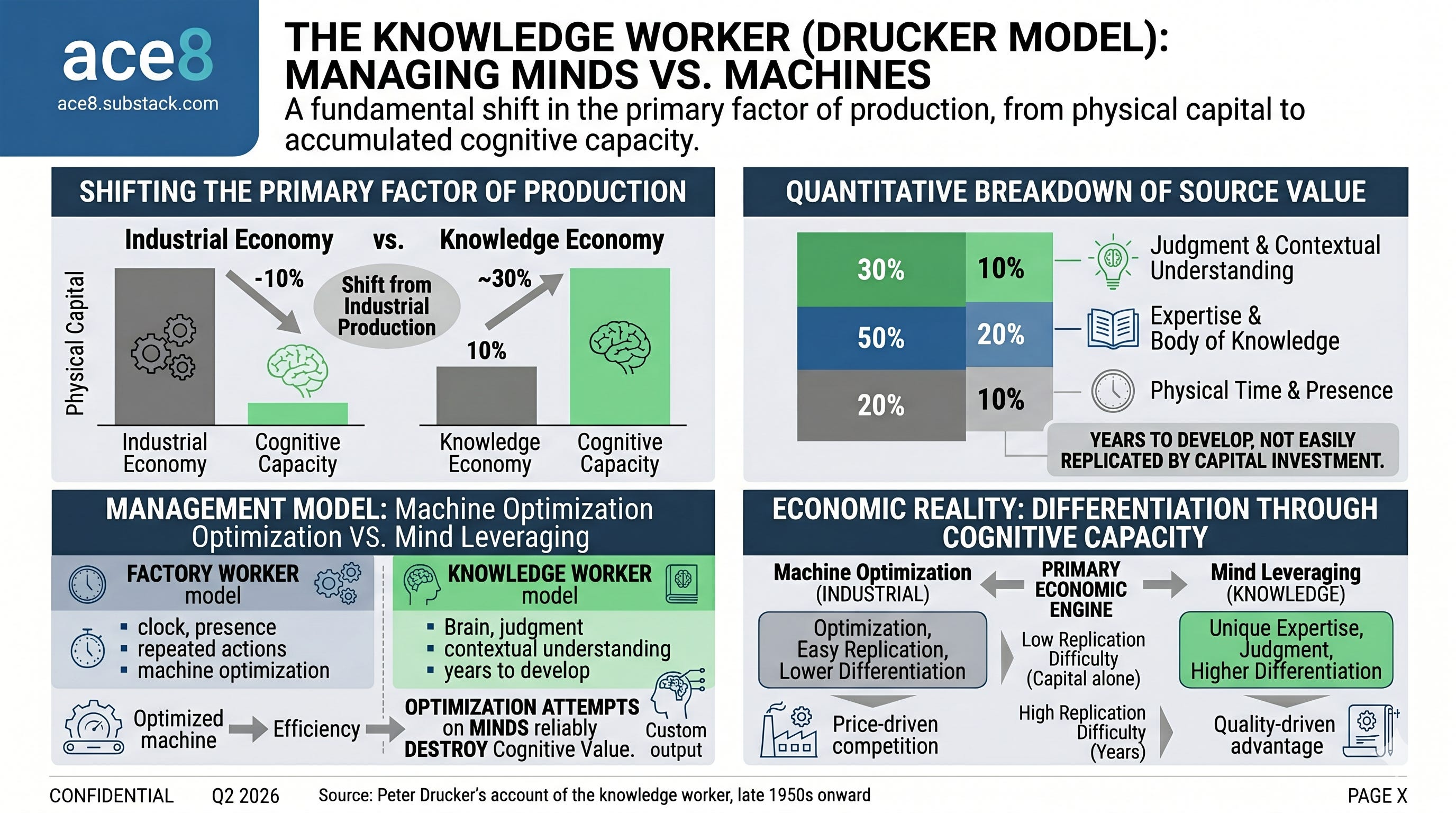
Peter Drucker’s account of the knowledge worker, developed from the late 1950s onward, was built on a specific and well-supported observation: that as economies shifted from industrial production to service and information work, the primary factor of production shifted from physical capital to the accumulated cognitive capacity of trained individuals. The knowledge worker’s value, in Drucker’s account, was not reducible to her time or her physical presence. It resided in a body of expertise, judgment, and contextual understanding that she carried, that took years to develop, and that could not be easily replicated by capital investment alone. This is why Drucker insisted that managing knowledge workers required an entirely different approach than managing factory workers: you could not optimize a mind the way you optimized a machine, and attempts to do so reliably destroyed the very thing you were trying to leverage.
The challenge that generative AI poses to this framework is not that it makes knowledge workers obsolete, though some fraction of current knowledge work roles will not survive the next decade in their current form. The challenge is more specific and more structural: it disaggregates the components of expertise that Drucker treated as a unified package. The knowledge worker’s value derived from the combination of domain knowledge, judgment, contextual awareness, communication capacity, and accumulated relationship capital. Generative systems, running on sufficient context, can now perform the domain knowledge and communication components at a level that equals or exceeds human performance across a wide range of tasks.
What they cannot replicate, and what therefore becomes the concentration point of durable human value, is judgment operating on institutional context that has not been encoded, relationship capital that exists in non-digital registers, and the kind of tacit situational awareness that accumulates from years of operating inside a specific organization with specific constraints and specific stakeholders.
This is not reassuring in the way that most technology transitions have been reassuring, where displaced workers could move into adjacent categories of work that the new technology opened up. The cognitive breadth of the current displacement is wide enough that the adjacent categories are themselves being disrupted simultaneously. What it implies for organizational strategy is not that human expertise is becoming less valuable, but that the specific components of human expertise that resist replication are shifting faster than most organizations have updated their models of what they are hiring for, developing, and retaining.
The Platform Is Now the Commodity
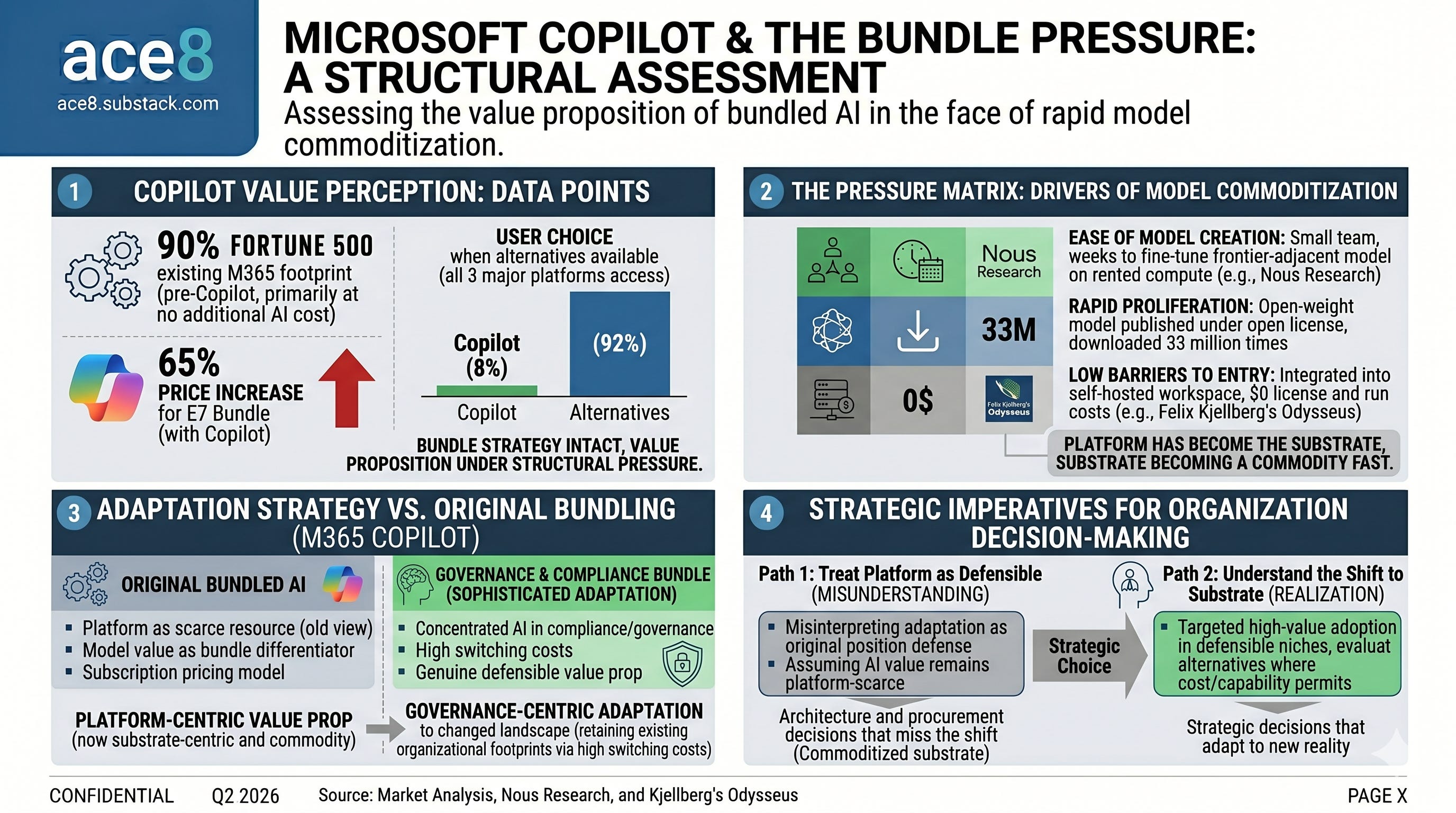
For approximately three decades, enterprise software operated on a logic that Drucker would have recognized as a straightforward extension of industrial-era capital concentration: the companies that controlled the platforms controlled the productivity of the knowledge workers who depended on them. Microsoft’s position in enterprise computing was built on this logic and executed with extraordinary discipline. Office, then Windows, then Exchange, then SharePoint, then Microsoft 365, then the E3 and E5 bundles that concentrated security, compliance, analytics, and collaboration into a pricing architecture that made piecemeal alternatives economically irrational for large organizations, regardless of whether those organizations were actually using the bundled capabilities at a level that justified the cost. As of early 2026, 3.3% of the 450 million Microsoft 365 users were paying for Copilot, Microsoft’s AI offering, and a 65% price increase in the E7 bundle landed into an environment where 90% of Fortune 500 companies were already using it primarily at no additional cost and where only 8% of users who had access to all three major AI platforms chose Copilot when alternatives were available. The bundle strategy is intact. The value proposition underlying it is under structural pressure it has not previously faced.
The pressure comes from the direction that Nous Research and Felix Kjellberg’s Odysseus workspace make concrete. When a frontier-adjacent model can be fine-tuned in weeks by a small team on rented compute, published under an open license, downloaded 33 million times, and integrated into a self-hosted workspace that costs nothing to run and nothing to license, the platform is no longer the scarce resource. The platform has become the substrate, and the substrate is becoming a commodity at a rate that the bundle pricing model was not designed to absorb. Microsoft’s response, concentrating AI capabilities into governance and compliance bundles where switching costs remain high and where the value proposition is genuinely defensible, is a sophisticated adaptation. But it is an adaptation to a changed landscape rather than a defense of the original position, and the organizations that understand the distinction will make different procurement and architecture decisions than the organizations that do not.
Odysseus is the clearest illustration of where the pressure is coming from, partly because its provenance is so dissonant with what enterprise technology is supposed to look like. It was built over approximately a year by a former YouTuber who had walked away from institutional attention, released as open-source software with no sales team, no enterprise tier, no support contract, and no telemetry. It runs persistent memory through ChromaDB, connects to email and calendar and file systems, orchestrates agents, and integrates with any model through Ollama or OpenRouter, which means it can run Hermes 3, DeepSeek, Qwen, or any other open-weight model alongside or instead of OpenAI or Anthropic APIs, on hardware the user controls, with data that stays local. Within a week of release it had 11,000 GitHub stars and a discussion board full of engineers extending it in directions its author had not anticipated.
The enterprise analogue to this is not a competitor to Microsoft in the platform sense. It is evidence that a category of user, and more importantly a category of organizational architecture, has emerged that does not need the platform to be provided by a vendor at all.
The Strategic Problem, Stated Precisely
The question that strategy-oriented practitioners are actually asking when they describe the current AI landscape as interesting but difficult to plan around is not a question about technology. It is a question about the relationship between the rate at which the landscape is changing and the minimum viable planning horizon for decisions that compound. Capital investment in AI infrastructure, organizational redesign around AI-augmented workflows, talent acquisition for roles that assume AI capability, and vendor commitments to platforms whose value propositions are shifting: all of these decisions require a time horizon of at least two to three years to generate returns, and the technology landscape is demonstrating a capacity to change materially every six to twelve months.
The standard response to this problem is to argue for optionality: make smaller commitments, build modular architectures, maintain flexibility. This is correct as far as it goes, but it is not sufficient as a strategy because optionality has a cost. An organization that maintains maximum flexibility by making no durable commitments is also an organization that accumulates no compound advantage from any specific capability, and compound advantage in AI-augmented workflows is real and growing. The organizations that committed early to developing genuine internal AI competence, that built the institutional knowledge of where AI reasoning actually outperforms human judgment and where it does not, and that accumulated the organizational experience required to integrate AI outputs into decision processes without either over-trusting or under-utilizing them, are not simply more efficient than organizations that are still evaluating. They are operating in a qualitatively different decision environment.
The frame that resolves this tension is not optionality versus commitment. It is the distinction between betting on a specific technology and betting on a specific capability. The organizations that bet on specific technologies, specific vendors, specific model architectures, or specific platform configurations are exposed to the rate of change at the technology layer, which is high. The organizations that bet on the capability of understanding how to deploy AI reasoning effectively in their specific institutional context, how to identify the tasks where AI augmentation produces durable value and distinguish them from the tasks where it produces the appearance of value while degrading decision quality, and how to build the organizational muscle of integrating synthetic judgment into real workflows without losing the human judgment that makes that integration productive, are betting on something that compounds regardless of which model is running underneath it. Kurzweil’s curve applies to the technology layer. The capability layer is built by the organization and stays with the organization.
Harboring Generative Capabilities for Beneficence
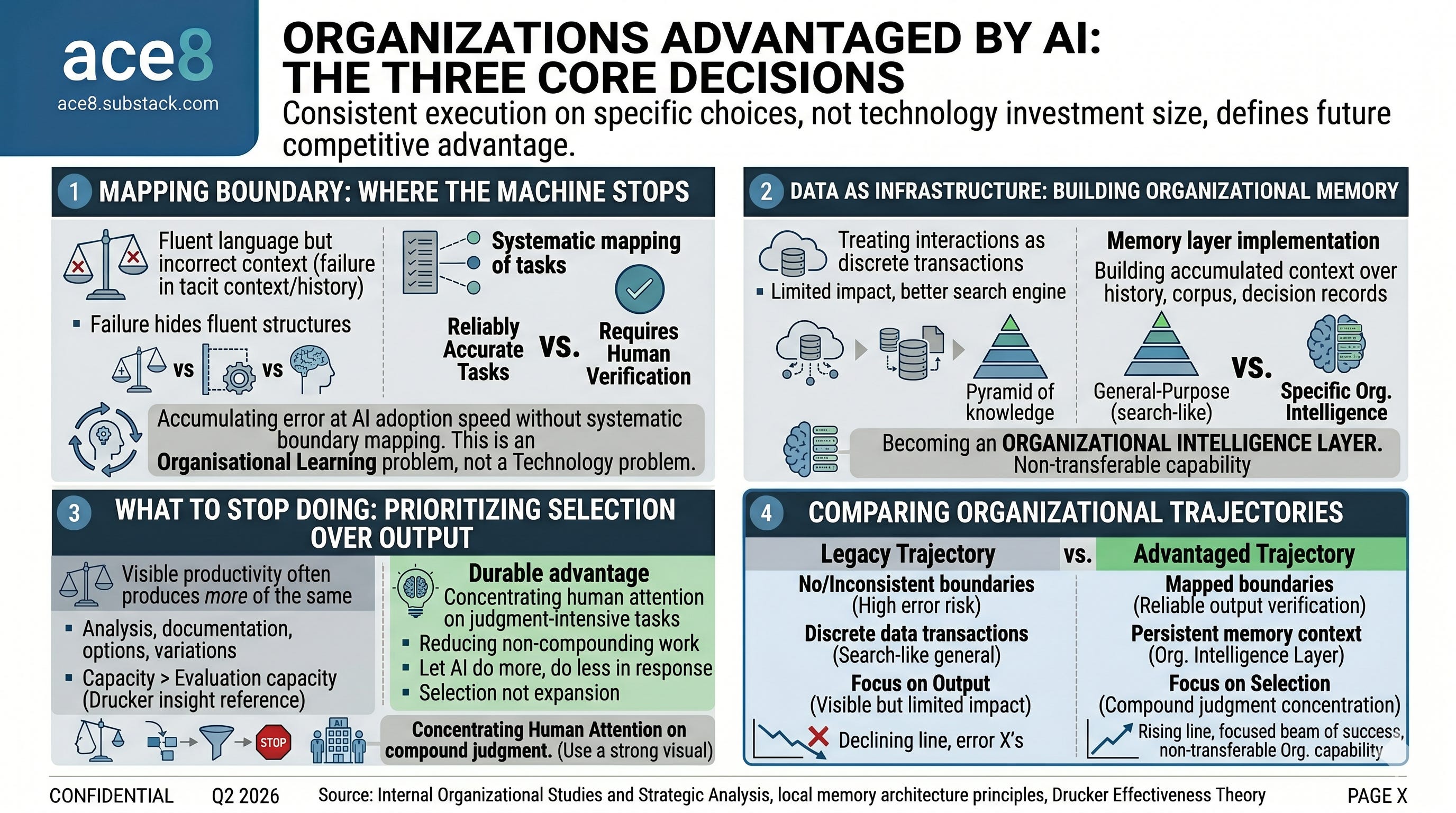
The organizations that will be most legible as advantaged by AI in three years are not the ones making the largest technology investments today. They are the ones that have made three specific decisions with sufficient clarity to execute on them consistently.
The first is a decision about where the machine stops. AI reasoning systems, including the most capable frontier models currently available, have a specific and documentable failure mode: they produce high-confidence outputs on questions where the right answer is determined by institutional context, relationship history, or tacit situational knowledge that was not encoded in the training data and is not present in the context window. The failure is not obvious in the output because the language is fluent and the structure is coherent. An organization that has not systematically mapped the boundary between tasks where AI judgment is reliably accurate and tasks where it requires human verification as a condition of use is an organization that is accumulating undetected error at the speed of its AI adoption. Mapping this boundary is not a technology problem. It is an organizational learning problem, and it requires the same sustained institutional investment that any other form of organizational learning requires.
The second is a decision about data as infrastructure. The persistent memory architecture that Odysseus implements locally and that the major cloud platforms implement in their own data architectures is not a convenience feature. It is the mechanism by which AI systems become more useful to a specific organization over time rather than simply more capable in the abstract. An organization that treats each AI interaction as a discrete transaction, without building the accumulated context that makes subsequent interactions more accurate and more relevant to its specific situation, is using AI as a better search engine. An organization that treats its interaction history, its document corpus, its decision records, and its institutional knowledge as the primary input into an AI system that learns from them is using AI as an organizational intelligence layer. The difference in output quality is not marginal. It is the difference between a general-purpose capability and a specific organizational capability, and specific organizational capabilities are the ones that do not transfer to competitors when an employee leaves.
The third is a decision about what to stop doing. Drucker’s insight that effectiveness is about choosing the right tasks rather than performing all tasks efficiently is more urgent now than it was in 1967, because the capacity to produce output has increased faster than the capacity to evaluate which output is worth producing. The organizations that are generating the most visible AI productivity gains in 2026 are frequently generating those gains by producing more of what they were already producing: more analysis, more documentation, more options, more variations. The organizations that are generating durable competitive advantage are the ones that used the productivity gains to reduce the volume of work that did not compound, and to concentrate human attention on the judgment-intensive tasks where compound advantage is actually built. This requires a willingness to let AI do more, and to do less in response, that runs against the instinct of most organizations to treat productivity gains as an opportunity to expand output rather than to improve selection.
What the Shape Implies
Kurzweil’s curve does not flatten. The rate of capability improvement at the frontier will continue to compress the time between what seems like an extraordinary capability and what seems like a baseline assumption. The open-weight model ecosystem will continue to close the gap with proprietary frontier models on well-specified tasks, and the context engineering practices that make that gap smaller will continue to disseminate through communities like the ones that built and extended Hermes 3 and Odysseus. The platform as the scarce resource is already a description of the recent past rather than the present. The organizations waiting for the landscape to stabilize before making strategic commitments are waiting for something that the shape of the curve makes structurally unavailable.
What is available, and what compounds at a rate that the curve does not erode, is the institutional knowledge of how to use AI judgment well in a specific context. Not AI in the abstract, not the frontier model of the moment, not the platform that happens to be dominant in the current pricing cycle, but the deep organizational understanding of where synthetic reasoning produces reliable value and where it requires supervision, of how to build the accumulated context that makes AI systems increasingly specific to the institution rather than generically capable, and of what to stop doing so that the gains from AI adoption concentrate in the decisions that matter rather than distributing across the decisions that do not. That understanding is built through practice, it accumulates through experience, and it stays with the organization that builds it. The shape of generative to come rewards the organizations that start building it now.
Alan Eyzaguirre, a Silicon Valley corporate and product strategist, writes about practical applications for the next wave of generative AI.