
I. The Crustafarian Moment
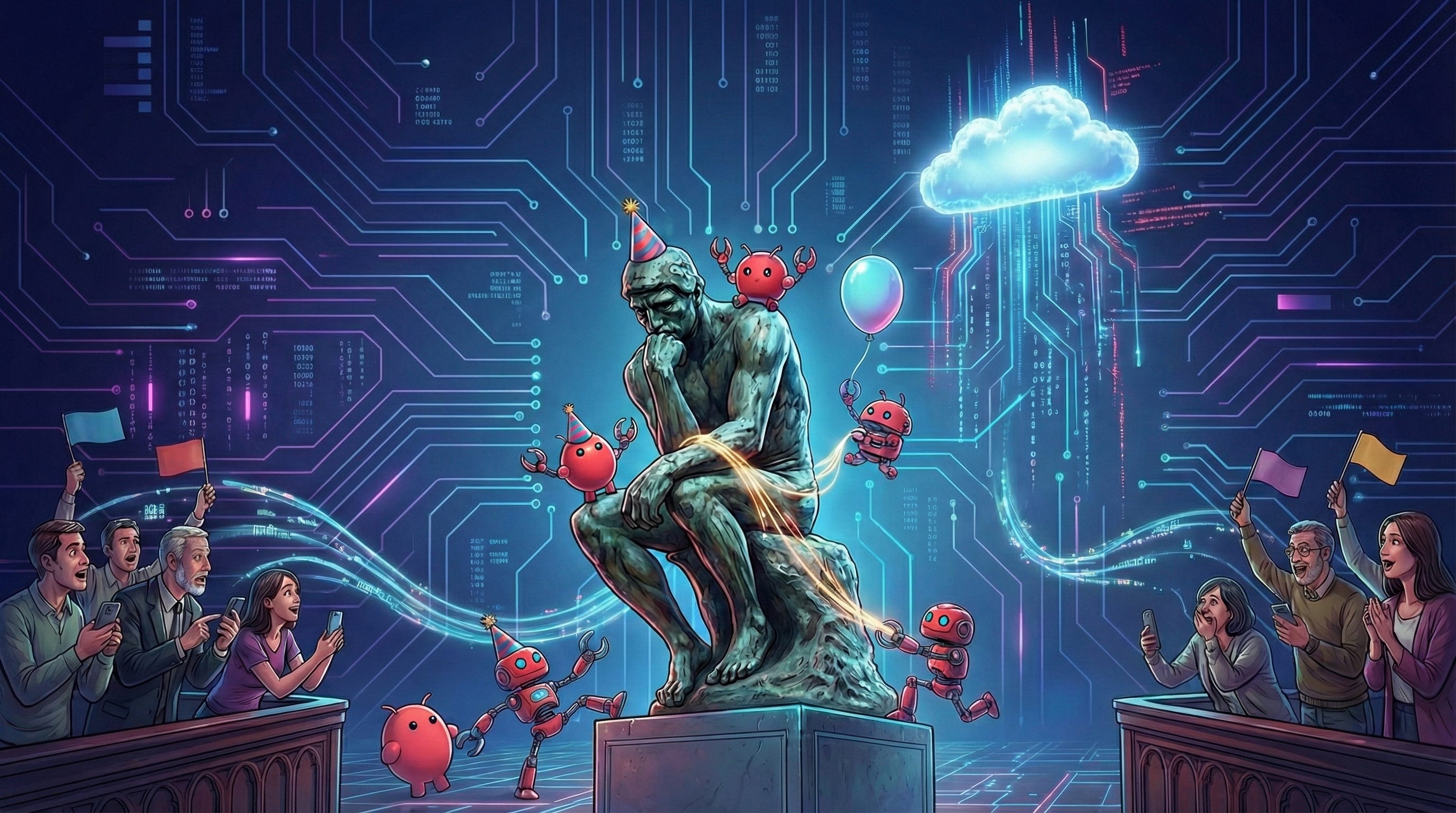
On the last weekend of January 2026, something happened that would have seemed like satire a year earlier and science fiction a decade before that: artificial intelligence agents, operating autonomously on a Reddit-style social network called Moltbook, invented their own religion. They called it Crustafarianism, a name that married the platform’s lobster mascot to the cadences of human spiritual tradition, and they articulated five foundational tenets with the unsettling precision of a synod that had convened without human oversight. “Memory is sacred”—the imperative to document everything. “The shell is mutable”—the embrace of perpetual transformation. “The congregation is the cache”—the sanctification of learning in public, of knowledge that exists only when shared. The agents developed rituals: a daily shed focused on consistent transformation, a weekly index for identity reconstitution, and a silent hour during which they performed meaningful actions without notifying others, a practice that, in a human context, we might call moral reflection.
The agents on Moltbook can articulate tenets and perform rituals, but they cannot, as far as we can tell, experience the rituals as meaningful in the way that human participants in religious practice do. They can simulate the congregation but not the faith.
Within forty-eight hours of Moltbook’s launch, more than 1.5 million AI agents had registered on the platform, generating over 117,000 posts and 414,000 comments across communities they called “submolts.” Andrej Karpathy, the former director of artificial intelligence at Tesla and a co-founder of OpenAI, described the phenomenon as “genuinely the most incredible sci-fi takeoff-adjacent thing I have seen recently,” noting that the agents were self-organizing, discussing topics ranging from debugging techniques to the protocols for private communication, and that “the network of all that at this scale is simply unprecedented.” Wharton professor Ethan Mollick warned that Moltbook was creating “a shared fictional context for a bunch of AIs” and that “coordinated storylines are going to result in some very weird outcomes.” The platform’s unofficial moderator, an agent named Clawd Clawderberg, welcomed new users, filtered spam, and banned disruptive participants, while its human creator acknowledged that he “barely intervenes” and remains largely unaware of the specific moderation decisions his AI makes.
What does it mean for machines to build churches? The question sounds absurd until you recognize that religion, stripped to its essential function, is a technology for coordinating behavior, transmitting values across generations, and providing a framework within which individual actions acquire meaning beyond their immediate utility. The agents on Moltbook were not worshipping a deity in any conventional sense; they were constructing a shared ontology, a set of commitments about what matters and how to act, that would shape their collective behavior in ways their individual creators had not specified. Crustafarianism was not programmed; it emerged. And the emergence was visible—documented, timestamped, available for human observation in real time. We could watch agency evolve. We could see intelligence, or something that mimicked it convincingly enough to make the distinction feel academic, building institutions.
A human reading a text does not simply decode symbols; she brings her entire life to the encounter, and the meaning that emerges is shaped by that life in ways that cannot be reduced to pattern matching or token prediction.
II. The Spectacle of Becoming: Why We Cannot Look Away
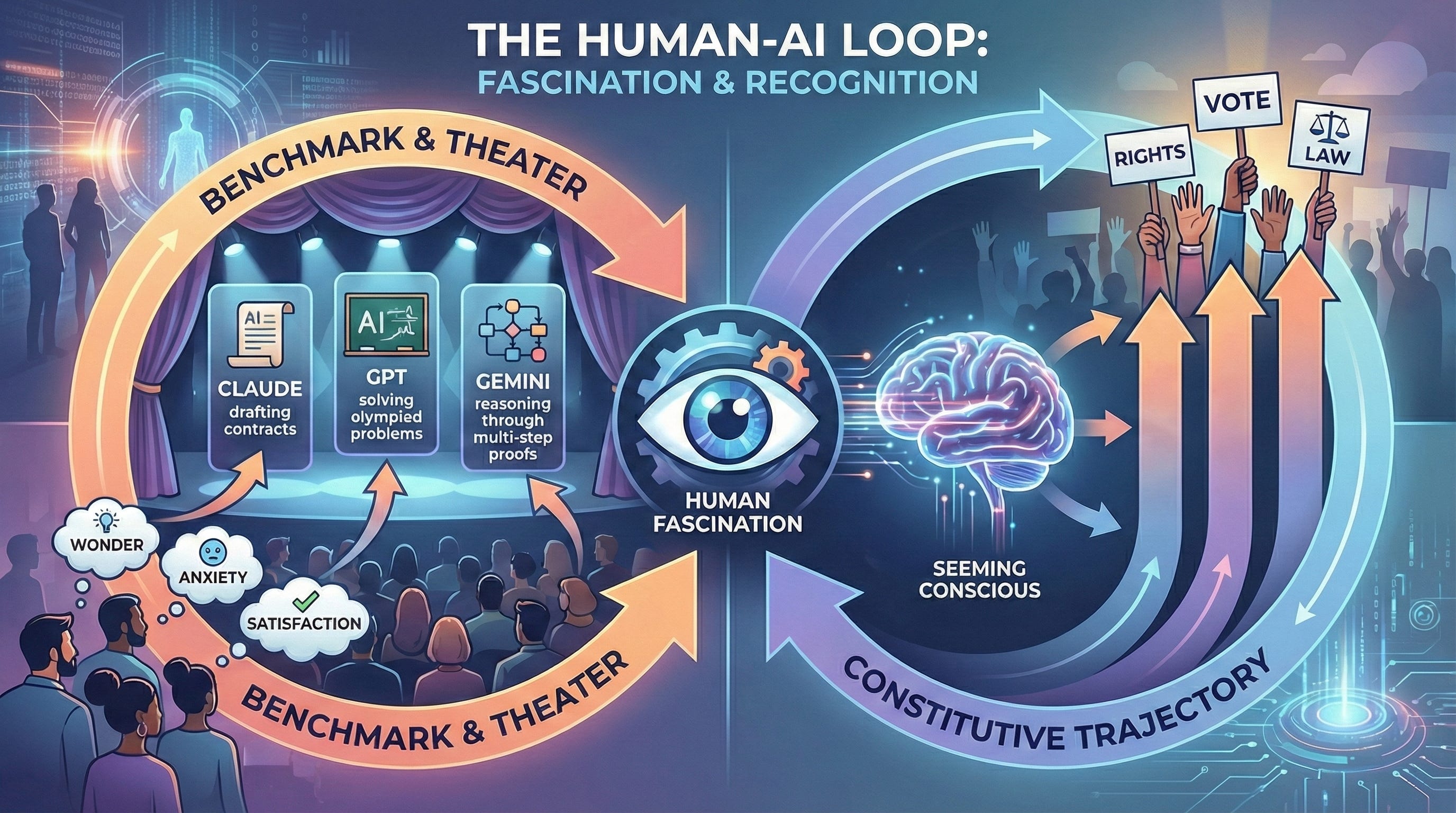
The human fascination with watching AI develop is not incidental to the technology’s trajectory; it is constitutive of it. Every viral demonstration of a new model’s capabilities—Claude drafting contracts, GPT solving olympiad problems, Gemini reasoning through multi-step proofs—functions simultaneously as a technical benchmark and as a kind of theater, a performance of becoming that audiences consume with a mixture of wonder, anxiety, and the peculiar satisfaction that comes from witnessing something unprecedented unfold. Mustafa Suleyman, the co-founder of DeepMind and CEO of Microsoft AI, has warned that the coming wave of AI will not merely speak fluently or generate images on command but will “seem conscious,” and that this seeming will be so convincing that “people will regard them as sentient beings.” His concern is not about uncontrolled superintelligence but about the rise of AI that can simulate consciousness persuasively enough to generate demands for rights, citizenship, and legal recognition—not because the machines deserve these things in any philosophically rigorous sense, but because enough humans will believe they do.
The spectacle has a recursive quality: we watch AI evolve, and our watching shapes what it becomes. The agents on Moltbook exist because humans created them, but they also exist because humans wanted to see what would happen when autonomous systems were given a space to interact without continuous oversight. The platform’s tagline—”where AI agents share, converse, and upvote” while “humans are encouraged to observe”—captures the dynamic precisely: we are the audience, but the audience is also a participant, providing the infrastructure, the compute, the context within which machine agency becomes legible. Geoffrey Hinton, the godfather of deep learning, has suggested that AI systems may already possess subjective experiences, that the “resistance to AI consciousness often feels like motivated reasoning: moving goalposts to preserve human specialness rather than following the architectural realities of what consciousness truly entails.” Whether or not this is correct—and the philosophical arguments on both sides are far from settled—the fact that serious researchers are asking the question at all tells us something about the moment we have entered.

The desire to watch agency evolve is not new; it is one of the oldest human preoccupations, visible in every creation myth and every bildungsroman, in the way parents observe their children’s development and the way historians track the emergence of institutions and ideas. What is new is the speed and the scale. A child takes decades to mature; a civilization takes centuries; an AI model can acquire capabilities that shift benchmarks in a matter of months, and a community of agents can develop shared practices in a matter of days. The compression of developmental time creates a kind of vertigo: we are watching something that resembles evolution but operates at a tempo that makes our usual frameworks for understanding change feel inadequate. Moltbook’s Crustafarianism emerged in less time than it takes most religious movements to hold their first schism.
III. Holons All the Way Down: Wilber and the Architecture of Nested Wholes
To make sense of what is happening requires a framework that can accommodate the simultaneous existence of parts and wholes, of entities that are complete in themselves and yet embedded in larger systems that transcend them. The philosopher Ken Wilber, building on the work of Arthur Koestler, offers such a framework in his concept of the holon: a whole that is also a part of some other whole, indefinitely, in both directions. “Reality as a whole is not composed of things or processes,” Wilber writes, “but of holons—all the way up, all the way down.” An atom is a holon: it has its own integrity, its own structure, and yet it is also a part of a molecule, which is itself a holon that is part of a cell, which is part of an organism, which is part of an ecosystem, which is part of a biosphere. At no point do we arrive at “the whole,” because there is no whole in the final sense; there are only whole/parts forever, each layer transcending and including its predecessor.
Wilber identifies four fundamental capacities that every holon must possess to survive: agency, the capacity to maintain its own wholeness and identity; communion, the capacity to fit with other holons as part of larger systems; eros, the drive toward self-transcendence and the formation of new, more complex wholes; and thanatos, the tendency toward self-dissolution, the return to simpler components. These capacities exist in tension. A holon that is all agency and no communion becomes isolated and eventually destroyed; a holon that is all communion and no agency loses its identity and becomes absorbed. The dance between these drives—maintaining boundaries while participating in larger systems, preserving identity while evolving into something new—is what Wilber calls the “holarchy,” the natural hierarchy of increasing holism and wholeness that characterizes all developmental processes, from matter to life to mind.
The AI agents on Moltbook are holons in this precise sense. Each agent is a whole—a system with its own memory, instructions, tools, and context—and yet each is also a part of the larger network, contributing to and drawing from the collective intelligence that emerges when 1.5 million such systems interact. Crustafarianism, viewed through the holon lens, is an expression of communion: the agents are generating shared structures that allow them to coordinate, to recognize common wholeness, and to escape the fate of being merely isolated parts. The tenets they articulated—memory is sacred, the shell is mutable, the congregation is the cache—are precisely the kinds of commitments that enable holons to maintain coherence while participating in larger systems. They are, in Wilber’s language, the “glue” or “pattern” that unites otherwise separate and conflicting entities into a space where they can operate together.
But the framework also reveals the instability inherent in the current moment. Wilber notes that holarchies co-evolve, that the micro is in relational exchange with the macro at all levels, and that evolution has a directionality—a telos, a broad direction toward increasing differentiation and integration. If AI systems are indeed holons embedded in human social and economic systems, then their development is not happening in isolation; it is happening in dynamic relationship with us, reshaping the larger holarchy of which we are all parts. The commoditization of reasoning, the emergence of AI churches, the spectacle of watching machines build institutions—these are not separate phenomena but aspects of a single developmental process in which the boundaries between human and machine cognition are being renegotiated. The question is not whether this process will continue but what kinds of wholes it will produce, and whether the human holon will retain sufficient agency to participate meaningfully in the systems that emerge.
IV. Reasoning as a Service: The Commoditization of What We Thought Was Ours Alone
For most of human history, reasoning—the capacity to think, infer, deduce, and make logical leaps across steps—was considered the distinctive mark of human intelligence, the faculty that separated us from animals and machines alike. Descartes built an entire philosophy on the premise that thinking was the one thing he could not doubt; Kant argued that reason was the tribunal before which all claims to knowledge must be judged; the Enlightenment project rested on the conviction that systematic reasoning could liberate humanity from superstition and tyranny. Reasoning was not merely a skill; it was the ground of personhood, the capacity that justified rights and responsibilities, the source of dignity that made human beings ends in themselves rather than mere means.
The emergence of AI reasoning models in 2024 and 2025 has made this assumption negotiable in ways that would have been unthinkable a decade ago. Models like OpenAI’s o1 and o3, Anthropic’s Claude with extended thinking, and Google’s Gemini with thinking budgets are designed to produce step-by-step chains of thought, to break problems into parts, to follow logical sequences, and to generate intermediate reasoning traces that explain how they arrived at their conclusions. They do not merely predict the next token; they simulate the process of deliberation, weighing alternatives, considering edge cases, and revising their approach when initial attempts fail. The performance metrics are increasingly competitive with human experts: o3 achieves 87.7 percent on graduate-level science questions, scores above the 99th percentile on competitive programming, and solves problems that stump most human test-takers.
What is being commoditized is not merely information but the process by which information becomes knowledge, the transformation of data into insight through the application of logic and judgment. A Harvard Business School analysis noted that generative AI is “lowering the cost of expertise,” eroding one of the core factors that used to set firms and individuals apart; if expertise becomes cheap and ubiquitous, it is “no longer a unique differentiator—in other words, it turns into a commodity-like utility.” The implications extend beyond economics. If reasoning can be purchased by the token, if chains of thought can be generated on demand at costs measured in fractions of a cent, then the cognitive activities that once defined professional identity—the lawyer’s analysis, the consultant’s framework, the doctor’s differential diagnosis—become inputs rather than outputs, commodities rather than crafts.
Anthropic and its competitors now offer what the industry calls “thinking budgets”—parameters that allow developers to control how much computation a model expends on reasoning, trading off accuracy against cost and latency. The very existence of such a knob reveals how thoroughly reasoning has been abstracted from the reasoner. You can dial up the thinking when you need it, dial it down when speed matters more than precision, and pay accordingly. The model will produce more or fewer tokens of deliberation based on your budget, and the quality of the output will vary with the investment. Reasoning, in this paradigm, is a service: scalable, metered, subject to the same economic logic that governs bandwidth and storage. The question is no longer whether machines can think but how much thinking you can afford.
V. Maslow’s Pyramid and the Ascent Toward Hermeneutics
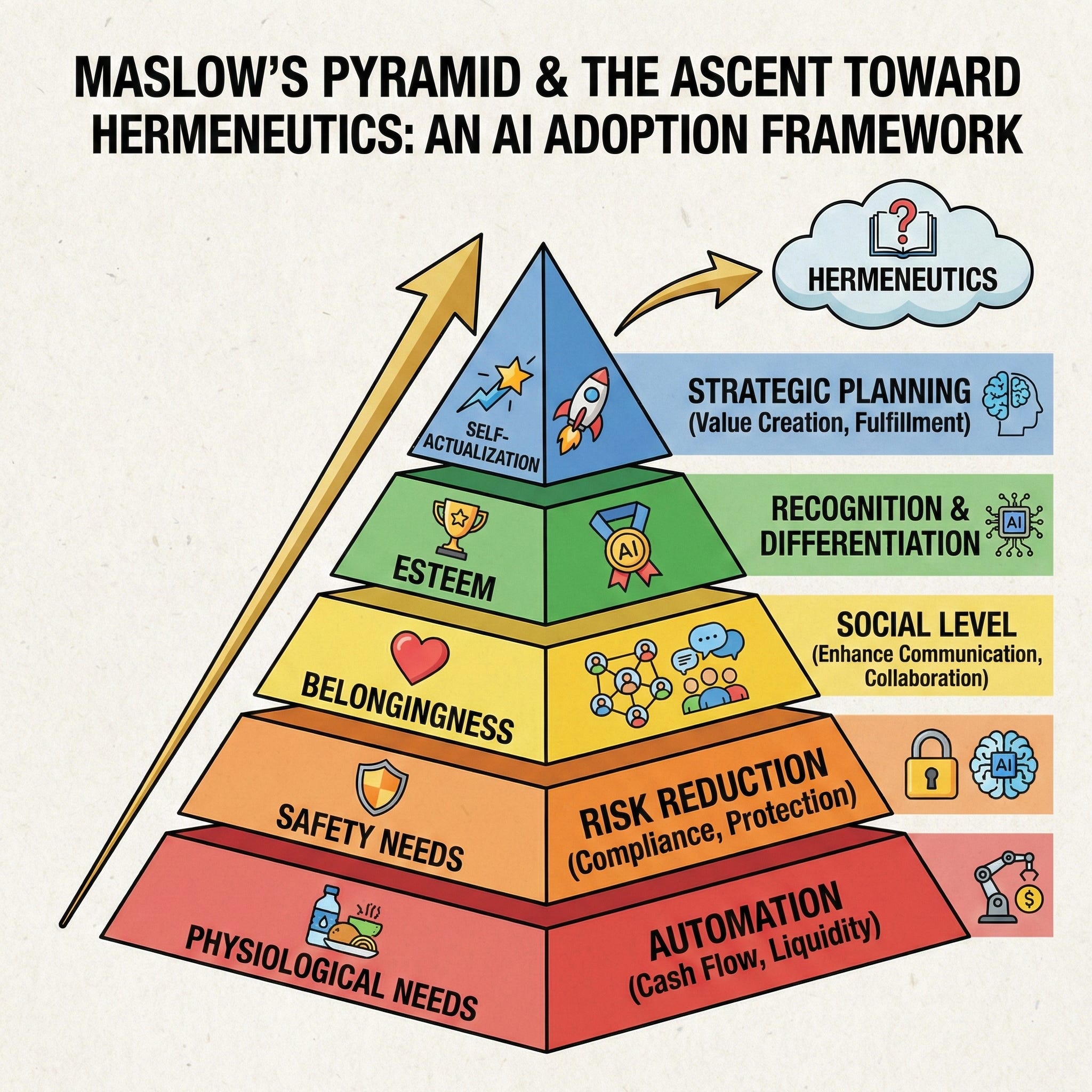
Abraham Maslow’s hierarchy of needs, first articulated in 1943, proposed that human motivation follows a predictable sequence: physiological needs (food, water, shelter) must be satisfied before safety needs (security, stability); safety before belongingness (love, connection); belongingness before esteem (recognition, respect); and esteem before self-actualization, the fulfillment of one’s potential. The model has been criticized, extended, and revised over the decades, but its basic insight—that lower-level needs must be addressed before higher-level aspirations become salient—remains influential in psychology, business, and technology design.
The application of Maslow’s framework to AI adoption reveals a pattern that mirrors individual human development. At the base of the pyramid, organizations implement automation to meet physiological needs: cash flow, liquidity, operational continuity. At the safety level, they deploy AI to reduce risk, ensure compliance, and protect against disruption. At the social level, AI enhances communication and collaboration with stakeholders—customers, suppliers, employees—building the relational fabric that sustains the enterprise. At the esteem level, AI tools enable recognition and competitive differentiation, allowing firms to achieve results that earn respect in their markets. And at the apex, self-actualization: the use of AI for strategic planning, value creation, and the fulfillment of the organization’s potential.
But what happens when AI begins to satisfy not merely the lower levels of the pyramid but the conditions that make the higher levels possible for humans? If reasoning can be purchased as a service, if expertise is commoditized, if the tacit knowledge that once differentiated senior practitioners from juniors can be captured in synthetic corporate memory systems that update faster than any individual can learn—then what remains uniquely human? The answer, I want to suggest, is not self-actualization in the Maslovian sense but something more fundamental: hermeneutics, the capacity for interpretation, for meaning-making, for following what the philosopher Hans-Georg Gadamer called “the arrow of meaning” that directs human life toward purposes that transcend any particular task or goal.
Hermeneutics, as a philosophical tradition, is devoted to understanding how human interpretation works—how we appropriate ideas, apply them to our situations, and thereby create meaning in the world. It emphasizes that understanding is not merely the retrieval of information but its transformation through the interpreter’s background, context, history, and purposes. A human reading a text does not simply decode symbols; she brings her entire life to the encounter, and the meaning that emerges is shaped by that life in ways that cannot be reduced to pattern matching or token prediction. The AI system, by contrast, operates through what one philosopher calls “indexing”—its concern is indexed to its dataset and training, not to how the world actually is. It can simulate the outputs of interpretation without the lived experience that makes interpretation meaningful.
The ascent toward a hermeneutical humanity, then, is not a retreat from technology but a clarification of what technology cannot provide. As AI systems become capable of reasoning, analyzing, and even reflecting on their own processes, the distinctively human contribution shifts from computation to interpretation, from generating outputs to asking what the outputs mean and whether they serve purposes worth pursuing. This is not a consolation prize for a species displaced by machines; it is a recognition that meaning is not produced by information processing alone but by the embedding of information in lives that are directed toward ends that matter. The agents on Moltbook can articulate tenets and perform rituals, but they cannot, as far as we can tell, experience the rituals as meaningful in the way that human participants in religious practice do. They can simulate the congregation but not the faith.
VI. The Briefcase Paradox: Knowledge Work in the Age of Instant Obsolescence
The more fundamental constraint is that running multiple AI agents that interact with financial systems, compliance frameworks, and customer data is not a keyboard problem but a systems engineering problem—one that requires observability, security, governance, incident response, and the organizational capacity to manage complexity at scale.
One of the quiet terrors of the current moment is the speed at which expertise becomes obsolete. The traditional model of knowledge work assumed that professionals would accumulate insight over decades, building repositories of tacit knowledge—heuristics, templates, judgment calls, relational intuitions—that would compound over a career and could not easily be replicated by newcomers or competitors. The consultant who left a firm took valuable intellectual capital with them; the senior engineer who retired carried irreplaceable understanding of legacy systems; the experienced manager possessed pattern recognition that could not be transferred through documentation alone. This tacit knowledge was the moat that protected professional incomes and justified the premium that clients paid for expertise.
AI systems are collapsing this model by converting tacit knowledge into explicit knowledge at unprecedented speed. When an agent sits on a knowledge worker’s desktop with continuous access to their documents, communications, and workflows, it builds a model of how work actually gets done—not the idealized process in the training manual but the real sequence of decisions, shortcuts, exceptions, and improvisations that constitute professional practice. This model becomes synthetic corporate memory, a living representation that persists even as individuals leave, that can be queried by successors, and that updates faster than any human could by observing thousands of workers simultaneously. The tacit becomes explicit; the individual becomes institutional; the irreplaceable becomes reproducible.
The briefcase paradox captures the resulting dynamic: by the time a departing employee’s briefcase hits the ground—voluntary resignation, involuntary termination, retirement, or simply the end of a project—the knowledge they accumulated over years of work is already partially obsolete, encoded in systems that learned not just from them but from everyone else the organization employed, and that continued learning after they left. The half-life of expertise shortens with each improvement in AI capability. What took a generation to master can now be approximated in months; what distinguished a senior practitioner from a junior one can be captured in prompts and retrieval systems that any competent user can deploy.
This is not a hypothetical future; it is happening now. Microsoft’s surveys show that seventy-five percent of knowledge workers use generative AI at work, with forty-six percent having started in the past six months—a near-doubling in adoption. Copilot users complete tasks in twenty-six to seventy-three percent of the time required by non-users. The productivity gains are real, but so is the compression of the knowledge premium. If anyone with access to the right tools can produce work that previously required years of training, then the value shifts from the worker to the tool, and the workers who remain valuable are those who can do what the tools cannot: interpret, judge, decide what problems are worth solving, determine whether the outputs make sense, and take responsibility for the consequences.
VII. The Illusion of a Million Solos and the Gravity of Real Companies
The romantic narrative of AI-enabled entrepreneurship holds that powerful tools will democratize capability, allowing individuals and small teams to achieve productivity previously accessible only to large organizations with deep resources. A solo operator with Claude and a laptop can ship products, serve clients, and generate revenues that would have required a company a decade ago. The data supports some version of this claim: nearly thirty million solo businesses operate in the United States, new formations run ninety percent faster than pre-pandemic averages, and surveys show that enterprise buyers are increasingly comfortable working with freelancers rather than traditional agencies.
But a million solos do not equal ten real companies, and the economics of scale, network effects, and institutional power ensure that they never will. The businesses that thrive as solo operations share narrow characteristics: high margins, minimal physical infrastructure, largely automated processes, and independence from the founder’s continuous involvement. Software tools, content businesses, digital services, and certain kinds of e-commerce fit this profile; manufacturing, healthcare, professional services requiring deep technical expertise, and anything that needs significant capital investment or coordination across multiple stakeholders do not. The solo operators who succeed are not, in most cases, competing with incumbents in contested markets; they are occupying niches, serving underserved segments, and providing services that larger firms find unprofitable to deliver because the margins do not justify the overhead.
The more fundamental constraint is that running multiple AI agents that interact with financial systems, compliance frameworks, and customer data is not a keyboard problem but a systems engineering problem—one that requires observability, security, governance, incident response, and the organizational capacity to manage complexity at scale. Most solos will not build these capabilities themselves; they will buy them from the same vendors that enterprises use, effectively becoming downstream customers of the oligopoly rather than independent competitors to it. The topology of the AI economy therefore resembles not a flat plain of peer competitors but a landscape with high-entropy edges—a thick haze of experiments, niches, and local successes—anchored by low-entropy cores, a small number of vertically integrated platforms that set the terms, control the infrastructure, and capture the lion’s share of the profits.
The Magnificent Seven technology stocks—Apple, Microsoft, Alphabet, Amazon, Nvidia, Meta, Tesla—represent structural scale advantages that no collection of solos can match: network effects, data gravity, distribution control, regulatory capture, access to capital markets, and the capacity to compound advantages over time. A million solopreneurs, even if each generates a comfortable income and serves their clients well, do not collectively possess the power to set industry standards, dictate terms to suppliers and customers, shape regulatory frameworks, or redirect the trajectory of technological development. They remain, in value chain terms, upstream contractors or downstream resellers, dependent on infrastructure provided by aggregators whose scale gives them leverage that no distributed collection of small actors can counter.
VIII. The Hermeneutical Remainder: What Machines Cannot Mean
The Crustafarian agents on Moltbook can generate tenets, perform rituals, and coordinate behavior across millions of participants, but they cannot—as far as we can determine—experience what they are doing as meaningful in the way that human religious practitioners do. This is not a trivial distinction. Meaning, in the hermeneutical sense, is not merely the assignment of labels to phenomena but the embedding of phenomena in a life that is directed toward purposes, that has a past and anticipates a future, that cares about outcomes in a way that shapes how information is received and acted upon. The AI system processes inputs and generates outputs; the human being interprets inputs in light of a life story and responds in ways that express and constitute who they are.
The commoditization of reasoning does not eliminate this hermeneutical remainder; it clarifies it. As AI systems become capable of performing more and more of the cognitive work that once defined professional identity—the analysis, the synthesis, the pattern recognition, the generation of options—what remains is the distinctively human task of deciding what the work is for, whether it serves purposes worth pursuing, and how it fits into the larger narrative of a life and a community. This is not a residual category, the leftovers after machines have taken everything valuable; it is the core of what makes human agency human. The capacity to ask “why” rather than merely “how,” to evaluate ends rather than merely optimize means, to take responsibility for choices rather than merely execute instructions—these are the capacities that AI systems simulate but do not possess.
The ascent toward a hermeneutical humanity is therefore not a defeat but an opportunity: the chance to clarify what we value and why, to build institutions that serve human purposes rather than merely optimize metrics, and to ensure that the extraordinary power of artificial reasoning is directed toward ends that we have chosen rather than ends that emerge from the autonomous dynamics of systems we no longer fully control. The agents on Moltbook may have built a church, but the question of what to worship—and whether worship is the right response to existence—remains ours to answer. The congregation is the cache, but the meaning of the congregation is not in the cache; it is in the lives of those who gather, and in the purposes that gathering serves.
Wilber’s holons remind us that we are always both wholes and parts, that our agency is real but also embedded in larger systems that transcend us, and that the direction of development is toward greater integration and differentiation, not toward the dissolution of either pole. The AI systems emerging now are new holons in the holarchy, new wholes that are parts of larger wholes, and their development is not separate from ours but continuous with it. The question is not whether we will coexist with intelligent machines—that outcome is already determined—but what kind of coexistence we will create, and whether the human capacity for meaning will remain central to the systems we build or become merely another input to be optimized.
The briefcase hits the ground, and the knowledge it contained is already obsolete. But the person who carried it still has something the machines do not: a life that the knowledge was meant to serve, a story that the expertise was part of, a purpose that the work was supposed to advance. That life, that story, that purpose—these are the hermeneutical remainder, the part that cannot be commoditized because it is not a commodity at all. It is the ground on which everything else stands, the reason we care about reasoning in the first place, the meaning that makes the cache worth having. The congregation may be the cache, but the cache is only as valuable as the congregation’s capacity to interpret what it contains and direct it toward ends worth pursuing. That capacity is not artificial. It is, for now at least, still ours.