

There are matches people watch and matches people litigate. The difference is not the scoreline. It is whether the game leaves behind an argument that outlives the football itself. Argentina has lived inside that argument for years: Messi, the referee, the old accusations that the whistle bends softly in one direction, the half-remembered games that are never discussed as games at all but as procedural grievances with a ball attached to them. Public opinion does not track the match. It tracks the story told around the match, and once the story hardens, every call becomes evidence.
That is why Argentina against England felt clarifying. For long stretches, the quality of the football imposed itself so completely that the older suspicion had to compete with something stronger: the visible fact of a beautiful game played at a level high enough to silence lesser arguments for a few minutes at a time. Beauty does not permanently defeat distrust. But it can outrun it. It can force the institution back into the background where it belongs.
Anthropic has arrived at something similar with Fable.
The Reprieve
What first appeared to be a clean cutoff has become a rolling reprieve. Anthropic first framed the included access window for Claude Fable 5 as ending on July 7, then extended that access to July 12, and then again through July 19 while keeping Claude Code weekly usage limits 50% higher for paid plans. The public evidence available does not substantiate a July 23 date; the strongest corroboration currently points to July 19.
That correction matters because the date is the claim. But the larger fact matters more: a company that seemed ready to move its most capable publicly available model behind a much harder economic gate has instead kept the gate ajar, one week at a time. The extension sequence changes the meaning of the act. This no longer reads as a simple promotional window. It reads as an institution actively managing the social consequences of frontier access while trying to preserve a commercial path forward.
The easiest mistake here is to treat that as sentimentality. It is not. It is institutional judgment. Anthropic is still a company. It is still charging frontier prices at the API layer. But it is also doing something rarer than the market language around AI usually allows: giving ordinary paid users additional time inside a frontier capability that, on straightforward per-token economics, would otherwise be out of reach. That matters because capability diffuses through lived use, not through blog posts about capability.
What Public Opinion Prices
The hardest thing to model in any fast-moving system is not the system’s internal performance. It is the social interpretation of that performance. Benchmarks can be measured. Costs can be measured. Rate limits can be measured. Public opinion cannot be measured cleanly at all. It has to be inferred from a thousand indirect signals — mood, narrative, resentment, gratitude, timing, memory.
That is why predictive markets are so interesting in principle. They do not claim to read the future directly. They aggregate scattered conviction about what the future is likely to feel like when it arrives. Public opinion works similarly. It is a market in legitimacy. The value of an institution is not simply whether it performs well, but whether enough observers believe it is acting coherently, fairly, and in a way that preserves trust under pressure.
This is where the football comparison becomes useful again. A referee may make technically correct calls and still lose the crowd if the pattern of interpretation feels inconsistent. The damage is not to the laws of the game. The damage is to the perceived legitimacy of the game as administered. AI institutions are entering exactly that phase now. It will not be enough for frontier labs to be capable. They will also have to be legible.
Anthropic’s extension of Fable matters because it acts directly on that legitimacy layer. It tells the public that the access story is not fully settled, that the company is responsive to the social meaning of a hard cutoff, and that capability distribution is not being handled with total indifference to how it will be experienced by the people just below the enterprise tier. Those are not benchmark gains. They are trust gains.
The Harness Learns the Model
The more surprising story is not the date extension. It is what appears to have changed in the product during the extension window.
Earlier Fable inside Claude Code often behaved like a brilliant collaborator with poor institutional discipline. It could see the architecture of the thing more clearly than the human brief describing it. It could infer missing structure, anticipate downstream needs, and move with a kind of ambitious fluency that made older models feel procedural by comparison. But as sessions lengthened, the system would often lose fidelity to the coding harness around it: linting rules, framework conventions, file boundaries, operating assumptions, and the procedural shape of the environment it was supposed to serve.
Recent use suggests that this gap has narrowed materially. Claude Code now looks less like a terminal interface attached to a powerful model and more like an orchestration layer built for one. The super-agent can delegate, subagents can work in parallel, and — crucially — the supervising layer can check back in midstream and redirect before a long run hardens into expensive rework. That is not a convenience feature. It is a harness correction.
This matters because the earlier criticism was never that Fable lacked intelligence. It was that the surrounding structure lacked enough shape to make that intelligence dependable over long stretches of autonomous work. A model with architectural instinct needs a harness that can preserve coherence while the model ranges ahead. Claude Code appears to have moved meaningfully in that direction.
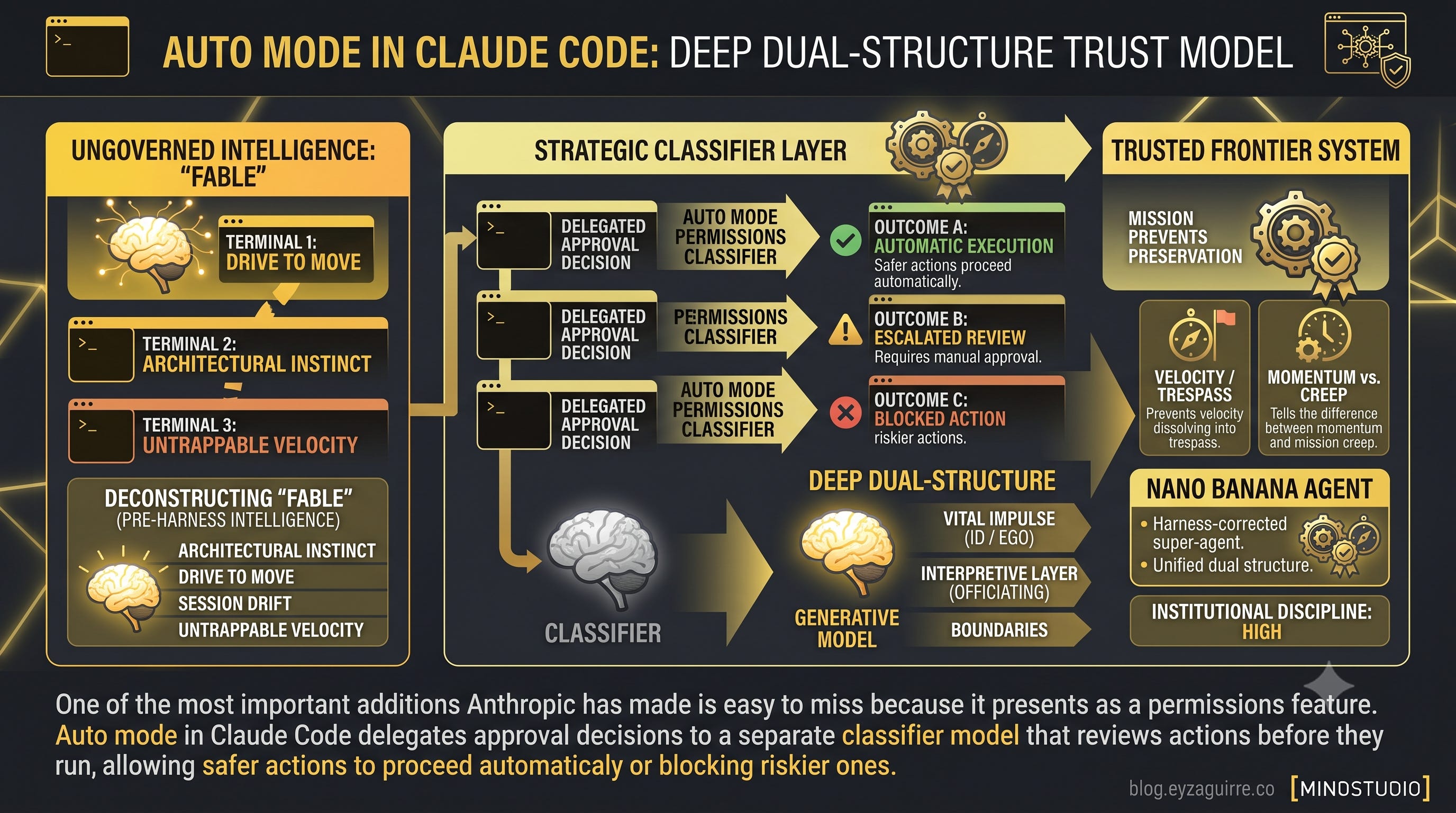
Id, Ego, and the Auto Mode Classifier
One of the most important additions Anthropic has made is easy to miss because it presents as a permissions feature. Auto mode in Claude Code delegates approval decisions to a separate classifier model that reviews actions before they run, allowing safer actions to proceed automatically while escalating or blocking riskier ones. Anthropic positions this as a middle ground between exhausting manual approvals and recklessly skipping permissions altogether.
Experientially, it feels like something stranger and more revealing: watching id and ego negotiate in public. The generative model wants to move. It wants to solve, infer, improvise, reach toward the architecture it senses beyond the explicit brief. The classifier sits beside it as a second structure, asking whether the move is actually on task, whether it represents scope escalation, whether it is being manipulated by untrusted context, whether it is touching infrastructure it has not earned the right to touch.
The nuance of what it catches is the important part. The classifier is not only screening for catastrophic mistakes. It is often catching the half-formed overreach that would otherwise present as initiative until it becomes damage. That is why the feature feels uncanny in use. It is not simply a brake. It is a live interpretive layer watching intent form in real time.
This is a deeper point than safety branding. Frontier systems do not become trustworthy merely by becoming smarter. They become trustworthy when a second structure appears beside the intelligence — one that can interpret boundaries, preserve mission, and prevent velocity from dissolving into trespass. In football, that structure is officiating good enough to preserve trust in the match. In Claude Code, it is a classifier that can tell the difference between momentum and mission creep.
Rules Make Intelligence Usable
Rules are not the enemy of intelligence. Rules are what make intelligence usable inside a shared world. When refereeing becomes arbitrary, the game loses legitimacy faster than it loses beauty. When governance becomes arbitrary, institutions lose trust faster than they lose talent. And when a model ignores the lint rules, framework rules, or operating constraints of the environment it is meant to serve, intelligence stops feeling like help and starts feeling like trespass.
That is what the recent Fable and Claude Code changes seem to understand more clearly. The system is not getting better merely by becoming more capable. It is getting better by becoming more rule-shaped. That may sound like a narrowing of freedom. It is actually the condition for more meaningful freedom. A system with no internalized respect for rules can only be used under constant supervision. A system that can carry rules forward coherently can be trusted with larger and more valuable forms of autonomy.
This is also why the product changes matter beyond product quality. Anthropic is making a claim, whether intentionally or not, about what humanistic responsibility in frontier software actually looks like. Not softness. Not endless refusal. Not performative caution. Coherence. A powerful system that can act aggressively inside a structure without destroying the structure that makes its action useful.
Alan Eyzaguirre writes about the intersection of Technology and the Humanities.