

As a long-time Claude Code loyalist, I couldn’t bear the idea of using OpenAI for coding. The tool always felt like a distant second, the model you fell back on when Anthropic’s usage limits ran dry. Then Fast Mode happened.
OpenAI’s Fast Mode, rolled out on July 30, 2026 as a replacement for the old Priority Processing tier, pushes GPT-5.6 Sol to speeds up to 2.5 times faster than standard processing, with no drop in intelligence, at exactly double the price: $4 per million input tokens and $20 per million output tokens become $8 and $40 under Fast Mode pricing. For anyone running agentic coding loops all day, where latency compounds across hundreds of tool calls, that speed multiplier is the difference between a model that feels responsive and one that feels like waiting on a dial-up connection. It was enough to make a Claude Code die-hard switch, at least for a session.[openai]
And then the second question arrives immediately behind the first: WOW, but who can actually pay for this. A typical Codex task on GPT-5.5 already burns 5 to 45 credits, and OpenAI itself estimates developer costs averaging $100 to $200 per month before Fast Mode’s price premium is even applied on top. Doubling the per-token cost of the flagship model for speed is a rational trade for a well-funded engineering org billing compute to a corporate card. It is a much harder trade for an individual developer, a bootstrapped startup, or anyone treating AI coding tools as a fixed monthly subscription rather than a variable, scaling utility bill. Fast Mode, in other words, is less a feature than a stratification device: it quietly separates the buyers who experience AI coding as a metered, negotiated resource from those who experience it as a flat-rate convenience.[uibakery][eesel]
That stratification is not confined to token pricing. The same tug-of-war over who gets to pay for speed and who gets rationed by it is playing out one layer down in the physical supply chain, where Apple, Nvidia, and a wave of Chinese manufacturers are all bidding for the same scarce wafers, packaging capacity, and helium that make chips like the one running Fast Mode possible in the first place. That’s where this piece goes next.
A Deposit for October That Assumes Nothing Changes
Apple opened Mac Studio pre-orders on August 25, 2026, for the new M5 Max and M5 Ultra models, with most configurations shipping September 22, 2026. One configuration — the 512GB unified memory M5 Ultra variant, the model most attractive to anyone trying to run a large open-weight model like GLM-5.3-Flash locally — was explicitly excluded from pre-order, with Apple stating only that it will be “available late October”. Entry pricing runs from $2,499 for the base M5 Max configuration to $18,299 for the maximum currently orderable M5 Ultra build (256GB memory, 16TB storage), with Apple’s own financing page listing installment options starting at $208.25 per month for 12 months or a $48.99-per-month, 36-month lease through its Apple Upgrade program. A deposit or partial payment toward an undated, unpriced 512GB configuration is therefore not a bet on Apple’s assembly line — it is a bet on a wafer allocation and a memory-module supply chain that Apple has not yet fully secured at the moment of sale, in a year when every major buyer of leading-edge silicon is competing for the same handful of fabs. [macobserver][macrumors][apple][appleinsider][apple]
Existing Mac order-to-delivery data from earlier in 2026 shows the strain already present in the pre-M5 pipeline: as of August 10, 2026, Apple’s own online store was quoting 56-to-70-day delivery windows for Mac Studio M4 Max configurations with 64GB/512GB specifications, well before the new M5 generation added further demand on top of an already-stretched supply chain. Layering a brand-new, higher-memory SKU onto that backdrop — one requiring additional DRAM packaging Apple has not finished qualifying — makes a firm November 2026 delivery date for a maximally configured unit closer to a probabilistic forecast than a purchase confirmation.[talk.tidbits]
Three Buyers, One Foundry, One Strait
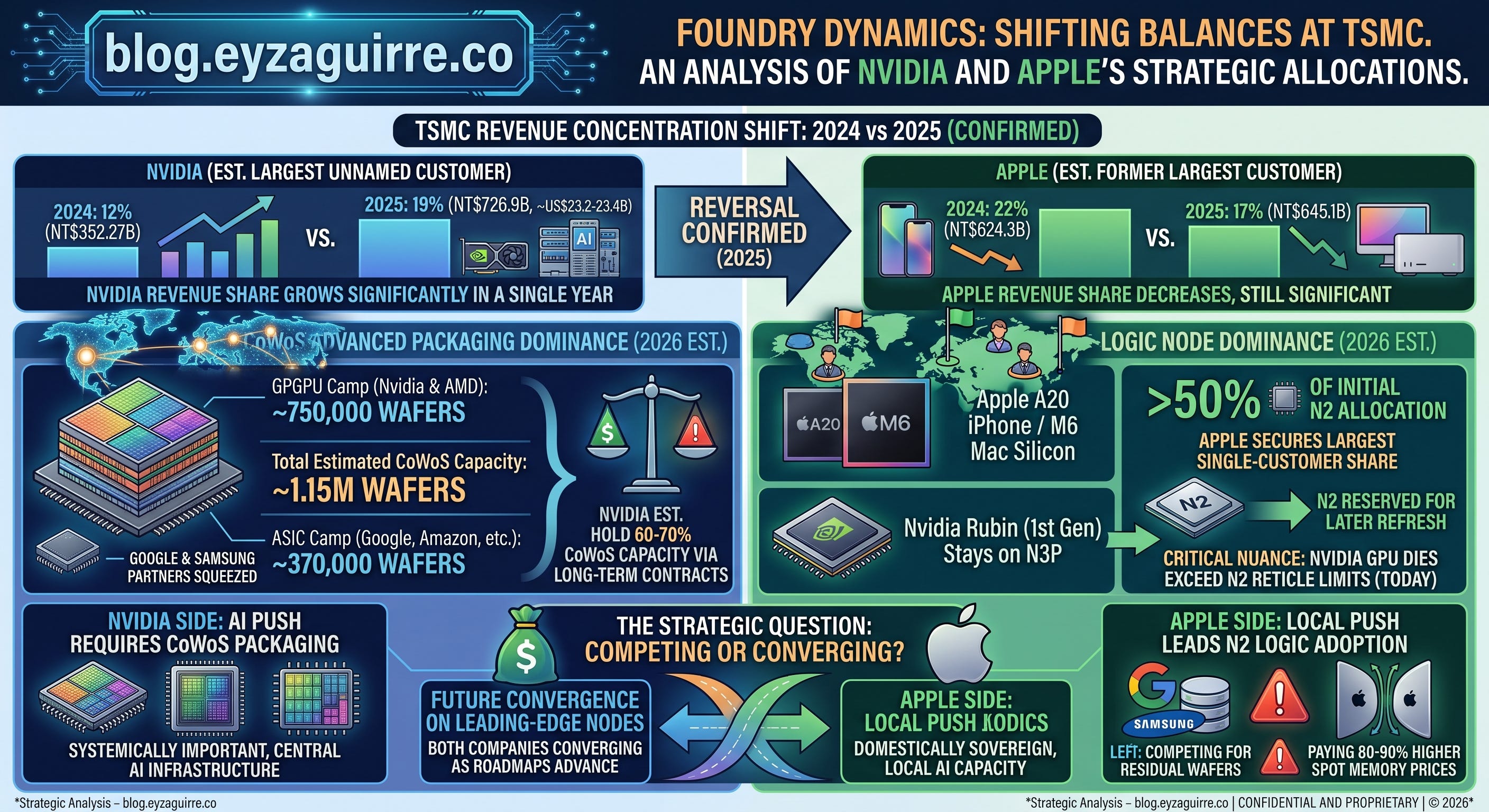
The structural reason for this uncertainty is that Apple, Nvidia, and a fast-growing cohort of Chinese “Mac Studio-style” mini-PC manufacturers are all drawing, directly or indirectly, from the same constrained inputs: TSMC’s leading-edge wafer capacity and a global helium supply chain that runs disproportionately through the Strait of Hormuz.
On the foundry side, the reversal is already visible in reported 2025 data, not merely projected for 2026. TSMC’s largest unnamed customer — widely identified as Nvidia based on analyst and press reporting, since TSMC discloses concentration anonymously rather than by name — contributed NT$726.9 billion (approximately US$23.2-23.4 billion), or 19% of TSMC revenue, in 2025, ahead of the second-largest customer, widely identified as Apple, at NT$645.1 billion (17%). This is a reversal from 2024, when Apple’s position as TSMC’s largest customer was reported at 22% of revenue (NT$624.3 billion) against Nvidia’s 12% (NT$352.27 billion), meaning Nvidia’s TSMC revenue share grew from roughly 12% to 19% in a single year. Creative Strategies analyst Ben Bajarin projects this gap will widen further in 2026, estimating Nvidia will generate roughly $33 billion (about 22% of TSMC revenue) versus Apple’s roughly $27 billion (about 18%) — figures that should be read as an analyst estimate rather than a direct TSMC disclosure, since TSMC’s own annual report discloses customer concentration only in anonymized percentage bands.[linkedin]
On CoWoS advanced packaging specifically — the process step required for Nvidia’s large, multi-die AI accelerators — Nvidia and AMD’s combined GPGPU camp is estimated to control roughly 750,000 of TSMC’s approximately 1.15 million wafers of 2026 capacity, versus roughly 370,000 wafers for the ASIC camp that includes custom accelerators from Google, Amazon, and others; Nvidia alone is estimated to hold 60-70% of CoWoS capacity through long-term contracts. On TSMC’s separate N2 (2-nanometer) leading-edge logic node — the process feeding Apple’s A20 iPhone and M6 Mac silicon rather than Nvidia’s large-die GPUs — Apple has locked in more than 50% of initial 2026 allocation, the largest single-customer share since the original N3 ramp, while Nvidia’s Rubin generation is reportedly staying on N3P for its first generation with N2 reserved for a later refresh. This is a critical nuance: Apple and Nvidia are not purely fighting over the identical wafers today, because Nvidia’s largest GPU dies exceed the reticle limits that make them efficient on N2, but the two companies are converging onto the same nodes as both roadmaps advance, and Google’s and Samsung’s chip partners are already reported to be left competing for residual 3-nanometer wafers and paying 80-90% higher spot memory prices as a result.[eu.36kr][presenc][finance.yahoo][reddit][linkedin]
The helium constraint sits underneath both companies’ wafers regardless of node. Qatar’s Ras Laffan facility, historically responsible for roughly one-third of global helium supply, was largely taken offline in early 2026 following regional conflict and an effective closure of the Strait of Hormuz, through which roughly 80% of global helium transits. Bank of America estimated the disruption removed 27-30% of global helium supply with spot prices surging 40-100% within weeks, and gas distributor Airgas declared force majeure on helium shipments in March 2026, cutting some US customer deliveries by up to 50%. Helium is not substitutable in the specific process steps that matter most — wafer backside cooling during lithography and etching, maintaining vacuum and thermal stability in EUV tools, and as a carrier gas in plasma-enhanced deposition — and industry consultant Richard Brook told the Financial Times that when a chip material becomes unavailable, “the cost of that material is basically infinity, because you have to shut the wafer fab down”. Countervailing evidence exists, however: as of May 2026, TechInsights reported the disruption had produced no measurable effect on semiconductor sales or production after ten weeks, with TSMC stating on its earnings call it expected “no near-term impact on our operations for material supply,” and GlobalFoundries estimating only a 0.5-percentage-point quarterly margin impact through the rest of 2026. The honest read is that the helium risk is real and structurally unhedged, but has not yet materialized into visible output cuts — a tail risk still loaded into 2026 capacity planning rather than a realized shortage. [forbes][kinaxis][marketwise][techinsights]
The Chinese Manufacturing Wildcard
A parallel and distinct competitive front has emerged in Chinese mini-PC manufacturing, where multiple vendors now sell Mac Studio-styled desktop chassis housing high-end consumer GPUs rather than Apple silicon. Independent reviews document Chinese-made units such as the FN60G WE, styled explicitly after Apple’s Mac Studio chassis, supporting Intel 12th-14th generation CPUs and accommodating GPUs up to Nvidia’s RTX 4090-class silicon, with barebones pricing starting around $380. Western comparison outlets tracking 2026 “Mac Studio alternatives” for local AI workloads list additional competitors including the Minisforum MS-S1 Max ($2,599, designed specifically for running large AI models locally) and ASUS’s ROG NUC 16, both of which use Nvidia or AMD silicon inside form factors explicitly designed to compete with Apple’s desktop AI positioning. These products consume a different slice of the same TSMC/foundry ecosystem than either Apple or Nvidia’s flagship chips — typically lagging-node CPUs paired with consumer GPUs on older process nodes — meaning they compete less directly for 2-nanometer wafers and more for legacy-node capacity, discrete GPU allocation, and DRAM/NAND supply, all of which are also tightening as AI demand pulls memory pricing higher industry-wide. [finance.yahoo][techradar][techrepublic]
The larger political variable shaping Chinese manufacturers’ access to genuinely competitive silicon is the ongoing, unstable US export-control regime around Nvidia’s advanced chips. Through 2026, US policy on Nvidia’s H200 has swung from outright ban, to permitted sale with a 25% tariff and case-by-case licensing, to congressional pushback via the Chip Security Act, which would embed physical tracking into exported chips to prevent diversion. Reported smuggling cases — including the March 2026 arrest of Super Micro Computer’s co-founder for allegedly diverting Nvidia chip-equipped servers to China via Taiwan and Malaysia, and a separate case involving 750 servers worth roughly $170 million routed through false end-use certifications — demonstrate that Chinese access to frontier Nvidia silicon persists through both authorized channels (the H200 licensing pathway, capped at an estimated 1 million units, roughly half of what Chinese buyers reportedly had on order) and unauthorized diversion. Separately, CNBC reported in August 2026 that Chinese AI firms are accessing Nvidia’s most advanced compute (including export-restricted GB300s) not through physical chip imports at all, but via remote cloud access to data centers in Southeast Asia — a loophole the proposed Remote Access Security Act aims to close, though it faces significant implementation hurdles around know-your-customer verification. Even under the most permissive plausible policy scenario, analysts estimate the US would retain a 21-to-49-times advantage in AI compute produced in 2026 versus China.[semiconductorsinsight][bisi.org][cnbc][securityandtechnology]
Monte Carlo: Simulating the Tug of War
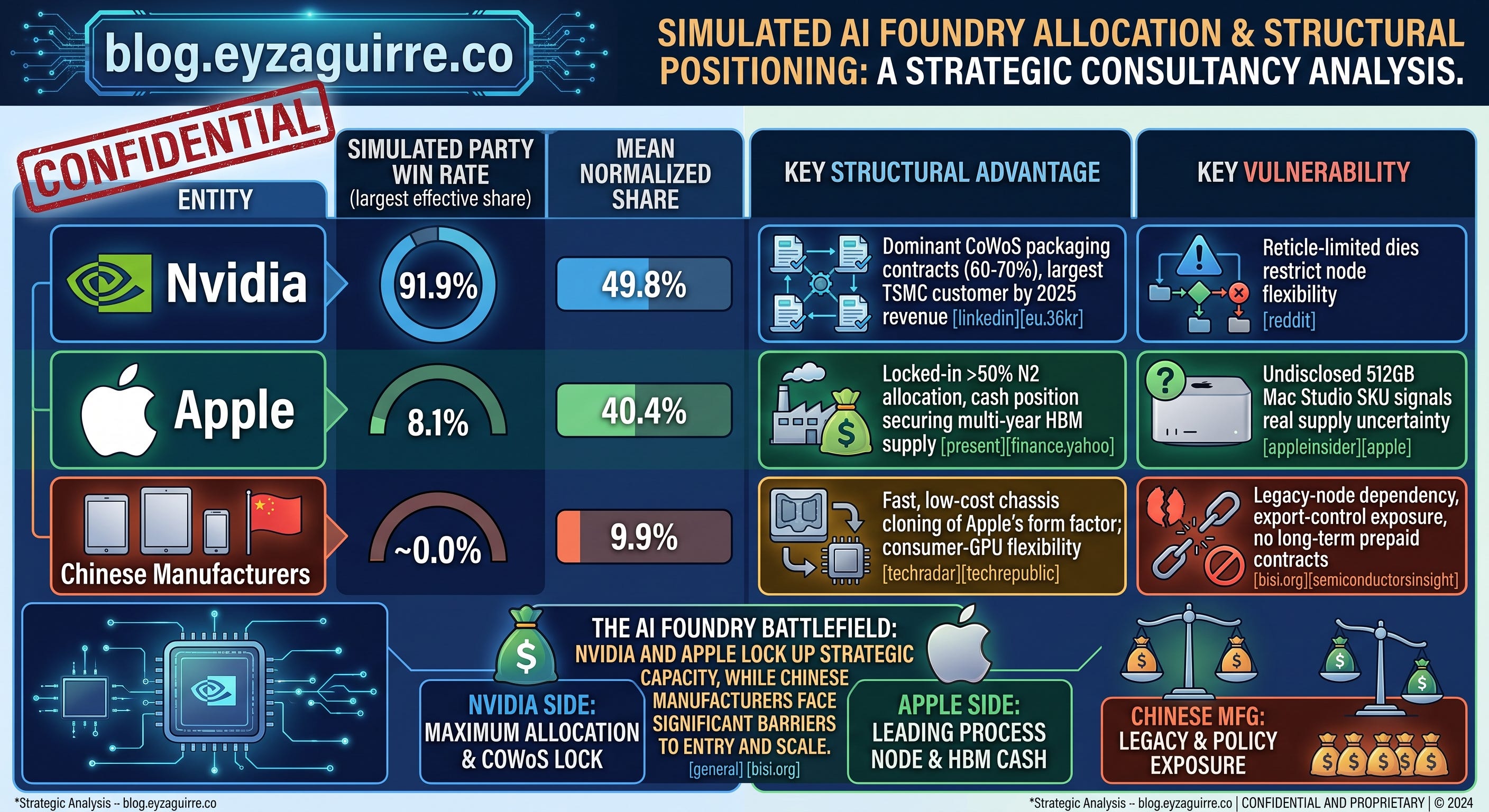
To quantify the competing pressures — TSMC allocation share, Nvidia’s packaging dominance, and the probability and severity of a renewed helium disruption tied to the Strait of Hormuz — a Monte Carlo simulation was run across 100,000 trials. Each trial drew Apple’s, Nvidia’s, and Chinese manufacturers’ effective share of constrained leading-edge capacity from triangular distributions calibrated to the reported ranges above (Apple 35-60% of N2-class capacity, center 50%; Nvidia 45-75% of advanced-packaging-relevant capacity, center 60%; Chinese manufacturers 5-20% of relevant legacy-node and residual capacity, center 12%), combined with a binomial helium-shock variable set at a 35% probability of a materially disruptive re-escalation in the relevant delivery window, and a helium-driven capacity derate applied disproportionately — most severely to Chinese manufacturers, who lack the multi-year prepaid contracts Apple and Nvidia hold, and least severely to Apple, whose cash position has reportedly locked in multi-year HBM memory and wafer supply agreements.[presenc][finance.yahoo]
The simulation resolved decisively in Nvidia’s favor: Nvidia won the largest effective share of constrained capacity in 91.9% of trials, Apple in 8.1%, and Chinese manufacturers in effectively 0% of trials. On average across all trials, Nvidia retained a mean normalized effective capacity share of 49.8%, versus 40.4% for Apple and 9.9% for Chinese manufacturers, even after accounting for the possibility of a renewed helium shock. The result is intuitive given the inputs: Nvidia’s dominant, long-term-contracted position in CoWoS advanced packaging (the process step, not merely the transistor node, that is scarcest for large AI accelerator dies) combined with the sheer dollar volume of its TSMC spend gives it first call on capacity even in years, like 2026, when Apple’s own N2 allocation is unusually large. Chinese manufacturers, dependent on legacy nodes, discrete consumer GPUs, and a politically unstable export-control pipeline for anything approaching frontier-class silicon, are structurally the most exposed to any tightening of global capacity, whether from helium disruption, export-control escalation, or simple allocation crowd-out by the two dominant buyers.[techradar][bisi.org][cnbc][linkedin][eu.36kr]
The Tug of TSMC
The tug of war is not really a three-way contest for the same physical wafers so much as a hierarchy: Nvidia and Apple both hold prepaid, contractually secured positions at the front of TSMC’s queue, while Chinese manufacturers — regardless of how convincingly they replicate Apple’s Mac Studio chassis or how many RTX-class GPUs they can package into it — sit downstream of a supply chain shaped by US export policy, TSMC’s own capacity-allocation decisions, and a helium logistics network that transits a strait currently sitting inside an active geopolitical fault line. The specific $800 deposit scenario for a loaded Mac Studio configuration due in November 2026 is not irrational, but it is a bet stacked on top of Apple successfully defending a wafer and memory allocation against the industry’s largest buyer of leading-edge capacity, during a year in which the input most likely to disrupt that allocation — helium — has already shown it can be knocked offline by events entirely outside any chipmaker’s control, even if the disruption has not yet shown up in shipped units.[marketwise][techinsights][bisi.org][linkedin][forbes]
Alan Eyzaguirre writes about AI and Society from the perspective of a Silicon Valley entrepreneur and corporate strategist. Alan worked at Apple from 2001-2010 and served as Director of Emerging Product Marketing, and also is named in a U.S. Patent for Apple Smart Tables.