

The most important AI decision most people will make in the next two years is not “which model?” but “where do I want that model to live: in someone else’s data center, or in a box I can finance and keep?” That is a household‑budget decision, but it sits on top of the same balance‑sheet questions this blog has been tracking since The Gravity of Free and Everything Gravity Does, It Does for Free: who quietly pays for “free” or cheap AI, and what happens when the capital structure underneath it starts to shift.
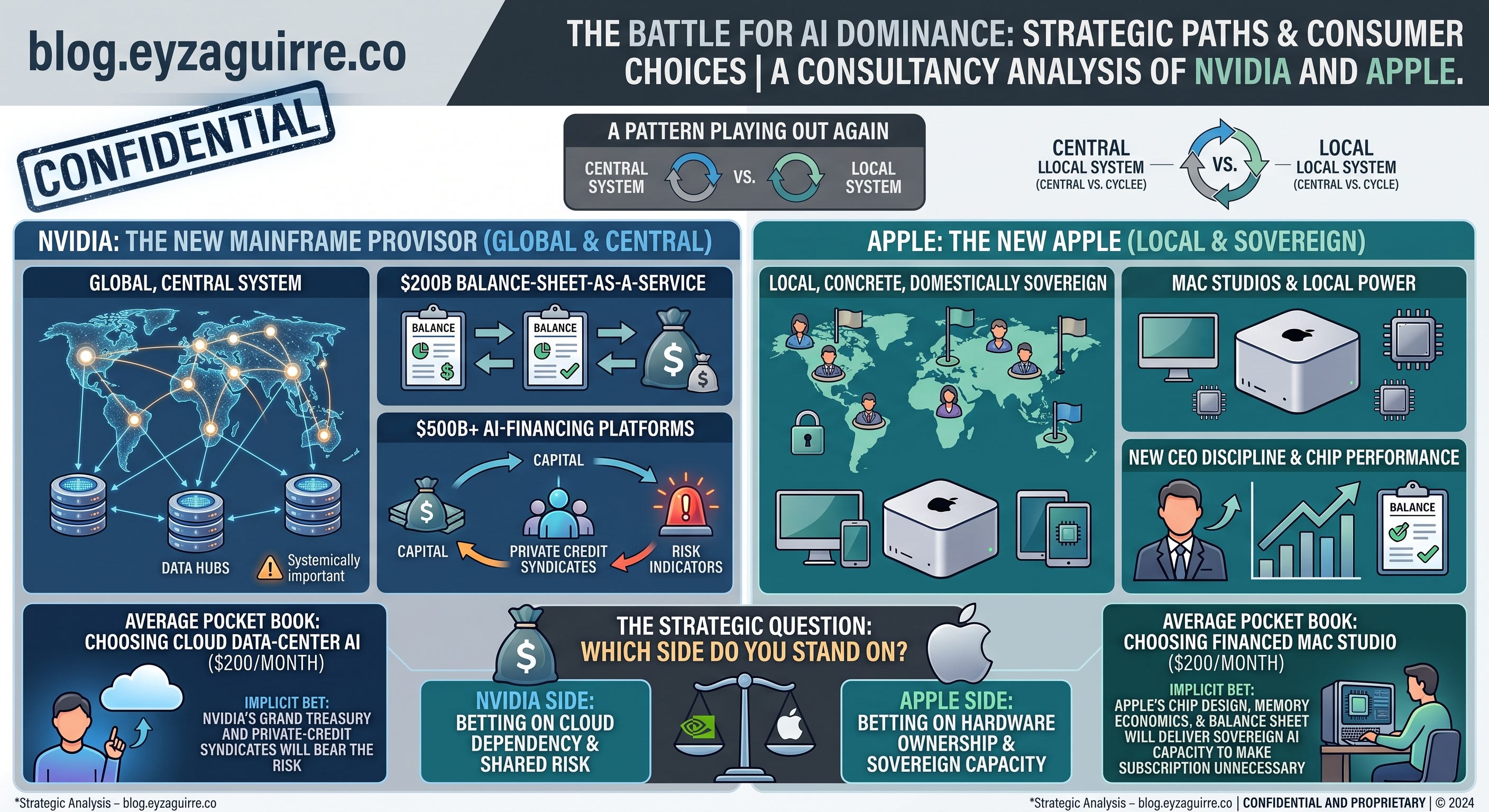
On one side, Nvidia is building what FT Alphaville and Morgan Stanley now call a $200 billion “balance‑sheet‑as‑a‑service” machine: a global AI treasury that makes data centers financeable by backstopping their hardware and revenue. On the other, Apple’s new CEO has stepped into a company whose core advantage is brutally simple: it manufactures chips that can run serious AI locally, and it controls a balance sheet large enough to push those machines into households on terms those households already understand. Klarna and the fintech rails are real, but they are a footnote in that story — an opportunity, not the fulcrum.
The analogue is not “cloud vs. edge.” It is the 1980s all over again: IBM mainframes vs. Apple personal computers, only this time the mainframe is Nvidia‑backed AI infrastructure and the “personal computer” is a Mac Studio whose unified memory could have been carved up into twenty thousand dollars’ worth of phones instead.
Nvidia as the AI Treasury
Morgan Stanley’s credit initiation on Nvidia formalizes what The Landgrab Has No Territory and Holon Levels of Agentic LLM and Orchestration have been circling in qualitative terms: Nvidia has turned its balance sheet into a policy lever for AI adoption. The note describes Nvidia as “turning balance‑sheet strength into a strategic AI financing tool,” then stops at a neutral recommendation because the tail risk is both large and opaque. By 2028, the bank expects Nvidia to be carrying roughly $200 billion of all‑in credit exposure tied to AI infrastructure, about $170 billion of which will take the form of contingent, contractual, or debt‑like obligations rather than straightforward bonds.
The mechanism looks like a textbook mainframe play, updated for private credit. Nvidia has signed memorandums of understanding with Apollo, BlackRock, Blackstone, Brookfield, Goldman Sachs, and KKR to create independent compute‑financing platforms aimed at mobilizing more than $500 billion in third‑party capital. These platforms buy or lease GPU‑dense “AI factories” and rent out capacity to hyperscalers, neocloud providers, and labs. Nvidia’s role is not just to supply chips; it is to make those chips bankable by promising to support residual values and revenue floors — paying up to 25 percent of project value in some structures if utilization or pricing falls short.
From the point of view of an average pocket book, this entire apparatus shows up as one line item: $200 a month for Claude Max 20x, or the equivalent for other top‑tier AI subscriptions. The fact that those tokens are being minted in facilities whose economics depend on Nvidia’s guarantees and private‑credit SPVs is invisible. It matters only if something breaks.
Apple’s Chips and the Household Balance Sheet
Apple’s new Mac Studio and Apple Upgrade program push in the opposite direction. Instead of underwriting other people’s data centers, Apple is shipping sovereign AI capacity into homes and studios and letting households decide whether they want to finance it like a car or a phone. The latest Mac Studio refresh supplies AI-ready, robust configurations with M‑series Max and Ultra chips and unified memory scaling into the hundreds of gigabytes — enough to host large open‑weight models and serious orchestration workloads locally, at a price of about $5,000 to $12,000 properly configured, which in itself is an eye-watering discount to the equivalent industry standard GPU card.
One of the subtle innovations in all this is the Apple Upgrade program, enabling the average professional office or consumer access a $10,000+ configuration, capable of running near frontier models, for about $200 a month. That’s quite the coincidence when you consider the embroiled Claude Pro Max subscription price. And when you consider, you can put a deposit today for less than $1,000, towards a delivery in November, is the kind of supply chain risk that only the likes of Apple can assuage.

Enter John Ternus, Apple’s new CEO. He’s as comfortable arranging microprocessor boards as he is with a balance sheet. And, oh, does he have a blessed choice on his plate. Maximize revenue and retain the iPhone dominance, and/or grow the base for Sovereign AI at the professional and prosumer level. Apple is now shipping the presses, not just the typesetting terminals.
Apple Ameliorates The AI Divide
The centre of gravity here is Apple’s inventory. Apple knows how many Mac Studios it can build with 256GB or 512GB of unified memory and what those configurations do to unit economics. Choosing to keep the Mac Studio price curve within a band that can be smoothed by consumer‑credit rails is a strategic move: it pours sovereign AI capacity into the same households that used to buy high‑end iMacs, but with a completely different downstream effect on where AI workloads live.
Apple is now willing to ship machines whose memory footprint is more typical of data‑center nodes than of desktops, and to do so at retail price points that, once financed, are within reach of small firms and serious individuals. That is exactly the kind of scale inversion The Maelstrom Beyond Intelligence and Infrastructure suggested: infrastructure that used to be centralized is now being shipped in slices.
On the other side of the board, Nvidia’s role as Provisio Grand Exchequer — the global AI treasurer — depends on keeping that scale centralized. The more RAM and compute Apple and others push into sovereign machines, the more AI workloads can move off cloud and into environments governed by local rules, open‑weight stacks, and predictable household budgets. The more Nvidia succeeds in making its balance‑sheet‑as‑a‑service platform attractive, the more workloads stay in data centers financed with complex guarantees and purchase commitments.
Ultimately, for the consumers and enterprise buyers alike, this is a choice between two architectures of sovereignty:
Sovereign AI for households and firms: compute and memory sit on devices you own or finance; you choose models, control data, and can opt out of vendor loops. Financial sovereignty looks like fixed monthly payments that amortise into assets.
Sovereign AI for states and hyper-scalers: compute sits in national or regional data centers; sovereignty is defined by where racks and data live and whose export controls apply.
Nvidia is building the second architecture at global scale. Apple is quietly enabling the first by making sure its chips and memory configurations can host serious AI locally and by tying those machines into financing rails households understand.
IBM vs Apple, Again — With AI
Seen through the lens of The Rear‑view Odometer And Its Antidote, we keep trying to read today’s AI capital structures through yesterday’s cloud narratives. IBM once bet that computing would stay in centralized facilities and that clients would attach themselves through terminals. Apple bet that computing would become personal, that managers would have machines instead of secretaries, and that software and culture would follow the device.
We are about to watch that pattern play out again. For the average pocket book, the question is not “which side will win?” but “which side do I want to stand on?” If you spend $200 a month on data‑center AI, you are implicitly betting that Nvidia’s grand treasury and its private‑credit syndicates will bear the risk for you. If you spend $200 a month on a financed Mac Studio, you are betting that Apple’s chip design, memory economics, and balance sheet will deliver enough sovereign AI capacity to make that subscription unnecessary. Regardless, on both sides, the notable part about this supposed “AI Bubble” is that capacity constraint stresses both sides. It could be, in this case, that both sides win.
Alan Eyzaguirre writes about AI, capital markets and corporate strategy, from the lens of a Silicon Valley entrepreneur and corporate strategist. Thanks to Mark Pesce for the continuous dialog on the future of AI Economics, and in particular, the insight on Apple’s choice of one Mac Studio vs. ten iPhones.