

Source: CEOInsighter.com
On a Tuesday in July, I built a media company. Not a slide deck describing one — an actual company, with a name, a voice, a production pipeline, and eight finished episodes by dinner. CEO Insighter takes a real earnings call or interview, extracts the executive’s actual insight, and turns it into a branded video in the time it takes most teams to schedule the kickoff meeting. No writers’ room. No production company. No six-month runway. The insights are automatically generated. What isn’t automatic — what took the actual craft — was deciding what the thing should say, how it should sound, and why anyone should trust it. That distinction turns out to be the whole essay.
The economy is already reorganizing around a different unit of value than the one anyone is currently counting.
Contrast that Tuesday with a report the Penn Wharton Budget Model published last September, which has become the year’s favorite citation for the argument that AI’s productivity revolution is mostly marketing. The study is careful, and its authors are top-flight practitioners — that’s what makes it worth taking seriously rather than dismissing. It finds that generative AI will raise the level of productivity and GDP by about 1.5% by 2035, nearly 3% by 2055, and 3.7% by 2075 relative to a no-AI baseline. Those numbers sound respectable until you get to the sentence that actually made headlines: once adoption saturates, the permanent boost to the annual growth rate settles at less than 0.04 percentage points — four one-hundredths of a point, after a brief peak contribution of about 0.2 points in the early 2030s that fades through the decade. The authors’ own summary of their finding is admirably restrained: “a material but not transformative macroeconomic effect under current evidence.”
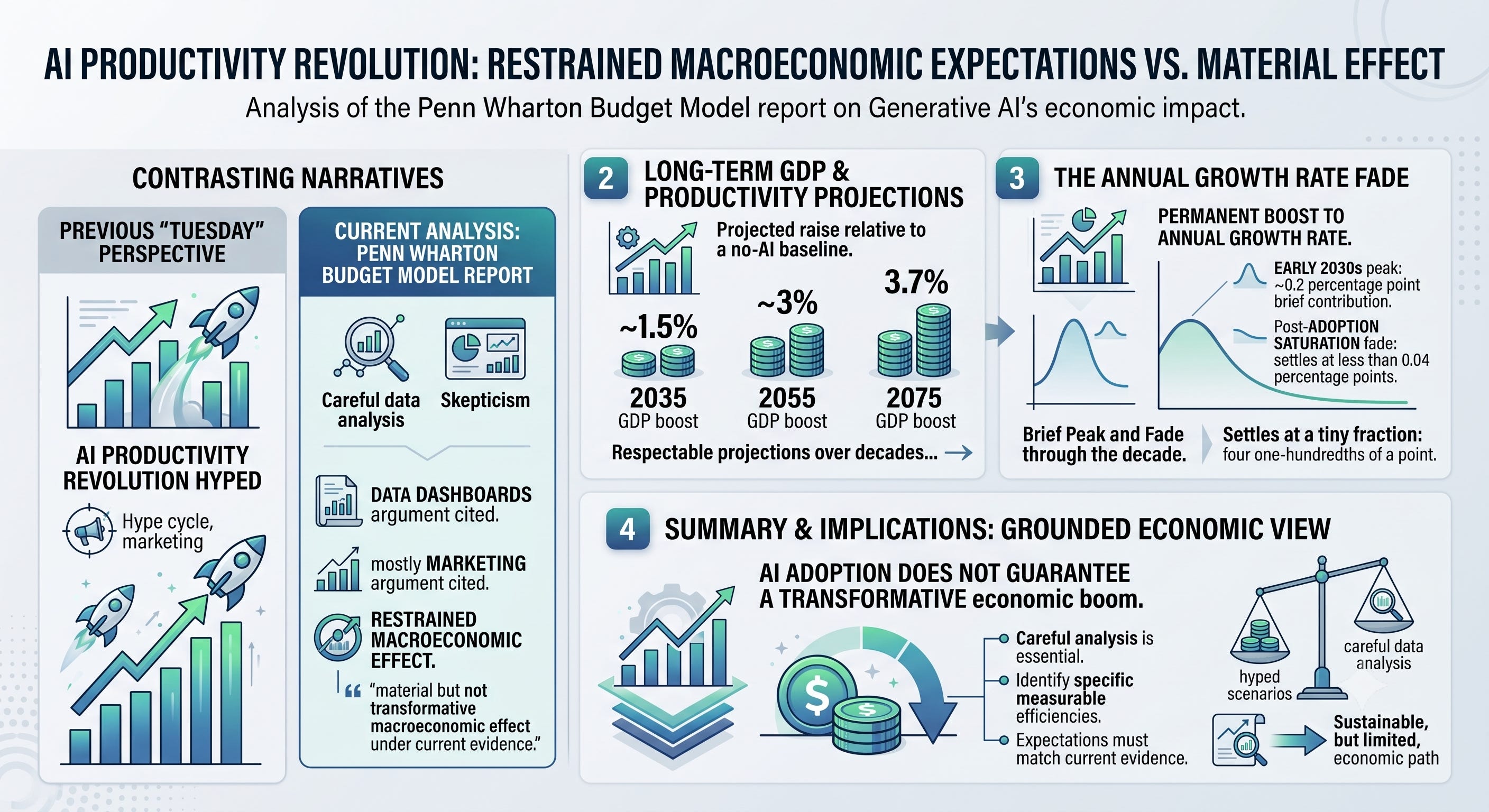
I want to sit with that phrase for a moment, because it’s honest in a way that most AI commentary isn’t, and because its honesty is exactly what exposes the limits of the exercise. Buried in the same paper is an admission that matters more than the headline number: the model explicitly excludes “the emergence of new products and labor tasks as a result of AI adoption.” Read that again. The instrument that produced the 0.04 figure was built to measure how much faster the existing economy — existing firms, producing existing goods, sold through existing channels, staffed by workers doing existing jobs — would run with AI bolted on. It was not built to detect an economy that doesn’t have a line item yet. That’s not a flaw in the modeling; it’s a structural property of every GDP-style instrument going back to Kuznets. You can only count what already has a category. And an odometer, however precisely calibrated, cannot register the road that hasn’t been paved.
An Instrument Built to Look Backward
This is the crux of the counter-argument, and it’s worth being precise about it rather than just gesturing at “AI skeptics don’t get it.” The studies declaring AI a productivity dud are not wrong about their own data. They are rear-view instruments by construction — national accounts measure output through the lens of last quarter’s occupational codes and last decade’s industry classifications. When a former Cisco director spins up a one-day media company that didn’t exist as a category twelve months ago, that activity doesn’t show up as “software” or “media production” in any dataset built to track those categories as they were defined before this was possible. It shows up, if it shows up at all, as noise inside “other services” — assuming anyone remembers to file the 1099.
Meanwhile the actual convergence is happening in exactly the places these instruments don’t look. Upwork’s own research arm reported this February that demand for AI-referencing skills on its marketplace more than doubled year over year, with AI video generation and editing up 329%, AI integration work up 178%, and AI-enabled freelancers earning meaningfully more per hour than those without — not because gig work is shrinking under AI pressure, but because gig work and AI fluency have fused into a single, faster-moving labor category that didn’t have a name two years ago. That’s Upwork’s own marketplace data, not a projection — actual contracts, actual dollars, moving toward exactly the seam this essay is about: individuals who can direct machine output toward a specific, provable outcome for a specific client.
Widen the lens and the pattern repeats. Solo YouTube channels with no studio, no crew, and no distribution deal are generating real, sustained income by publishing at a volume and cadence that used to require a production team — the same dynamic, one operator directing tools rather than commanding headcount. Former executives — the kind who used to require a $50,000 speaking fee and an agent to get fifteen minutes of their judgment in front of a room — are now running paid private workgroups and cohort-based communities where that same judgment is priced directly, monthly, without an employer in between. None of this is speculative; it’s just dispersed across too many individually small transactions for any national accounting framework to aggregate before the framework itself is out of date.
Orchestration Is the New Craft
What connects CEO Insighter, the Upwork freelancer, the solo YouTuber, and the ex-CXO running a paid Slack is that in every case, the underlying execution — the writing, the editing, the analysis, increasingly even the code — has become close to free. What hasn’t become free is the judgment about which output is worth producing, in what voice, aimed at whom, and why anyone should believe it. McKinsey’s own framing of what it calls the agentic organization gets at this directly: “In the agentic organization, humans will move from executing activities to owning and steering end-to-end outcomes,” and pointedly, that this requires deliberate orchestration — “to align teams around shared context and outcomes, identify the right mix of human and AI capabilities... and build trust between humans and agents”. That’s a research firm’s polite way of saying execution is being commodified from the bottom up — starting with the software engineer’s boilerplate and working its way, faster than most boardrooms have priced in, toward the CXO’s slide deck.
Bain’s technology practice reached a version of the same conclusion from the enterprise software side. Their May report on agentic AI’s disruption of SaaS argues that the durable moat isn’t the platform anymore — it’s what they call cross-workflow decision context, “the ability to see, interpret, and act across workflows that traverse multiple systems,” because agentic AI’s real opportunity “isn’t replacing SaaS. It’s automating the expensive human coordination work that connects SaaS systems”. Swap “SaaS systems” for “job functions” and you have the labor-market version of the same thesis: the coordination layer, not the execution layer, is where the value concentrates once execution stops being scarce.
I made a version of this argument in my own writing , working through what happens once generative systems can perform the domain-knowledge and communication components of expertise at or above human level. The conclusion I landed on was this:
“What they cannot replicate, and what therefore becomes the concentration point of durable human value, is judgment operating on institutional context that has not been encoded, relationship capital that exists in non-digital registers, and the kind of tacit situational awareness that accumulates from years of operating inside a specific organization with specific constraints and specific stakeholders.”
— Alan Eyzaguirre, blog.eyzaguirre.co
That’s the orchestration economy in one sentence, arrived at from the enterprise side rather than the gig-work side, which is exactly why it’s worth cross-referencing against McKinsey and Bain rather than taking my own word for it. Three independent vantage points — a strategy consultancy, a technology consultancy, and someone who’s actually shipped the machinery — converging on the same structural claim: the roles get commodified from software engineer up through CXO, and what survives, what gets paid for, is the layer that decides what the machine should be pointed at and vouches for the result.
Where the Value Actually Relocates
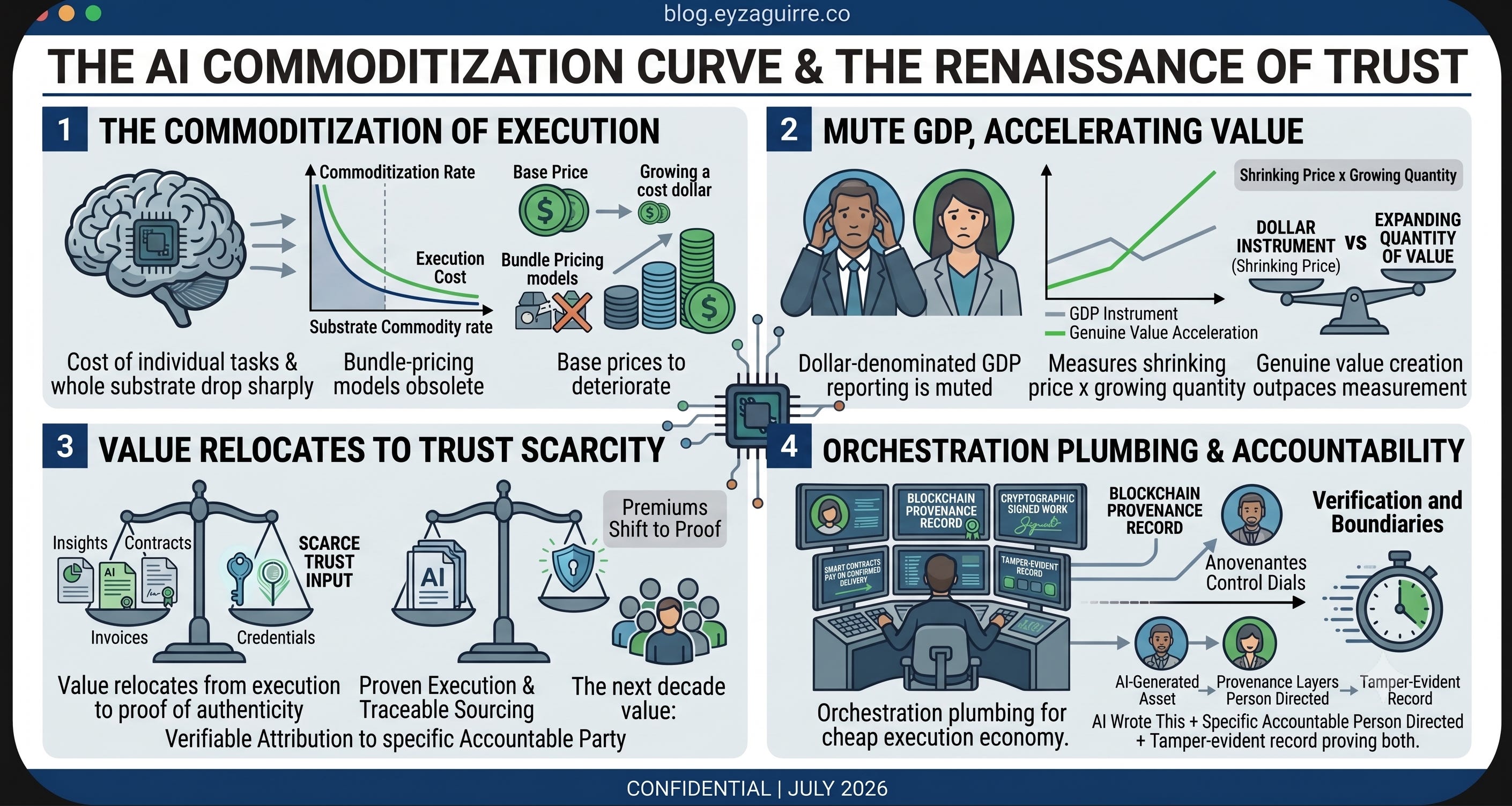
Here is where the GDP arithmetic gets interesting again, and where I think the Wharton framing quietly understates its own case in the opposite direction from where the AI-skeptic crowd wants to take it. If execution keeps getting cheaper — and the same paper I wrote about platforms becoming commodities argued that the substrate itself, not just individual tasks, is being commoditized at a pace bundle-pricing models weren’t built to absorb — then the base price of a huge swath of current products and services is going to deteriorate, possibly sharply, over the coming decade. That deterioration is real, and it’s part of why a purely dollar-denominated GDP instrument built on today’s price levels will keep reporting muted numbers even as genuine value creation accelerates: you’re measuring a shrinking price times a growing quantity, and the two can net out to something that looks like nothing happened.
But the deterioration in old pricing is not the whole story, because value doesn’t just vanish when a price falls — it relocates to wherever trust becomes the scarce input. When anyone can generate a plausible-sounding insight, an invoice, a contract, or a credential in seconds, the premium shifts to whatever can prove the thing is real: provably executed, traceably sourced, verifiably attributable to a specific accountable party. That’s the opening for blockchain-verified provenance, cryptographically signed work product, and smart contracts that pay out only against confirmed delivery — not as speculative crypto-hype, but as the plumbing an orchestration economy actually needs once execution is too cheap and too fast to police any other way. The next decade of enterprise value probably looks less like “AI wrote this” and more like “AI wrote this, a specific accountable person directed and stood behind it, and here is the tamper-evident record proving both.”
Which loops back to that Tuesday in July. CEO Insighter isn’t valuable because the videos are automatically generated — that part is, by design, close to free, and getting cheaper every quarter. It’s valuable, to the extent it is, because someone with real corporate-strategist judgment decided which insight mattered, positioned it, and put a name behind it that a viewer can choose to trust or not. That’s the entire commercial thesis compressed into a single afternoon of work. The reason it’s worth writing about isn’t as a case study in AI hype — it’s as a small, honest data point for exactly the phenomenon the Wharton instrument was never built to see: not proof that AI is transforming the GDP numbers this decade, but proof that the economy is already reorganizing around a different unit of value than the one anyone is currently counting. Four one-hundredths of a percentage point is a fair verdict on the old economy running slightly faster. It has nothing to say about the new one that hasn’t been named yet — and that new one is where any entrepreneur paying attention should be building right now, virtualized machinery and all.
Alan Eyzaguirre writes about technology, market structure, and the long arcs that connect them.