

Executive Summary
Note: This report extends the holonic taxonomy methodology first applied in “Holon Levels of Agentic LLM and Orchestration” (May 2026) to the advertising intelligence and media-buying stack.
Advertising technology is undergoing the same structural transition that reshaped agentic LLM orchestration: single-purpose monitoring tools are being absorbed into composable, hierarchical systems that perceive signal, model attribution, and act on live media budgets. This report applies the holonic systems framework—originally proposed by Arthur Koestler in The Ghost in the Machine (1967) and later formalized for distributed artificial-intelligence research—to classify the advertising intelligence and media-control landscape. A holon is simultaneously a self-contained whole and a functional part of a higher-order system. This dual nature maps precisely onto the layered architecture of the modern advertising stack, where a social-listening platform is a complete monitoring tool and, in mature deployments, a subordinate signal source feeding a larger budget-allocation holarchy.
In 2026, marketing budgets typically run 6–12 percent of revenue, with digital channels commanding roughly 61–68 percent of total spend; social listening, marketing mix modeling, and agentic orchestration all sit upstream of that spend and exist to inform and execute its allocation. Industry practice already treats social listening as advertising intelligence—fuel for creative, audience, and timing decisions—rather than brand monitoring alone. Marketing mix modeling (MMM) has re-emerged as a core discipline in response to privacy and signal loss, and a new set of agentic advertising protocols—Ad Context Protocol (AdCP), Universal Commerce Protocol (UCP), and agentic real-time-bidding frameworks—are being built specifically so AI agents can discover, plan, buy, and measure media autonomously.
This taxonomy defines five holon levels (A0–A4) for advertising intelligence and media control, grades nine leading vendors across A2–A4 using customer sentiment (G2, Capterra, TrustRadius, Gartner Peer Insights) and pricing benchmarks, and surfaces a structural irony: in phase 3 of the LLM crash—where infrastructure and point tools have deflated and open-source agents can now perform much of the underlying signal-capture work—the most opaque, most expensive tier of this market is still commanding premium pricing. The findings are intended to support enterprise martech selection, vendor negotiation, and internal build-versus-buy decisions for the A4 media-control layer.
Section 1: The Holonic Framework Applied to Advertising Intelligence
1.1 Origins of the Holon Model
Koestler defined a holon as a structure that is “stable and coherent” and exhibits a Janus-face duality: one face looking inward to govern its own internal logic, and another face looking outward to interface with its containing system. Applied to advertising infrastructure, a holarchy is a tree of monitoring, modeling, and execution systems in which each node simultaneously acts as a functionally complete tool and as a governed component of a higher node that ultimately controls budget movement.
1.2 Holons Reframed Around Media Control
In this framework, each platform is simultaneously a whole and a part: a complete unit of advertising function that also serves as a component in a larger media system. An A2 listening platform is a complete tool—it monitors and interprets conversations—but in mature deployments it is a subordinate signal source to A3 modeling and A4 agentic control, which decide how budgets shift across channels. The higher-order holon at the top of this stack is explicitly a budget-allocation and media-buying system: not a generic governed-action layer, but a media control plane that holds the levers on advertising spend and exposes them to agents and humans via protocols such as AdCP and UCP.
1.3 Holon Level Definitions
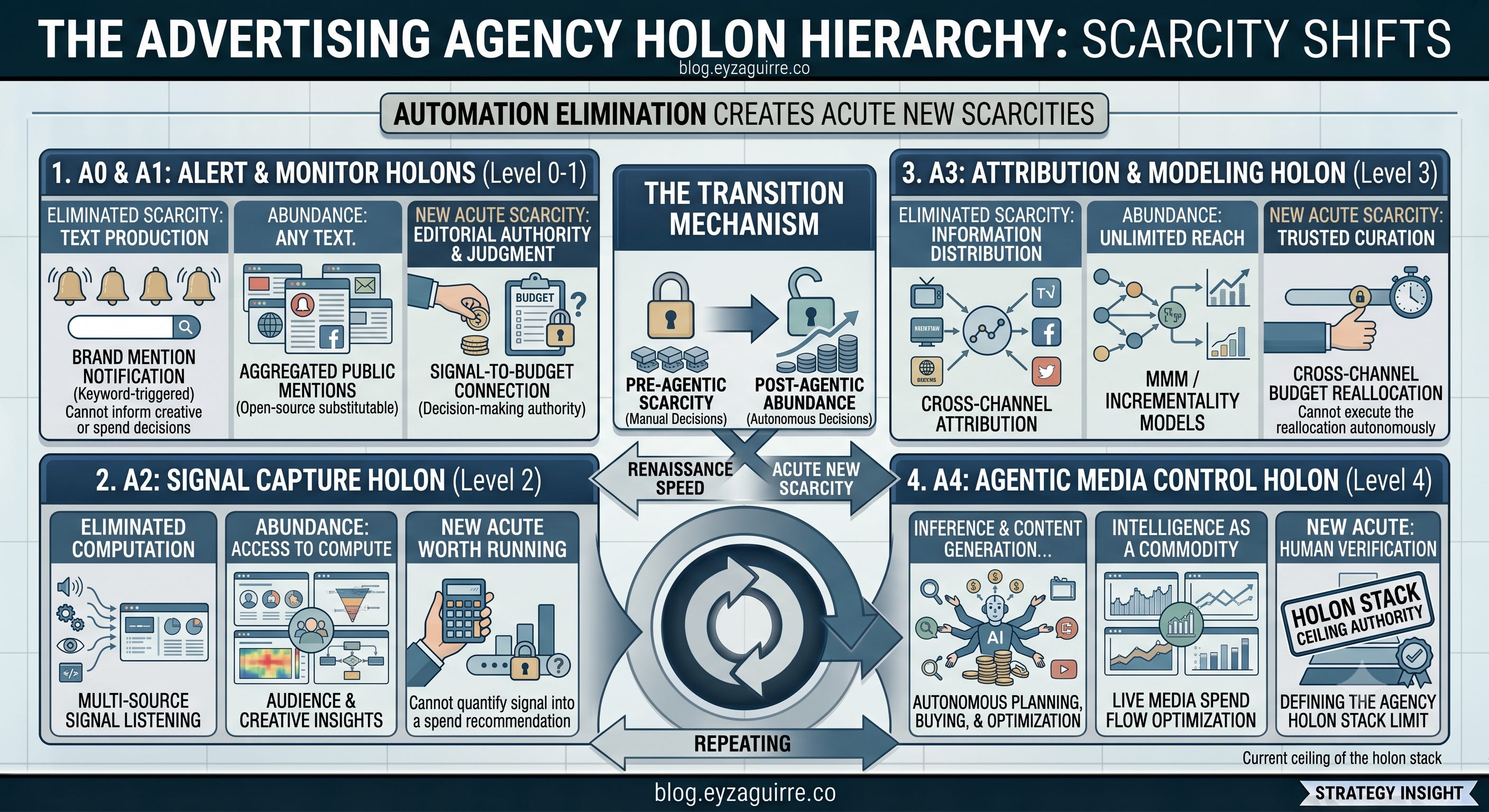
Every holon level ultimately answers two questions: where should the next media dollar go, and which agent, platform, or internal team is authorized to move it. The following taxonomy defines five ascending levels of advertising-intelligence autonomy, each inheriting the capabilities of the level below it.
Section 2: Holon Level Technical Specifications
A0 — Alert Holon
The fundamental indivisible holon in the advertising stack. Free tools such as Google Alerts and F5Bot provide basic keyword-triggered monitoring of brand, competitor, and topic mentions. These tools have never been meaningfully monetized and set the market expectation that raw mention capture should cost nothing.2
Key Characteristics:
Keyword-triggered notification only
No aggregation across sources
No connection to campaign or budget decisions
Zero cost to deploy
A1 — Monitor Holon
The open-source substitution layer is real and already in production use. Postiz is an open-source, self-hosted social scheduling and analytics tool supporting over two dozen networks, with maintainers and users emphasizing its “fully open-source” status and absence of recurring license fees. Mixpost Lite offers comparable scheduling capability under permissive licensing, and n8n is a source-available workflow automation engine marketed explicitly as an AI workflow automation platform with a free self-hosted tier and hundreds of integrations. Directories of self-hosted tools confirm that most such applications are open source and free, with cost limited to hosting and any paid APIs called.2
Key Characteristics:
Aggregation and search across public mentions
Open-source substitutable at near-zero software cost
Basic scheduling and routing, no budget-modeling capability
Cost limited to infrastructure and internal labor
A2 — Signal Capture Holon
Industry strategy guides define social listening as tracking and analyzing conversations across social platforms, forums, blogs, and the web to understand brand, competitor, and industry sentiment, explicitly to drive marketing, product, and CX decisions. In an advertising-centric holarchy, A2 holons turn scattered conversations into narrative intelligence for campaigns—a complete monitoring tool that becomes a subordinate signal feed once A3/A4 layers exist above it.2
Key Characteristics:
Multi-source listening (social, news, forums, blogs)
Narrative and audience-insight generation for creative teams
Cannot itself quantify a signal into a spend recommendation
Typically licensed at five- to six-figure annual contracts
A3 — Attribution & Modeling Holon
A3 holons turn signal into budget math: marketing mix modeling, incrementality testing, and cross-channel reallocation recommendations. Guides on MMM for 2026 describe it as correlating aggregate marketing spend by channel against aggregate outcomes such as sales, noting that credible MMM generally needs 78–104 weeks of weekly data to capture seasonality and enough budget variation. Provider roundups show MMM costs ranging from free open-source tooling (Google Meridian, Meta Robyn) to six-figure annual contracts, with open-source options still requiring $100K–$200K+ per year in data-science headcount to build, maintain, and interpret. In holon terms, A3 is where advertisers stop discussing insights and start discussing reallocations: which channels gain or lose budget, by how much, given modeled ROI and constraints.2
Key Characteristics:
MMM and incrementality modeling across channels
Produces concrete budget-reallocation recommendations
Cannot execute the reallocation autonomously
Self-service SaaS: $12K–$36K/year; managed/hybrid: $75K–$500K/year2
A4 — Agentic Media Control Holon
The current ceiling of the advertising holarchy. A4 systems implement autonomous or semi-autonomous discovery, planning, buying, and optimization of live media spend via emerging open protocols. The Ad Context Protocol (AdCP), Universal Commerce Protocol (UCP), and agentic real-time-bidding frameworks are being built specifically so AI agents can discover, plan, buy, and measure media without continuous human mediation. Google’s UCP, unveiled in January 2026, is positioned as the first production implementation of an open standard for agentic commerce across platforms.2
Key Characteristics:
Protocol-mediated discovery, planning, and buying (AdCP, UCP)
Holds the executable levers on live advertising budgets
Exposes control to both human operators and autonomous agents
No vendor in this study has yet achieved full A4 maturity; several sit at the A3–A4 boundary
Section 3: Vendor Taxonomy and Grading Framework
3.1 Grading Methodology
Nine platforms are evaluated at A2, A3, and the A3–A4 boundary using customer sentiment volume and consistency (G2, Capterra, TrustRadius, Gartner Peer Insights), pricing transparency, and documented friction points (implementation effort, contractual lock-in, support quality). Grades are assigned on a standard letter scale (A– through B–) reflecting the balance of capability, sentiment, and total cost of ownership within each holon tier.
Section 4: Vendor Profiles and Grades
4.1 A2 Signal Capture Platforms
Brandwatch — Grade A–
Brandwatch’s Consumer Intelligence suite covers over 100 million sources across social, news, forums, and blogs. G2 reviewers consistently praise “comprehensive data coverage” and “intuitive dashboards,” describing daily cross-client use and rapid conversion of social data into usable insight; Brandwatch is named a Leader by G2 in social media monitoring, analytics, and social media management. Recurring complaints center on cost and complexity, with enterprise configurations often reaching six-figure annual contracts. Typical annual bands run roughly $10K at entry, $20K–$45K mid-market, and $60K–$150K+ at enterprise scale.
Talkwalker / Lumen — Grade B+
Talkwalker by Hootsuite holds a 4.3/5 G2 rating across roughly 137 reviews and an 8.6/10 TrustRadius score. Users describe it as “easy to use with powerful cluster analysis,” and Lumen’s data coverage—30+ networks, roughly 150 million websites, multi-language support—gives advertisers wide visibility into conversation. Talkwalker is unusually transparent on pricing: public Core/Analyze/Business tiers run approximately $9.6K–$15K, $20K–$35K, and $40K–$100K+ per year respectively, often with unlimited users. Complaints focus on setup effort and higher costs for deeper history and governance features.
Meltwater — Grade B–
Across G2, TrustRadius, and Gartner Peer Insights, Meltwater averages roughly 4.0/5, with reviews highlighting a “user-friendly interface” and “powerful AI insights and reporting capabilities”. A large review base also flags a consistent complaint pattern: “incredibly expensive platform,” steep and sometimes opaque pricing, and frustrating contractual lock-in. Pricing benchmarks put entry around $10K/year, mid-market between $25K and $70K, and enterprise contracts at $130K+.
4.2 A3 Attribution and Modeling Platforms
Chattermill — Grade A– (A3-leaning)
Chattermill’s customer sentiment is unusually well-documented: ratings sit around 4.4–4.5/5 across G2, Capterra, and Gartner Peer Insights, spanning roughly 355 verified reviews. Buyers praise its ability to unify feedback across channels, surface themes, and provide actionable insight for product and CX teams; independent comparisons note that complexity and cost can hinder adoption for smaller organizations. Pricing is custom, with Vendr data suggesting an average around $64K/year.
Thematic — Grade A–
Thematic’s G2 rating is 4.8/5 across 43 reviews. Customers highlight its “great user interface” and note that “creating and managing themes is really easy and intuitive,” aligning with a design built around transparent, editable taxonomies. A handful of reviewers cite “inaccurate scoring mechanisms” or find impact scoring hard to interpret. Thematic publicly lists a $25K/year Foundation plan, a rare instance of pricing transparency at this tier.
SentiSum — Grade B+
SentiSum’s G2 rating is 4.8/5 based on 14 reviews. Buyers describe it as a “great solution for finding and tracking major keywords and topics over time,” explicitly praising root-cause analysis and cost-reduction impact; the company positions its product as a “closed-loop intelligence layer” that turns customer voice into measurable cost reduction. The limitation is sample size—only 14 G2 reviews and no Gartner Peer Insights rating yet. Public pricing tiers are $12K/year for Growth and $36K/year for Pro, with custom Enterprise pricing above.
4.3 A3–A4 Boundary: CX Suites as Advertising Infrastructure
Platforms in this category provide deep CX and ad-intelligence measurement and are frequently wired into the decision processes that control budgets, placing them structurally between the modeling holon and the still-unrealized agentic control holon.
Qualtrics XM — Grade B
Qualtrics Customer Experience holds a 4.3/5 G2 rating across more than 700 reviews, with customers praising its flexibility and depth for complex CX and survey programs. Reviews also flag a steep learning curve and describe it as “overly complex for basic needs,” with pricing prohibitive for smaller businesses. Pricing for self-serve research starts around $1.5K–$5K/year, with full CX suites ranging from roughly $15K–$50K+ at mid-market to $50K–$250K+ at large enterprise scale.
Medallia — Grade A–
Medallia Customer Experience averages 4.5/5 on G2 with around 210 reviews. Users praise “powerful analytics” and the platform’s ability to surface errors, broken links, unknown pages, and customer frustration while making feedback filtering easy. Practitioners on forums such as r/customerexperience nonetheless actively seek “Medallia alternatives,” citing cost and complexity. Pricing benchmarks place entry around $20K/year, mid-market around $180K–$300K, and large-enterprise deployments between $400K and $1.5M+ annually.
Sprinklr — Grade B
Sprinklr Service averages 4.3/5 on G2 with over 750 reviews. Customers describe it as “complete and powerful,” praising its ability to manage customer voice, feedback, and complaints with intelligent routing and real-time sentiment analysis across an omnichannel hub. Self-serve tiers have been discontinued; pricing for Insights commonly falls between $60K and $105K/year, with full multi-module deployments ranging from $200K to $750K+.
Section 5: Consolidated Vendor Scorecard
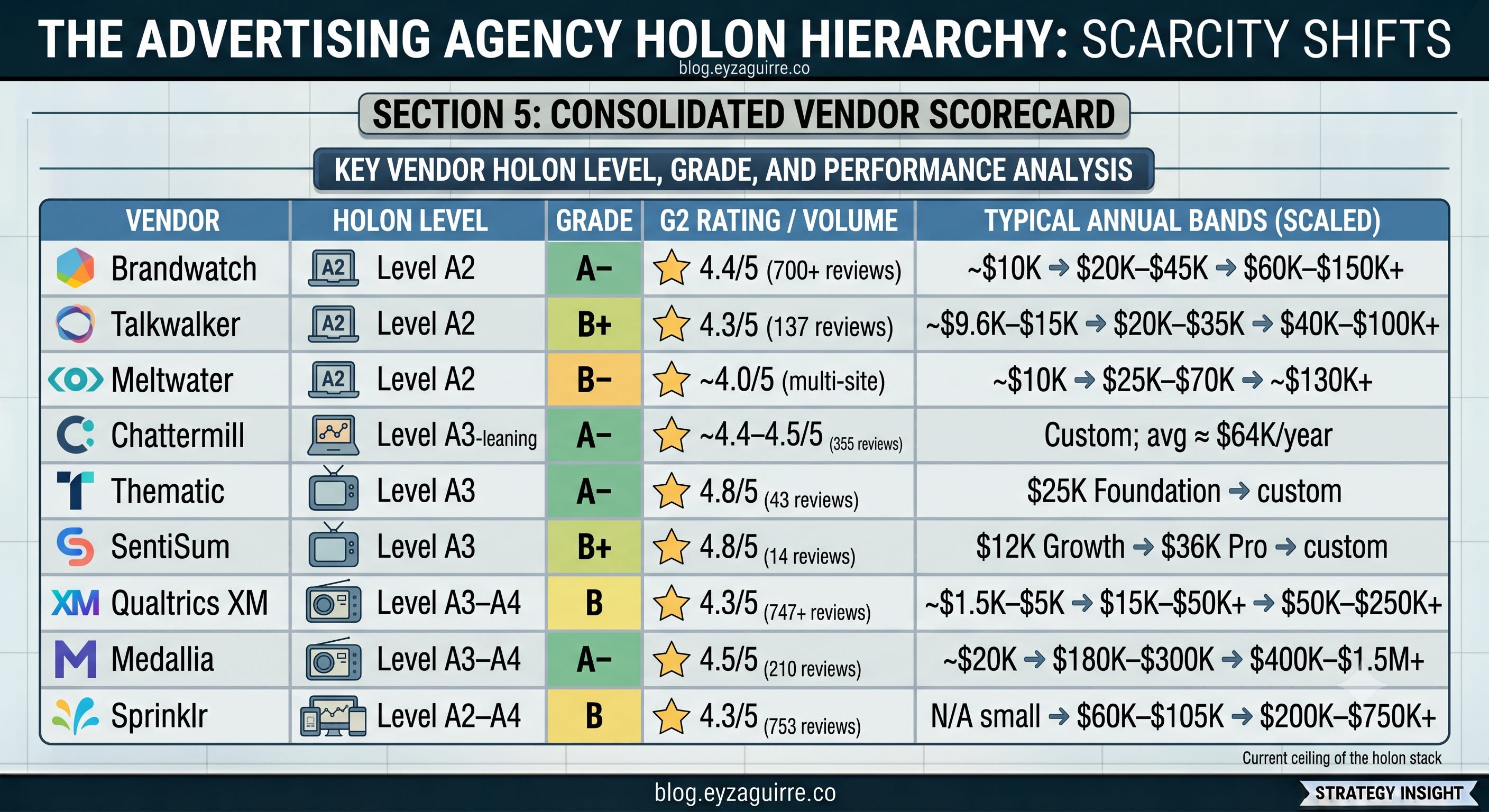
This table makes the tiering visible: mid-tier platforms cluster between $20K and $100K/year, while top-tier suites often sit at $200K–$1.5M+ despite the availability of lower-cost agents and open-source substitutes at A0–A2.
Section 6: Structural Market Observations
6.1 The Buyer Segment Effect: Large, Regulated Enterprises
Top pricing bands—$200K–$750K+ for Sprinklr, $400K–$1.5M+ for Medallia—are being bought predominantly by large, regulated enterprises: banks, telcos, airlines, major retailers, health systems, and governments. For these buyers, CX and ad-intelligence platforms are wired into compliance, service recovery, and executive reporting rather than marketing dashboards alone. Contracts carry SLAs, certifications, and auditability (SOC, ISO, HIPAA, PCI) that cheaper tools and internal agents have not yet matched, making a $500K+ platform small relative to nine-figure media and service budgets for these organizations.
6.2 Switching Costs and Installed-Base Gravity
Many deployments are multi-year and deeply embedded. Medallia positions itself as the backbone of NPS/CSAT programs, with its 2026 “State of Customer Experience” report showing brands using it as primary CX measurement infrastructure; Sprinklr is used “to manage the voice of the customer, feedback, and complaints in one place,” spanning social, service, and marketing. Agents and open-source tools arrive as overlays rather than immediate replacements—ripping out Medallia or Sprinklr means redesigning measurement, governance, and reporting simultaneously, which slows repricing even as LLMs commoditize the underlying analytical work.
6.3 What Agents Don’t Yet Replace: Story, Benchmarks, Risk Transfer
Agents can already route tickets, summarize sentiment, and propose budget changes. Top-tier platforms still bundle additional value that agents cannot yet replicate: an institutional story that can be taken to a board or regulator as the “system of record” for CX; cross-customer benchmarks available only to incumbents sitting on thousands of programs’ worth of data; and risk transfer, whereby large contracts move measurement and governance risk onto the vendor rather than the buyer. That bundle—story, benchmarks, risk—keeps an opacity premium alive in an otherwise deflating market.
6.4 The Commoditization Threat at A0–A2
At A0–A1, commoditization is essentially complete: free tools and open-source stacks (Google Alerts, Postiz, n8n) already substitute for basic monitoring and scheduling at near-zero software cost. At A2, capable signal-capture functionality is increasingly replicable by LLM-orchestrated agents layered over open data sources, pressuring the mid-tier listening vendors (Talkwalker, Meltwater) whose differentiation rests on breadth of coverage rather than proprietary modeling depth.
Section 7: Forward-Looking Considerations
7.1 The A4 Premium Is a Control Premium
The A4 premium is not sustained principally by superior models, dashboards, or orchestration logic. Those capabilities are increasingly reproducible through open-source tooling, internal data infrastructure, and agentic workflows. The remaining premium sits at the point where an AI system attempts to act across the open web: access to consumer attention, consumer signal, and executable advertising inventory.
This is one of the last major battlegrounds in the conflict between open LLM capability and closed online platforms. Consumer portals—including Instagram, TikTok, YouTube, Reddit, X, and the broader social and commerce ecosystem—retain the practical ability to throttle data access, restrict automation, limit API functionality, alter ranking and delivery rules, and price access to audiences. The resulting scarcity is not merely technical. It is contractual, platform-governed, and politically defended.
In this environment, A4 vendors can continue to charge a premium because they intermediate access to systems that brands cannot simply reproduce. The real product is not “AI media optimization.” It is governed passage through the consumer portals: authorized data access, identity resolution, inventory access, measurement compatibility, and operational continuity when a platform changes its rules.
7.2 The “Proprietary Data” Story Is Under Stress
The second support for the A4 premium is the vendor claim that proprietary data, benchmarks, and accumulated institutional knowledge are uniquely defensible. That claim is becoming materially weaker.
Much of what is presented as proprietary intelligence is an aggregation of first-party customer data, platform-derived signals, standardized survey responses, historical campaign data, and taxonomic work that a sufficiently capable internal team can increasingly reconstruct. LLMs and agentic systems reduce the cost of classification, summarization, workflow design, audience analysis, and reporting—the very operational layers that once made large CX and advertising-intelligence suites appear irreplaceable.
The distinction that matters is therefore narrower than vendors often imply:
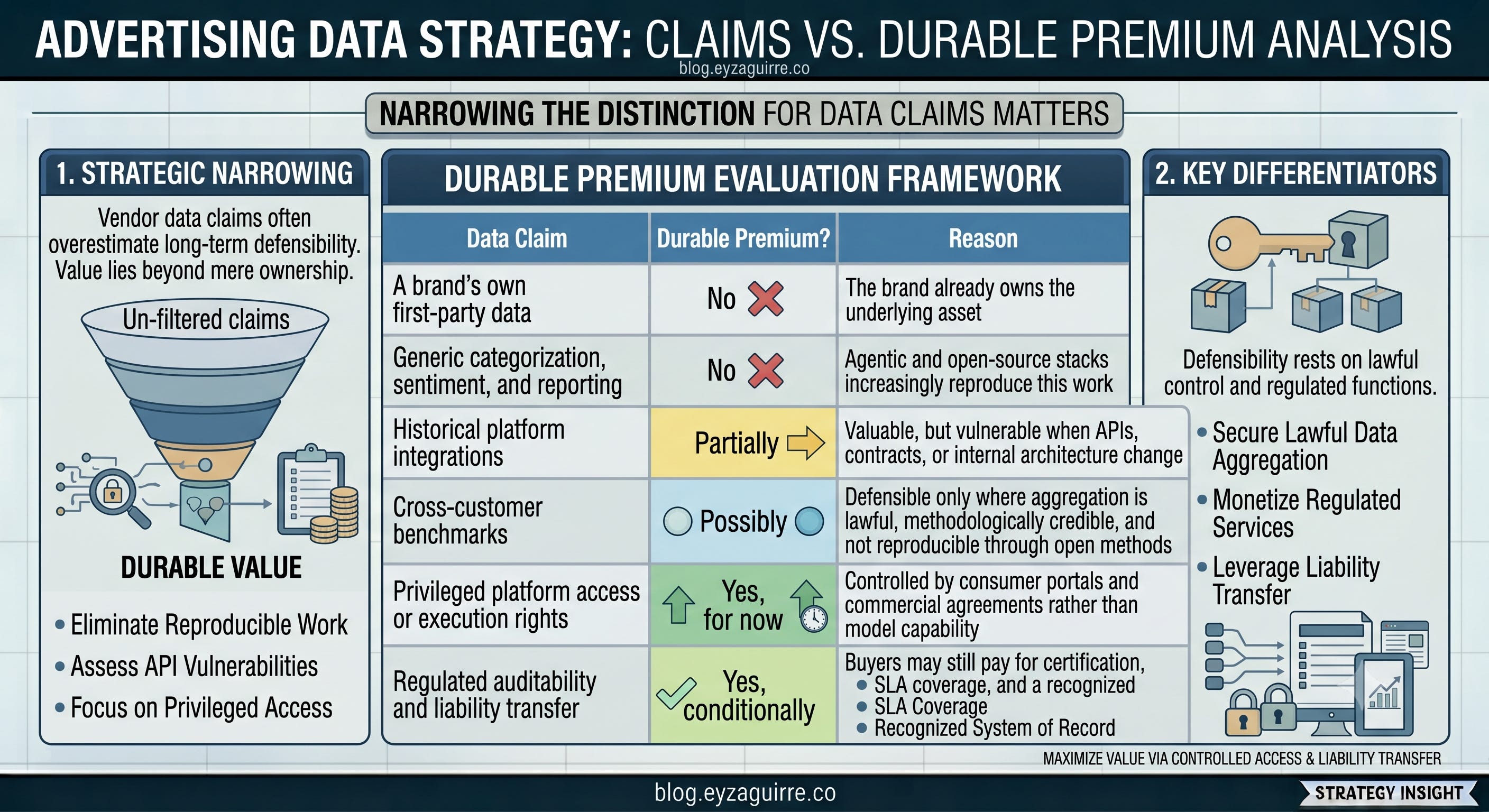
The vendor’s strongest defensible asset is therefore not a vague proprietary-data narrative. It is a demonstrable right to operate across controlled consumer environments, combined with a credible governance, measurement, and risk-transfer layer.
7.3 Consumer-Portal Throttling Is the Constraint
The decisive constraint on A4 is not whether an agent can reason about media allocation. It is whether the agent is permitted to observe, recommend, and execute within the portals where consumer attention is actually brokered.
Platforms can constrain the recursive ad-intelligence loop at every stage:
Signal capture: limiting API access, scraping tolerance, historical data availability, and granularity of consumer interaction data.
Audience formation: restricting identity resolution, lookalike construction, attribution windows, and cross-platform matching.
Media execution: requiring platform-native buying interfaces, certified partners, approved API pathways, or human review.
Measurement: controlling conversion reporting, incrementality tools, data-clean-room rules, and the attribution vocabulary available to advertisers.
Optimization: changing delivery algorithms and inventory rules faster than independent systems can model them.
This makes A4 a contested control plane. A brand may own its strategy, models, and first-party data while remaining dependent on consumer portals for the actual ability to reach, measure, and influence consumers. The premium survives because the portals can make interoperability scarce.
7.4 The Required Shift: From Vendor Dependency to Governed Independence
Brands should not assume that buying a top-tier suite constitutes ownership of the A4 holon. It usually constitutes delegated access to a vendor-managed layer sitting between the enterprise and the consumer portals.
A durable A4 strategy requires brands to separate what must be owned from what can be rented:
Own: first-party data, event architecture, taxonomies, measurement logic, budget constraints, decision rights, governance policies, and the agent-orchestration layer.
Rent: platform-specific connectors, certified execution access, specialized compliance coverage, and genuinely unique benchmark datasets.
Audit: every vendor claim of proprietary data, differentiated intelligence, exclusive access, and outcome linkage.
Preserve portability: require export rights, documented schemas, model outputs, historical decision logs, API access where available, and contractual transition support.
The objective is not immediate disintermediation. Consumer platforms will continue to impose real access constraints. The objective is to ensure that a vendor’s loss, price increase, or changing platform relationship does not destroy the enterprise’s ability to understand its customers, explain its media decisions, or govern the systems moving its budget.
7.5 What Dissolves the Premium
The A4 premium begins to dissolve when three conditions converge:
Brands own the decision layer. Internal systems become capable of producing board-safe, auditable explanations of what was measured, why a budget moved, which constraints applied, and who authorized execution.
Methods become legible. MMM, incrementality, customer-voice analysis, and benchmark construction move toward transparent methods that can be scrutinized, reproduced, and compared rather than treated as vendor magic.
Portal access becomes contestable. Standards, interoperability requirements, commercial pressure, or new agentic protocols reduce the degree to which a small number of platforms can restrict observation and execution.
Until then, the A4 premium remains one of the last defensible premiums in the online/LLM conflict. It rests less on model intelligence than on controlled access: the ability to cross the boundary between enterprise reasoning and consumer-facing platform action.
Methodology Note
This taxonomy synthesizes publicly available vendor documentation, customer-review data from G2, Capterra, TrustRadius, and Gartner Peer Insights, third-party pricing benchmarks, and industry material on marketing mix modeling, social listening, advertising APIs, and agentic advertising protocols as of August 2026. Vendor grades are interpretive assessments of publicly observable capability, customer sentiment, pricing structure, implementation friction, and reported governance characteristics; they are not investment advice, legal advice, procurement advice, or a substitute for direct technical, contractual, security, or compliance diligence.
The central claim in Section 7 is a research thesis: that the A4 premium is increasingly sustained by consumer-portal access constraints and by vendor claims around proprietary data, institutional credibility, benchmarking, and risk transfer—not necessarily by irreducible superiority in AI capability. This claim should be treated as a structured hypothesis for testing against specific platform contracts, API terms, data-rights arrangements, and enterprise deployments. Direct platform testing, source-code audits, contract review, and confidential vendor diligence were not conducted.
Use and Publication Notice
This material is provided for private research, strategic discussion, and internal evaluation only. It may not be reproduced, republished, excerpted, distributed, adapted, incorporated into client work, used for training, or presented publicly without prior written permission from the author.
Anyone seeking to reuse or publish any portion of this analysis—including quotations, tables, diagrams, thesis statements, or derivative work—must request permission in advance and receive written authorization before doing so.
Alan Eyzaguirre, a Silicon Valley-based corporate strategist, offers a weekly digest of relevant themes across the AI industry and its societal impact.