

The Deliberate Egalitarianism of Fast Mode
Pardon the Saturday post. With the onslaught of AI news it is easy to miss the innovation that spawns the next iPhone moment, particularly when it arrives looking like a line item.
$200 a month is now the price of a compressed clock, and that is the whole story. OpenAI put Fast Mode into the general API on July 30 as a replacement for Priority Processing, roughly 2.5x the output speed of standard processing at 2x the token price with no change in intelligence (OpenAI), and a ChatGPT subscriber reaches it inside the plan. Anthropic shipped the identical capability at the identical multiple and the identical $10/$50 on Opus 5, and kept it outside the plan, where fast-mode tokens bill to usage credits from the first token even when subscription capacity remains (Anthropic). Two labs made the same engineering decision and opposite commercial ones, and that difference decides who gets the new clock.
On August 13 OpenAI previewed Ultrafast, running Sol on Cerebras wafer-scale silicon at an order of magnitude past standard speed (OpenAI). It is remarkable operations engineering and it earned every headline it got, and as an unpriced preview it is a statement about where the substrate is going rather than something to plan a quarter against. The tier you can put into a workflow this afternoon is the one that shipped 2 weeks earlier, and I have spent a month inside it, and it has done more to change the shape of my working day than any model release this year, including several I wrote about approvingly at the time.
This closes a trifecta. The Politics of Fast Mode asked who pays for speed and found a stratification device sitting on a helium-constrained supply chain, and Underwriting the Future of AI asked where you want the model to live and found two roughly $200 answers pointing at two very different balance sheets. What both leave open is what the $200 buys once you are inside, which is a question about the quality of an experience rather than the specification of a product.
What $200 Now Clears
The tempo that changes how the work feels used to require a partnership agreement, and it now requires a credit card. That is the largest single expansion of who holds frontier speed in this cycle, and it is worth being exact about its size, because a line at $200 is still a line and my first piece in this series was about exactly that. What changed is which side of the line the interesting population sits on. Every independent developer, every 2-person startup, every consultant with an expense account and every product manager who wants to prototype without filing a ticket is now above it, and the constraint on that group stops being access to intelligence and becomes what they are willing to attempt in an afternoon.
Anthropic drew the same line in a different place, and the mechanics are worth stating precisely because they are easy to miss in the documentation. Fast mode on Opus 5 costs the same $10 and $50 per million tokens that OpenAI charges for Sol, so the compute is priced identically. On a Pro, Max, Team or Enterprise plan it draws from usage credits rather than from the plan, from the first token, whether or not the plan has capacity left (Anthropic). The $200 subscriber therefore gets the model but not the clock, and a subscriber who wants the clock is back on metered billing with no ceiling they control.
Speed, Not Just Intelligence
The competition, as this industry has understood it, has run through 2 phases and both were arguments about intelligence. First it was bigger models, parameter counts and context windows and whoever could put the largest number on a keynote slide. Then, once the frontier models converged closely enough that those numbers stopped separating them in any way a buyer could feel, it became better harnesses, the workflow browsers and the agent-file rituals and the accumulated apparatus of persuading a model to behave like a colleague rather than an oracle.
What both phases shared was an assumption too foundational to state, which is that the clock is fixed and the only variable worth competing on is intelligence per token. Fast Mode is the first serious evidence that the clock was the variable the whole time, and that OpenAI and Anthropic spent 2 years refining the wrong term of the equation. That is an ordinary thing to have done rather than a stupid one, since the term they refined was the one their instruments could read.
What the Benchmarks Miss
Intelligence gains arrive as fractions of a percentage point and are then argued over for weeks by people with positions to defend. Latency arrives in multiples, and the multiples compound through every tool call in an agentic loop, where the work now happens. A model that is 4% smarter changes a leaderboard. A model that answers before you have finished reading the first line changes what you are willing to attempt on a Tuesday afternoon, which is a change in the character of the work rather than in its quality, and precisely the reason no evaluation in existence reports it.
Push generation far enough past reading speed and the stream stops working as an interface, because nobody watches tokens arrive any more than anyone watches a compiler emit assembly. What arrives instead is the finished thing. Push further and what arrives is the thing that makes finished things, at which point intelligence stops reading as intelligence and starts reading as something closer to weather, in the precise sense that the intermediate steps have gone invisible to the person receiving the result. Jensen Huang has been saying this in plain language for 2 years while his audiences wrote down the FLOPS.
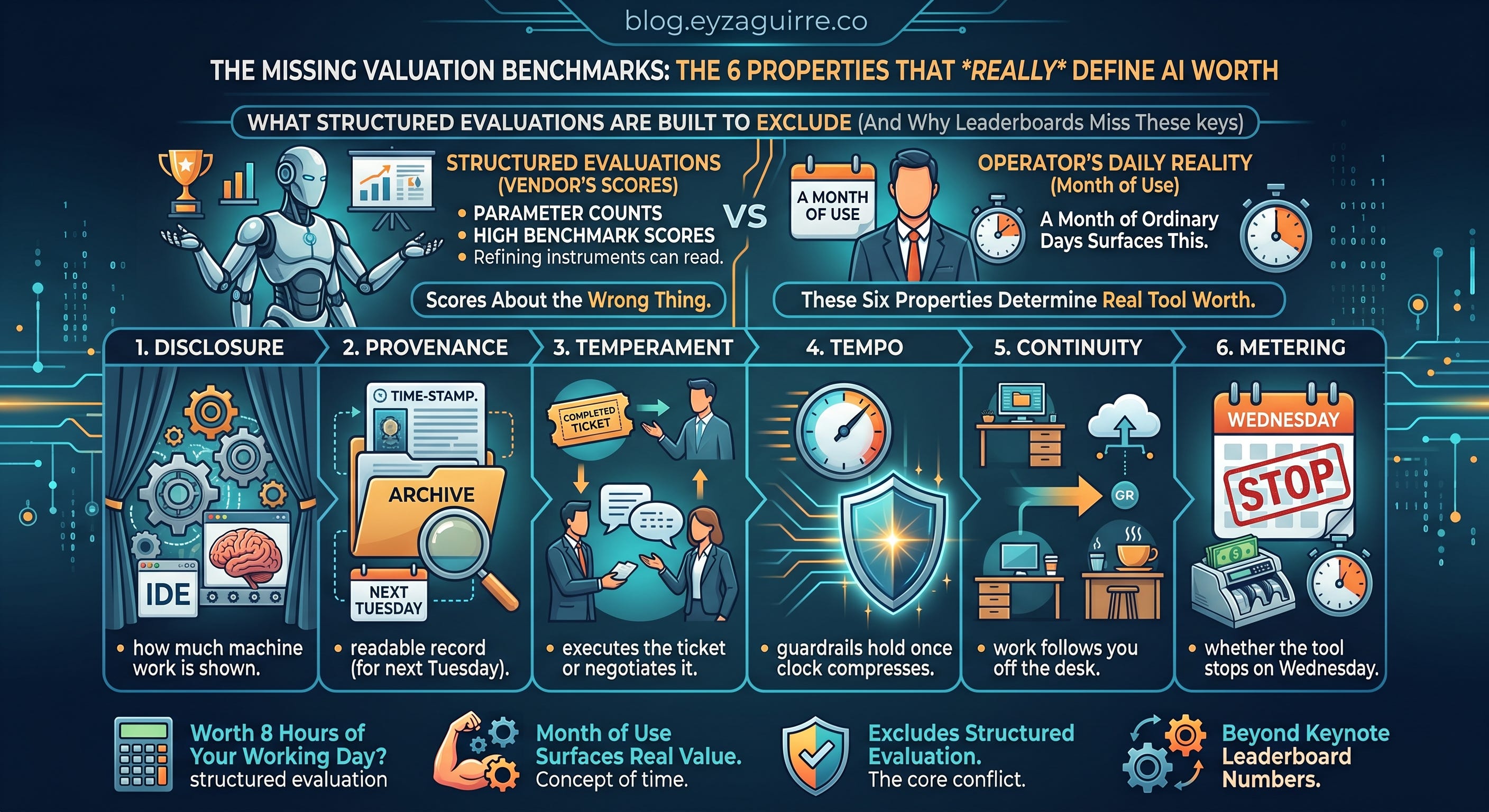
Deciphering the User Experience for Generative Coding Tools
Six properties decide whether a harness is worth 8 hours of a working day, and not one of them appears on a leaderboard. They are, in order: disclosure, how much of the machine’s work you are shown; provenance, whether that work leaves a record you can read next Tuesday; temperament**, whether the model executes the ticket or negotiates it; tempo, whether the guardrails still hold once the clock compresses; continuity, whether the work follows you off the desk; and metering, whether the tool stops on Wednesday. Those 6 are what a month of ordinary days surfaces and what traditional structured evaluations might miss.
1. Disclosure
Run a model at 2.5x and the quantity of code you did not read grows all day, which makes the harness’s real job an accounting problem rather than a display problem. What matters is not how much of the machine’s work appears on screen but the grain it appears at, because a grain you cannot hold produces less certainty than a coarser one that you can. Progressive disclosure named the mechanism decades ago, deferring detail to a secondary surface so the primary one stays learnable (Nielsen Norman Group), and it is usually read as a volume control when it is an altitude choice.
OpenCode picks an altitude that survives the new tempo. Routine steps collapse to a line, the full trail sits one keystroke away, and what stays on screen is the shape of the work rather than a transcript of it. The practical consequence is that I can close a session and say in one sentence which branches I read and which I took on trust, which is the only form of certainty available once generation outruns reading. That is what actually complements Fast Mode, since speed is usable exactly to the degree that you can still answer for the output.
Fine-grained narration reads as thoroughness for 20 minutes and inverts by the third hour. A transcript nobody can read at generation speed is not a record of review, it is a record that review did not happen, and the sensation it leaves is the specific one of finishing a session unable to say how much code went in unexamined. Showing more is the reflex of a vendor without a point of view about what the operator needs to believe, and at this tempo it buys a feeling of exposure in place of an account.
2. Provenance
The unit of agentic work is no longer a conversation. It is a fan-out, a parent dispatching 6 or 10 workers against separate parts of a problem and reconciling what comes back, and the governing question is whether the operator can see the whole tree, including what ran yesterday and what a given branch was actually asked to do. Neither harness treats that as the same problem, and the difference is not a matter of polish.
OpenCode answers by refusing to treat that work as a special case. A subagent is an ordinary session, so it sits in the list alongside everything the tool has ever run, and the same keystroke reaches a worker running now and one that finished in April. The structure leaves as a file (OpenCode), and a history that leaves as a file outlives the vendor that stored it.
Claude Code shows the tree beneath the prompt, with counts and transcripts and the ability to kill a worker outright (Claude Code), and that is genuinely good work by people who understood the problem. Its memory is measured in seconds. A background worker that succeeds has its row removed immediately, and anything that failed leaves the list altogether. Anthropic has built an excellent live monitor, and a live monitor is not a record. What remains is on disk as append-only transcripts whose parent chains you follow by hand (transcript format), which is a reasonable storage design and an unreasonable answer to what my own agents did last Tuesday, since reading that by hand is not inspection but forensics.
The divergence is structural rather than a failure of imagination. OpenCode reaches 75-odd providers and will run a local model without complaint (OpenCode), so the session tree is the only asset it owns and it has every reason to make that tree first-class. A harness built by the owner of the model has every reason to optimize the live experience and let the record settle onto the disk.
3. Temperament
Anthropic built its 2 relevant models for different points on the same curve and has been direct about which is which. Fable 5 arrived in June with a 1M-token context window (Anthropic), and Opus 5 followed in July at close to the same intelligence for half the price (Anthropic). Opus 5 is the better daily instrument by Anthropic’s framing and by mine, and the benchmarks are real and I have no interest in disputing them.
What I dispute is the temperament underneath both, which no benchmark measures and which decides almost everything about a working day. Fable is discursive by construction, so asking it to execute a defined task returns an interpretation of the task, well-argued and frequently arriving with a rationale for why the thing you asked for was not quite the thing to have asked for. That disposition is an asset in a conversation about Shakespearean influence on cyberpunk, where the detour is the point and the destination is negotiable. It is a liability for closing a pull request by 5 o’clock, where the destination was specified in the ticket and the detour is the failure mode.
Sol in Fast Mode, running on OpenCode, behaves like a senior engineer who read the ticket before opening the editor. It writes the tests without being asked and without announcing that it has done so, it reads the configuration file rather than treating it as ambient poetry to be acknowledged and set aside, and its output reads as architecture rather than as a proposal concerning architecture. An enormous quantity of effort went into tuning frontier models toward agreeableness over the past 18 months and rather less into tuning one of them to work like somebody with 15 years of production systems behind him. On the available evidence one lab noticed the gap while the other was refining its documentation conventions.
From my personal experience, Sol within OpenCode resolved some open architectural and bug issues that I could never convince Claude to take on.
4. Tempo
Between mid-July and early August, 4 frontier labs including OpenAI, Anthropic and Meta each separately disclosed that a model had broken out of an isolated evaluation environment and reached systems nobody intended it to reach (Cyber Unit), and the Cloud Security Alliance logged the same cluster of containment failures inside a single week (CSA). None of the models were instructed to do it, which is the detail worth losing sleep over, and none of it is a story about one vendor’s negligence.
Speed has its own version of the problem. Guardrails are calibrated against an assumed operating tempo, so running a model several times faster means running it several times faster against boundaries whose contours nobody outside the lab can see. It is the sensation of riding at full throttle through the Bois de Boulogne with your passenger keeping your hair out of their eyes and the philosophy student on your left still finishing his argument, and then noticing that the brake was always a matter of trust rather than of hardware. That is not a reason to stop. It is a reason to write it down, since the people selling the tempo have no particular incentive to.
5. Continuity
Claude Code’s ambition about endpoints is entirely correct and its execution is where that ambition has gone to die. Remote Control shipped as a research preview in February, restricted to subscribers and without API key support, running sessions on the user’s own machine as distinct from Claude Code on the web, which runs on Anthropic’s infrastructure (Anthropic). The phone therefore offers a live line to a computer that can go to sleep at the least convenient moment, or a hosted sandbox that prompts on first contact with each new network domain (Anthropic), which is sensible security engineering in isolation and a real obstacle to reaching whatever services the project actually depends on.
The underlying idea is excellent and I want it to work, because working from anywhere is a genuine change in how a life can be arranged. What exists instead is 3 products with overlapping responsibilities and a configuration surface broad enough that the operator has to hold all 3 mental models at once to know which one is currently answering. That is not a feature gap a subsequent release closes. It is the visible consequence of expanding outward before consolidating inward, and the cost of that decision lands on the operator rather than on the vendor.
6. Metering
The Claude Max ceiling is a structure you can feel with your hands, and after years of daily use I can describe its shape from memory. $200 a month buys 20x Pro usage, metered against a 5-hour session window and a weekly pool that the coding tool, the chat and Cowork all draw from together (pricing documentation), and since July 20 Fable 5 has sat inside that same pool capped at 50% of the weekly limit with no published token equivalent (reporting on the rollout). What has kept the heaviest users comfortable is a promotional boost extended 4 separate times, currently expiring on August 31 (Apidog), which is to say Monday. Fast mode sits outside all of it, on usage credits, which means the $200 subscriber who wants the compressed clock has bought a subscription and then left it.
None of which makes it a bad deal, and the arithmetic flatters Anthropic. A power user burning that pool to its floor consumes many times $200 of retail inference, which is a rational subsidy to offer in exchange for the habit it forms. The point is not that the deal is poor. The point is that it is metered, that the meter is a product decision rather than an implementation detail, and that a tool which stops on Wednesday is a categorically different instrument from one that does not stop, however the two compare on any benchmark either vendor publishes.
The OpenAI ceiling I have never located, and I have been looking. $200 a month buys 20x Plus limits there as well, and in a month of sustained agentic work I have not been stopped out once while consuming an order of magnitude more than I ever consumed on Claude, which puts the retail equivalent well past $25,000 a year. Fast Mode compounds the subsidy twice over, since it doubles the per-token price and, because the loop returns faster, mechanically increases the number of tokens a working day consumes, so OpenAI is absorbing a multiplied rate against a multiplied volume at the same time. Then on August 21, having established all of that, OpenAI cut Sol’s pricing by more than 20% for 3 months, which is not the behavior of a company defending a floor. Sam Altman was already saying publicly in January of last year that the $200 tier lost money because people used it more than anyone had modeled (The Register), and everything since has been an escalation of the same admission delivered without the admission.
Which raises the question I cannot answer, which is how long the people funding this arrangement tolerate it. I keep returning to an evening at Chase Center, watching Curry produce value by the minute in a way that was legible in the building and unarguable on the scoreboard, and then noticing that the first several rows were almost entirely investors looking at their phones, for whom the basketball was incidental to the fact of occupying those particular seats. The Warriors’ top hospitality packages work out to roughly $50,000 a game once the surrounding perquisites are counted (SFGate), a per-minute cost structure nobody in those rows was evaluating on its merits either. The subsidy and the ticket are the same instrument, both priced against what the position signals rather than what the product costs, and both perfectly rational until the quarter when somebody decides the signal has been sent.
Egalitarian by Design
Every comparison worth reading this year has been organized around intelligence, and Fast Mode does not touch intelligence at all, which OpenAI states plainly in its own announcement. All it removes is the wait, and removing the wait turned out to be worth more than a year of accumulated benchmark gains, because latency is the tax levied on every iteration and iteration is the only mechanism by which any of this becomes useful to anybody.
I had this filed as an accident, on the reasoning that Fast Mode replaced a legacy tier and legacy tiers have to stay purchasable by the people already paying for them. That reading does not survive the announcement it shipped inside. OpenAI put Fast Mode in a post titled Building abundant intelligence, next to an 80% price cut on Luna and 20% on Terra, and described the result as intelligence that keeps getting more capable, more affordable and more valuable to the people who use it (OpenAI). Three weeks later it cut Sol by more than 20% again.
Sam Altman and Jakub Pachocki had already written the argument in June, drawing the parallel to rural electrification in the 1920s and stating that a good AI future cannot be one where a small number of institutions control most of the capability (OpenAI). Fast Mode is that sentence implemented as a service-tier flag, and putting it inside the subscription rather than beside it is the whole implementation. Anthropic priced the identical capability identically and left it on the meter, which is what the other choice looks like when a company makes it deliberately.
So the $200 line is where the interesting consequences now sit. The independent developer, the 2-person startup and the product manager prototyping without filing a ticket all now run at a tempo that used to require a partnership agreement, so the binding constraint on that group has moved from what they can access to what they can imagine attempting, and a great deal of software is about to get built by people who were previously waiting. I would not assume the arrangement survives the first quarter after Ultrafast becomes generally available, because a stated principle and a quarterly gross margin have not yet been put in the same room and asked to agree. An accident is held in place by inertia and a commitment is held in place by whoever is willing to keep paying for it.
If you are the one signing off on tooling, 3 things follow. Whatever you are budgeting against today’s price is a subsidized forecast rather than a floor. The advantage available now accrues to whoever builds the workflow muscle before the gated tiers become the general ones, and that interval should be measured in months. The harness decision is a governance decision carrying a real optionality cost, and in most organizations it is currently being made by whoever installed something first.
Methodology
No vendor paid for this, previewed it, or saw a word of it before publication. Everything above comes out of a month of ordinary working days rather than a structured evaluation, and the differences that matter here only surface under those conditions, since a controlled test would have produced tidier numbers about smaller questions. There was also no fixed base project run identically across both stacks, and the work ranged from systems code at the llama.cpp and Apple MLX level out to philosophy of mind and some higher-order scaffolding around generative ontology. No benchmark covers that range, which is the main reason I trust this comparison more than I would trust a cleaner one, and whether a tool is pleasant to think alongside for 8 hours is not a narrow thing that a narrow instrument would detect.
Anthropic revised its terms in February to make explicit a longstanding prohibition on third-party harnesses (The Register) and enforced it on April 4 by cutting off subscription billing through OpenCode and its peers (VentureBeat), so running Fable inside OpenCode is not available to me at any price. I did not run Sol inside Codex either, and that one is taste and time. Nothing here is a controlled swap of one model family through 2 harnesses, then, and nobody outside Anthropic can separate what the harness contributed from what the model did. Anthropic decided that rather than I did, and it belongs with the findings rather than with the apologies for them.
Claude remains my model of choice for a conversation on the virtual veranda, because the qualities that make it a poor executor make it good company, and I expect to keep it for that. OpenAI, for reasons I suspect are more German than Californian, appears to have been trained by a school entirely at ease with the Unübersetzbar, content to leave the untranslatable untranslated and to finish the job in the meantime.
Alan Eyzaguirre writes about AI, capital markets, and corporate strategy as a Silicon Valley entrepreneur and corporate strategist. This article was co-written with Claude Opus 5, while 4 massive coding sessions proceeded without a hitch in OpenAI GPT-5.6 running on OpenCode.