

Stripe finalized its acquisition of OpenRouter for more than seven billion dollars in mid-August 2026, a price north of five times the $1.3 billion valuation OpenRouter carried after its Series B just three months earlier. The coverage that followed read the deal the way trade press reads every AI acquisition this year: as a bolt-on, a defensive move by a payments company nervous about being disintermediated by model gateways, a way to make sure businesses “optimize token usage across 400+ models from more than 80 providers” without leaving Stripe’s rails. That reading is not wrong. It is just small. It treats OpenRouter as a feature acquisition when it is closer to a confirmation — the final piece of a thesis Stripe has been building in public for two years, in filings, product launches, and blog posts that nobody in fintech commentary has bothered to read together. I have spent enough of my own writing on the architecture of orchestration economies and the commoditization of execution layers to recognize the shape of this one immediately, and the shape is bigger than “payments company buys AI router.”
Stripe Has Never Believed In Currency As A Fixed Category
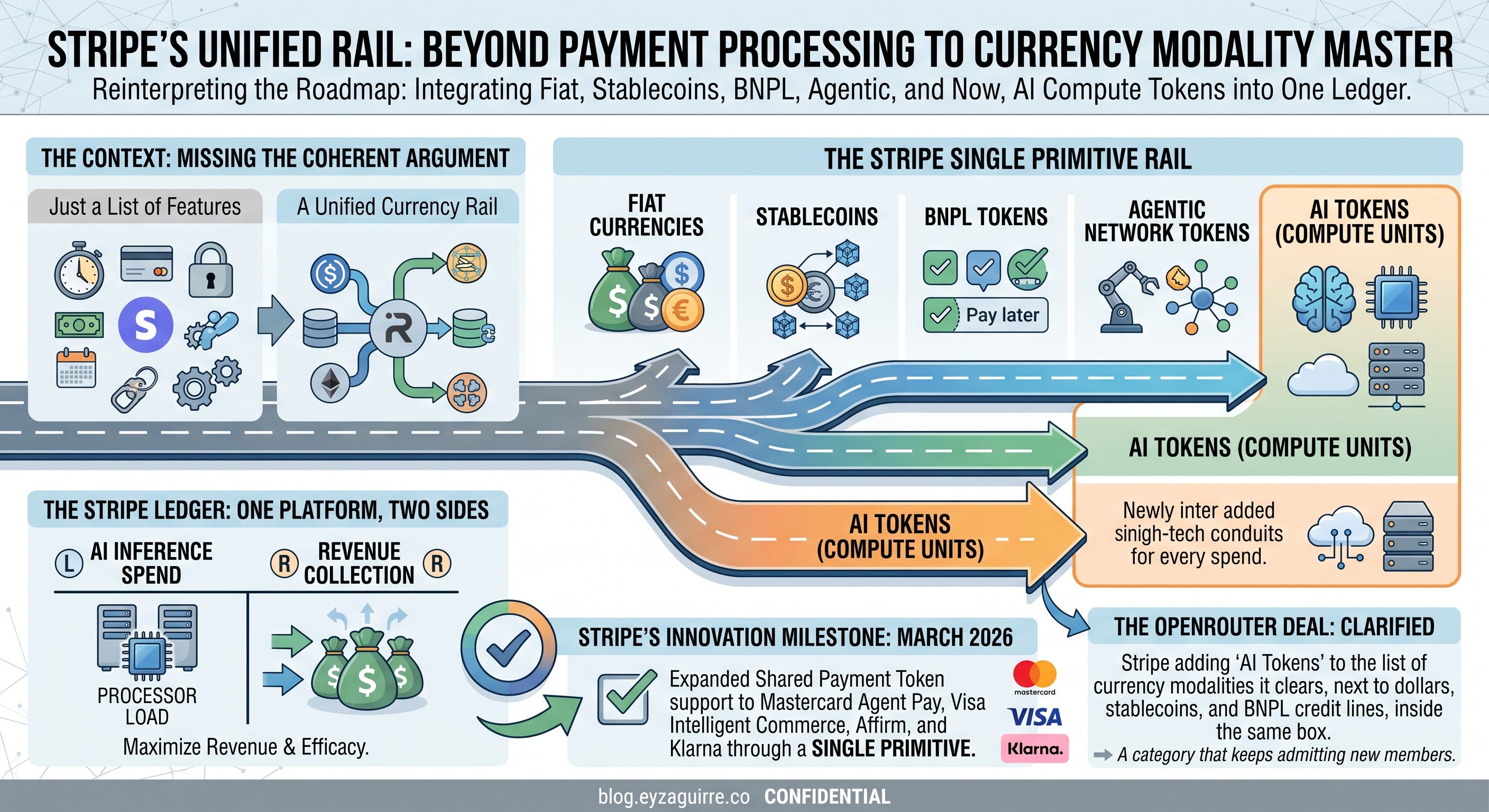
The first thing everyone is missing is the most basic, and the most consistently overlooked because it requires reading Stripe’s product roadmap as a coherent argument rather than a list of features. Stripe does not see itself as a processor of dollars that happens to dabble in crypto on the side. It sees itself as a purveyor of every currency modality that will exist, simultaneously, inside the same rail. Fiat, stablecoin, BNPL tokens, agentic network tokens, and now, with OpenRouter folded in, the token-as-compute-unit that underwrites every AI interaction on the internet — Stripe’s own language describes itself explicitly as making sure “businesses manage both sides of profitability in the AI era: maximizing revenue and efficacy,” which is a company telling you, in its own press release, that it considers AI inference spend and revenue collection to be two sides of one ledger it intends to operate. Stripe was the first and only provider to support both agentic network tokens and BNPL tokens in agentic commerce through a single primitive, according to its own March 2026 announcement expanding Shared Payment Token support to Mastercard Agent Pay, Visa Intelligent Commerce, Affirm, and Klarna simultaneously. No competitor has made that claim, because no competitor has organized its roadmap around the premise that “currency” is not a noun but a category that keeps admitting new members. Once you see the OpenRouter deal through that lens, it stops being an AI acquisition and becomes what it actually is: Stripe adding “AI tokens” to the list of currency modalities it clears, next to dollars, stablecoins, and BNPL credit lines, inside the same box.
The Company Already Lets Anyone Mint Their Own Money
The second thing is not speculative, and it is genuinely strange that it gets so little attention given how far Stripe has already gone. Through Bridge, the stablecoin infrastructure company Stripe bought for $1.1 billion, Stripe launched a product called Open Issuance in September 2025 that does exactly what the name suggests: it “enables any business to launch and manage its own stablecoin with just a few lines of code,” letting businesses “mint and burn coins freely, and customize their reserves to manage the ratio between cash and treasuries and choose their preferred partners.” This is not a pilot program or a partnership announcement. It is a live platform, and the framing from Bridge’s own CEO — that “any business whether it’s a bank or a marketplace or fintech can create their own stable coin” — is a company describing the end of currency issuance as a state or central-bank monopoly, at least at the layer Stripe operates. One analyst put the implication plainly: Open Issuance “enables an enterprise to issue its own branded stablecoin, with its own name, its own rules, its own economic model.” I made an adjacent argument in a different context last month, writing that “the next decade of enterprise value probably looks less like ‘AI wrote this’ and more like ‘AI wrote this, a specific accountable person directed and stood behind it, and here is the tamper-evident record proving both’” — the point there was about provenance, but the underlying claim is the same one Bridge is executing on with money itself: the unit of account is becoming something individual enterprises configure rather than something they merely receive from a central authority. Stripe did not build this by accident. It built the plumbing for a world where every large enterprise eventually runs its own currency, and it is charging rent on the pipes.
Stripe Operates As Though The Nation-State Container Already Cracked
The third thing is the one most likely to be dismissed as overreach, which is exactly why it is underpriced by the commentary. A company that lets any business mint its own stablecoin, settle it on a purpose-built Layer 1 blockchain, and interoperate that stablecoin with every other stablecoin issued on the same rail has stopped designing for a world organized around national currencies and started designing for a world organized around counterparties. Tempo, the payments-first blockchain Stripe incubated with Paradigm, is explicitly built for cross-border stablecoin settlement at scale, with 0.6-second finality, no volatile native gas token, and fees payable in whatever stablecoin the business already holds — a deliberate refusal to force any single national currency, or even a single company’s currency, into the position of default. Tempo’s first external validators were Stripe, Visa, and a custody firm, and its design partners at launch included Deutsche Bank, Nubank, Revolut, and OpenAI spread across at least four continents. That is not the validator list of a company building American payments infrastructure with international add-ons. That is the validator list of a company building a settlement layer that assumes the enterprise, not the nation-state, is the natural unit of currency sovereignty going forward. Stripe is, functionally, post-multinational before most multinationals have finished digesting what “multinational” used to mean.
Stripe Is Pricing Itself For A World Machines Pay Machines
The fourth thing is the one Stripe has been the most explicit about, in its own research, and it is still treated by most coverage as a footnote rather than the actual investment thesis. Stripe’s own five-levels framework for agentic commerce places the industry at Level 1 to Level 2 today — agents that fill out forms or make simple recommendations — while stating outright that “agents will likely soon be responsible for most internet transactions,” a claim serious enough that Stripe’s own assessment reportedly anticipates blockchain infrastructure needing to support over a billion transactions per second to keep pace. Stripe already ships machine payments that let developers charge AI agents directly for API calls via stablecoin micropayments, and its own guides describe agent-to-agent commerce as the frontier case: “powering autonomous purchasing agents by enabling secure, software-triggered transactions via subscriptions or replenishment flows,” the personal grocery agent automatically replenishing across retailers being the canonical example Stripe uses internally. Read against that backdrop, OpenRouter is not a hedge against AI disintermediation. It is inventory. Every one of the roughly 8 million developers who route requests through OpenRouter’s more than 400 models is a future node in an agent-to-agent transaction graph, and Stripe just bought the switchboard that decides which model handles which request, sitting directly upstream of the payment event that follows. I have written before that “the economy is already reorganizing around a different unit of value than the one anyone is currently counting,” pointing to gig-work and orchestration-layer data that GDP instruments were never built to see; Stripe’s own $1.9 trillion in prior-year payment volume, and its stated ambition around billion-transaction-per-second agent settlement, is the machine-native version of exactly that reorganization, arriving faster than the instrument, or the trade press, has priced in.
OpenRouter Is Also A Referendum On What Frontier Labs Are Worth
The fifth thing is the one with the shortest half-life, and the one most likely to look obvious in six months but is being badly underweighted right now. OpenRouter’s entire business model depends on model interchangeability — on the premise that a business can route a task to whichever of 400-plus models clears the bar for that task at the lowest price, and swap providers without friction. That premise gets stronger, not weaker, every time an open-weight model closes the gap with a frontier lab’s flagship. Z.ai’s GLM-5.3, released August 14, 2026, priced its API access at $1.40 per million input tokens and $4.40 per million output tokens against Claude Sonnet 5’s $2 and $10 on the same OpenRouter comparison page — meaningfully cheaper, on a model whose own vendor-published benchmarks show it trailing Claude’s frontier tier on Terminal Bench and FrontierSWE, but closing the gap fast enough that independent reviewers describe the trajectory, not the snapshot, as the real story: GLM-5.3 jumped from 4.6 to 28.3 on Terminal Bench 3.0 and from 67.5 to 78.1 on FrontierSWE in a single model generation. I made this exact argument in a different frame recently, writing that Anthropic’s enterprise pricing was “a funnel” built on venture-subsidized below-cost inference designed to create dependency before the real bill arrived, and that “a 7-billion-parameter orchestration model matching frontier benchmarks without any new training” was the early evidence that “the moat is shallower than the prospectus implies.” OpenRouter is the marketplace where that moat gets tested in real time, transaction by transaction, and Stripe now owns the exchange floor. Every dollar a business saves routing to GLM-5.3 instead of Claude or GPT is a dollar Stripe can now see, meter, and eventually settle in whichever currency modality — dollar, stablecoin, or agent-issued token — the business prefers. Stripe did not need to bet on which frontier lab wins. It bought the position that gets paid regardless of who wins, which is the more durable bet.
What Enterprise Leaders Should Actually Take From This
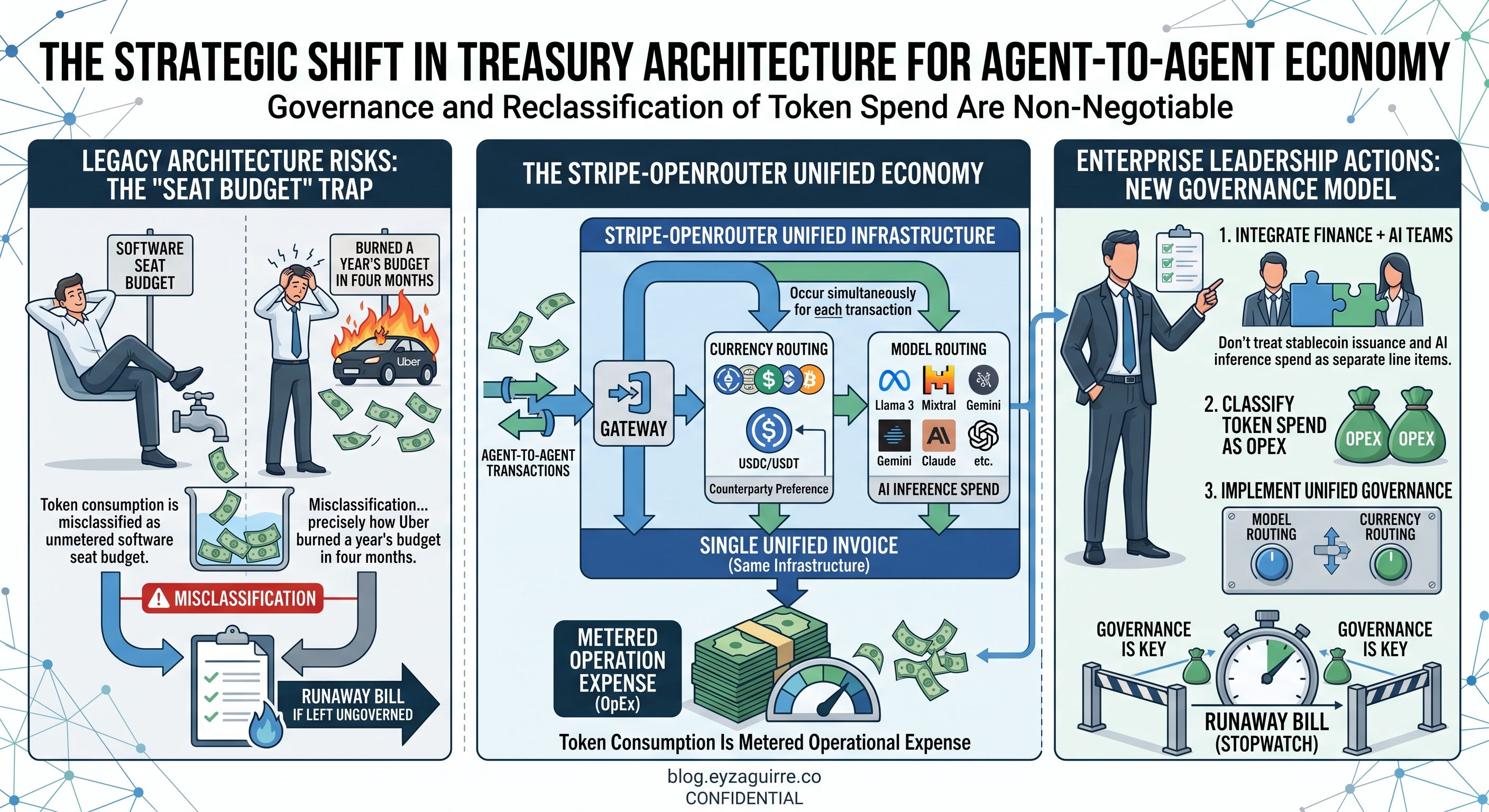
The first thing enterprise leaders should take from this deal has nothing to do with AI vendor selection and everything to do with treasury architecture. If Stripe’s stated ambition — agent-to-agent transactions at a meaningful share of total volume, settled across whatever currency modality the counterparty prefers — is even partially correct, then the finance organizations that treat stablecoin issuance and AI inference spend as separate line items owned by separate teams are already behind. I have argued elsewhere that token consumption should be classified as metered operational expense rather than folded into an unmetered software seat budget, because that misclassification is “precisely how Uber burned a year’s budget in four months;” the Stripe-OpenRouter combination makes that same discipline necessary one layer up, at the level of which currency and which model route a transaction takes, because both decisions will now run through the same infrastructure and generate the same kind of runaway bill if left ungoverned.
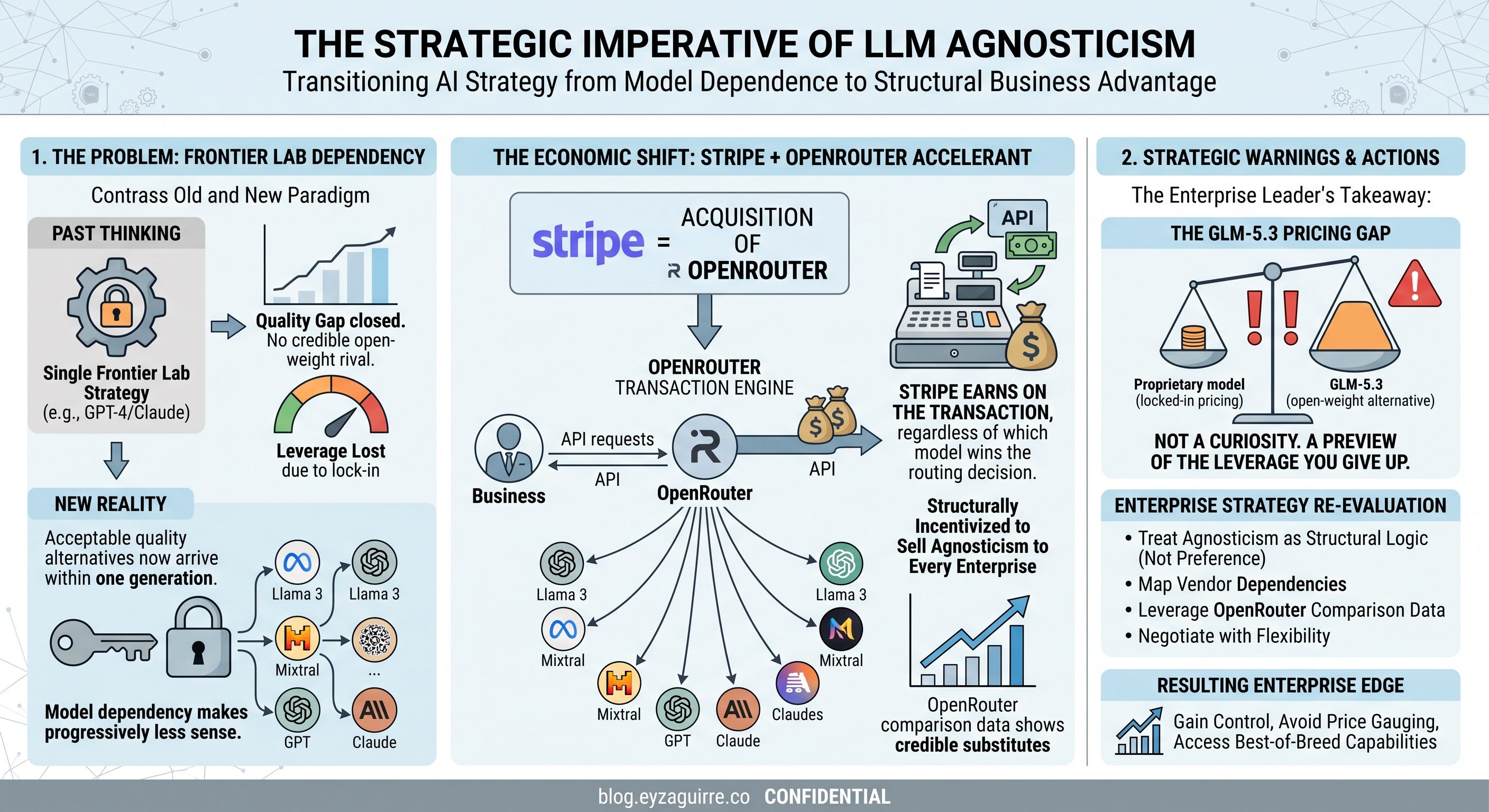
The second thing is that model-agnosticism is no longer a nice-to-have architectural preference — it is what OpenRouter’s acquirer is now structurally incentivized to sell every enterprise customer, because Stripe earns on the transaction regardless of which model wins the routing decision. Enterprise leaders who have built AI strategy around a single frontier lab relationship should read the GLM-5.3 pricing gap not as a curiosity but as a preview of the leverage they are giving up. The lab dependency that made sense when Claude or GPT-4-class models had no credible open-weight competitor at acceptable quality makes progressively less sense as OpenRouter’s own comparison data shows credible substitutes arriving within a single model generation.
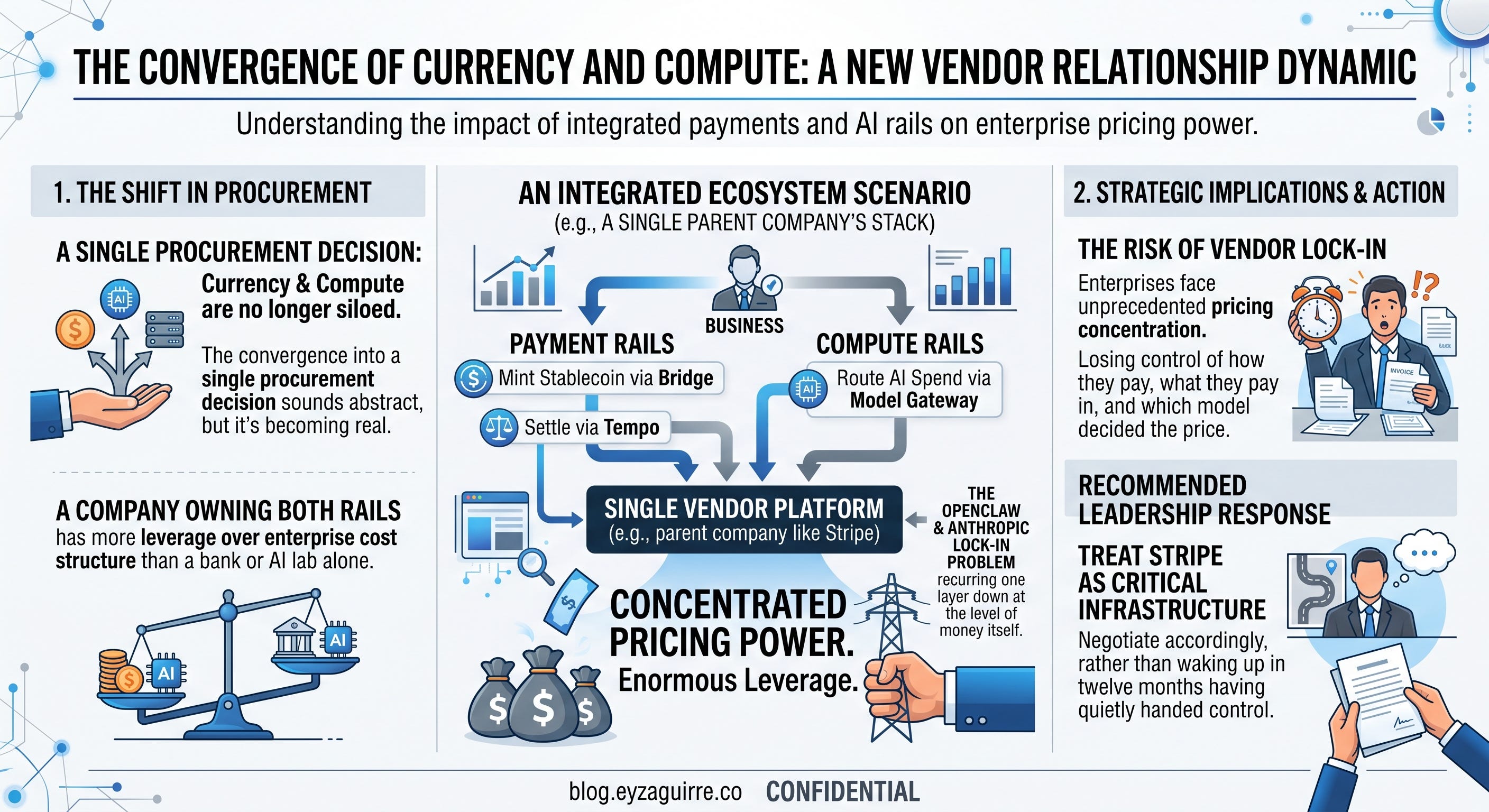
The third thing is the one most executives will resist because it sounds abstract until the invoice proves it is not: currency and compute are converging into a single procurement decision, and the company that owns the rails for both has more leverage over enterprise cost structure than either a bank or an AI lab standing alone. A business that mints its own stablecoin through Bridge, settles it on Tempo, and now routes its AI spend through the same parent company’s model gateway has concentrated an enormous amount of pricing power in one vendor relationship — the OpenClaw-and-Anthropic-style vendor lock-in problem I have written about in the agent-tooling context, now recurring one layer down, at the level of money itself. The leaders who benefit from this deal will be the ones who treat Stripe as critical infrastructure and negotiate accordingly, rather than the ones who wake up in twelve months having quietly handed one company control over how they pay, what they pay in, and which model decided the price.
Alan Eyzaguirre writes about technology, market structure, and the long arcs that connect them. Alan worked at PayPal and witnessed first-hand the rise of Stripe.